Few places in East Africa carry as much history and atmosphere in such a compact space as Stone Town. The old quarter of Zanzibar City sits on the western coast of Unguja, the main island in the Zanzibar Archipelago, and has long been shaped by trade, culture, and exchange across the Indian Ocean. Once a key centre in the slave and ivory trade, it also served as an important link between the mainland interior and the Middle East, a history reflected in the Sultan’s Palace and surrounding architecture.
Stone Town Zanzibar The Ultimate Guide To, Streets, Stories, And Spice
Stone Town is the historic heart of Zanzibar, where winding streets, carved doors, and centuries of trade come together in a compact old quarter on the edge of the Indian Ocean. This guide covers the best things to see, eat and experience in the city

Advertisement
Today, it is a UNESCO World Heritage Site, known for its maze of narrow, cobbled streets, coralline ragstone buildings, and mangrove timber structures. The area forms the cultural heart of Zanzibar, with lively bazaars, intricate carved doors, and rich local flavours. Here is a guide to the city.
Why Stone Town Is A UNESCO World Heritage Site

The architectural details of Stone Town are stunning Adam Jones/Wiki Commons
Stone Town feels like a place where different worlds have settled into the same streets. It was recognised by UNESCO because it is one of the finest surviving Swahili trading towns on the East African coast, and much of its old layout is still intact. Walk through it, and the history is not hidden behind glass or plaques—it is built into the fabric of the place itself.
What makes it stand out is the mix. Over more than a thousand years, traders and settlers from Africa, Arabia, India, and Europe all left their imprint here, and instead of replacing one another, their influences blended into a distinctly Swahili character. You see it in the carved wooden doors, the coral-stone buildings pressed close together, and the maze-like streets that still follow their original rhythm.
Advertisement
The Buildings Of Stone Town

Balcony details in Stone Town Adam Jones/Wiki Commons
As you walk through Stone Town, you are moving through a living record of Swahili coastal life. UNESCO describes it as “an outstanding example of a Swahili trading town” shaped by Arab, Indian and European influences, while still holding onto its indigenous roots. Built on a promontory overlooking the Indian Ocean, the town’s layout and architecture have survived with remarkable integrity.
Look closer, and you’ll see how it comes together. Houses built in coralline ragstone and mangrove timber sit behind narrow corridors and open courtyards, while carved Zanzibar doors, verandahs and shaded façades hint at the many cultures that shaped them. As UNESCO notes, the architecture reflects “a complex fusion of Swahili, Indian, Arab and European influences in building traditions and town planning.”
Things To Do
Step Inside The Old Fort

The Old Fort was built by the Portuguese in the 17th century Erasmus Kamugisha/Wiki Commons
You can’t really walk through Stone Town in Tanzania without stepping into the Old Fort—it’s one of those places that anchors the whole history of the city. Built by the Portuguese in the 17th century and later rebuilt by the Omanis in the 18th, it stands as one of the oldest surviving structures in Stone Town. You’re free to wander inside the thick stone walls, where the courtyard often comes alive with cultural events. Since the 1990s, it has operated as a cultural centre, complete with an amphitheatre that now hosts major festivals such as Sauti za Busara and the Zanzibar International Film Festival.
Advertisement
Visit The House Of Wonders

The House of Wonders on Stone Town’s seafront Moongateclimber/Wiki Commons
Stop at the House of Wonders on Stone Town’s seafront, once the most modern building in East Africa and the first with electricity and an elevator. Its design blends European structure with Zanzibari craft—cast iron columns, coral stone, carved doors and open courtyards that make it instantly recognisable.
Next door, the Palace Museum feels more grounded in history. Built in 1883 for the second Sultan of Zanzibar, it was once a royal residence. Inside, you’ll find marble floors, coral stone walls and simple displays of the Sultan’s life and Zanzibar’s Omani past, giving a quieter, more personal view of the island’s history.
Explore The Daily Rhythm At Darajani Market

Darajani Market is one of the central markets in Stone Town Yann Macherez/Wiki Commons
If you want to feel the pulse of Stone Town, head straight to Darajani Market. Tucked just beyond the old lanes, it spills out across streets and into a historic building first constructed in 1904 during the British Protectorate era, financed by Sultan Seyyid Sir Ali bin Hamoud.
Advertisement
Step inside and you’re met with organised chaos—spices stacked in small piles, fish fresh from the Indian Ocean, and pyramids of tropical fruit filling every corner. Known locally as Estella Market, it has grown into Zanzibar’s busiest trading hub, but still keeps its old character. Spices fill the air with the scent of cardamom, cinnamon, nutmeg, vanilla, cloves and turmeric, sold in small sachets or by the handful, reinforcing Zanzibar’s reputation as the Spice Island. Nearby, colourful kangas flutter above stalls of handwoven baskets and everyday household goods, offering a vivid glimpse into daily life in Zanzibar.
Confront History At The Old Slave Market
The Old Slave Market is one of the most confronting places in Stone Town, and its history is hard to separate from the streets around it. This was once the main slave trading site in East Africa, where men, women and children were brought from the mainland in chains and sold after long, harsh journeys. Zanzibar’s wealth and influence were closely tied to this trade, before it was eventually brought to an end. The market was shut down by order of the Sultan in 1873, a moment that marked a clear shift in the island’s history.
Advertisement
Pause At The Anglican Cathedral

The building has an unusual blend of styles, often described as “Saracenic” Erasmus Kamugisha/Wiki Commons
Just a few years later, in 1879, the Anglican Cathedral was built directly on the same site, transforming a place of suffering into one of remembrance. The church was intended as a symbol of emancipation, and its design reflects that layered meaning. You will notice its unusual blend of styles, often described as “Saracenic”, combining Zanzibari and Middle Eastern elements with Victorian Gothic and Arts and Crafts details.
Look closely inside, and you will see how ambitious its construction was for the time, including a barrel-vaulted roof made from coral stone and Portland cement, built before reinforced concrete was widely used. Today, this is one of Stone Town’s most visited sites, drawing people who come to understand both the weight of its past and the message of renewal it now carries.
Sip Coffee The Zanzibar Way

Try Zanzibar Coffee House for rooftop views over the old town zanzibarcoffeehouse/Instagram
Coffee in Zanzibar shows up in early Stone Town mornings, in shaded doorways, and in long chats that stretch into the evening. It’s part of karibu, the idea of welcome, where sitting down together matters more than the drink itself. You’ll often find it brewed with cardamom, clove or ginger, served strong and slightly sweet.
Advertisement
For a cup, try Zanzibar Coffee House for rooftop views over the old town, join the crowd at Jaw’s Corner for street coffee and conversation, or head to Emerson on Hurumzi for coffee at sunset as Stone Town winds down.
Where To Stay And Eat
Stone Town offers a wide range of stays. You’ll find budget rooms for backpackers, mid-range heritage hotels, and more polished boutique stays with rooftop terraces and pools. Prices typically range from around INR 3,000 to INR 25,000 per night, depending on location, season and level of comfort. Some handpicked ones are
Zanzibar Coffee House
Zanzibar Coffee House sits in the winding alleys of Stone Town, right in the heart of the UNESCO-listed old quarter. Set within an antique building, it offers eight individually designed rooms for single or double stays, each with air conditioning, four-poster beds draped in mosquito nets, and a mix of vintage furniture, lamps and small decorative details that reflect the building’s age. The rooftop is the highlight, often described as a crown above the house, with sweeping 360-degree views over the bustling Mkunazini area. Teak doors, coloured windows and original balustrades have stood for over a century, giving the place a sense of continuity that is hard to find elsewhere. A café on site adds to the experience, making it an atmospheric base in Stone Town.
Advertisement
Address: The Zanzibar Coffee Company Ltd, Mkunazini 1563/64. PO Box 4047, Zanzibar, Tanzania
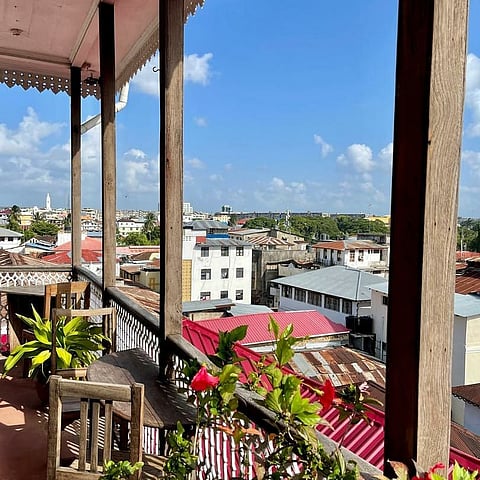
The Zanzibar Coffee House rooftop offers sweeping 360-degree views over the bustling Mkunazini area zanzibarcoffeehouse/Instagram
Kholle House Boutique Hotel
Kholle House Boutique Hotel sits in the heart of Stone Town, around 20 minutes from Zanzibar International Airport. Despite the maze-like streets, it is only a short walk from the main road and easy to find with maps, making it feel accessible and safe once you arrive. The hotel offers several relaxed spaces, including a striking swimming pool, a peaceful courtyard for meals, and a rooftop terrace where afternoon tea with local sweet treats is served.
Address: 607/608, Zanzibar, Tanzania
Dhow Palace Hotel
Dhow Palace Hotel is a restored Swahili merchant’s house set right in the heart of Stone Town, just a short walk from its winding lanes, markets and mosques. The building reflects Zanzibar’s layered history, with carved wooden doors, shaded courtyards and balconies shaped by Arab, Indian and African influences. Rooms are around open courtyards and have traditional furnishings. The rooftop restaurant offers sea breezes and wide views over the rooftops, a relaxed spot to end the day.
Advertisement
Address: Baghani St, Zanzibar, Tanzania

Food market in Forodhani Gardens in Stone Town Rod Waddington/Wiki Commons
Eating in Stone Town is as much about place as it is about flavour. Arab, Indian and African influences come together in spiced curries, fresh seafood and street food cooked right in front of you. You will find everything from busy night markets by the sea to small cafés tucked into narrow alleyways, plus boutique hotels where rooftop or courtyard restaurants are part of the stay itself. Forodhani Gardens is the most famous evening stop. As the sun sets near the Old Fort, the waterfront fills with stalls serving grilled seafood, samosas and Zanzibar pizza made fresh to order.
For a more local experience, Lukmaan Restaurant near the former slave market serves generous, home-style Zanzibari plates in a lively canteen setting. For coffee, Jaws Corner offers strong spiced kahawa in the middle of everyday street life, while Zanzibar Coffee House pairs its café with one of the best rooftop views in Stone Town. Many boutique stays, including places like Kholle House and Dhow Palace, also have attached restaurants where you can eat without leaving the atmosphere of the old city.
Advertisement
Essential Travel Tips
Apply for your Tanzania visa in advance to avoid airport queues. A single-entry tourist visa for Indian travellers costs around INR 4,000–5,000 and is valid for up to 90 days. Multiple-entry visas cost more.
Make sure your passport is valid for at least six months beyond arrival and has two blank pages.
Carry proof of yellow fever vaccination if you are arriving from or transiting through a risk country.
Stone Town is a malaria-risk area, so consult a doctor before travel.
Drink only sealed bottled or filtered water, including for brushing teeth.
Cash is widely used in Stone Town. US Dollars are accepted for tours, while Tanzanian Shillings are used for local purchases.
Wear comfortable shoes as Stone Town is best explored on foot through narrow, uneven streets.
Direct flights from Mumbai reach Dar es Salaam, followed by a short flight or ferry to Zanzibar.
Pack a UK-style plug adapter and light clothing suitable for heat and humidity.
The best time to visit Stone Town is June to October or November to February for pleasant weather and easier exploration.
Advertisement
FAQs
What is Stone Town famous for?
Stone Town is known for its UNESCO-listed old quarter, narrow winding streets, carved wooden doors, historic buildings, and its role in the spice and slave trade across East Africa.
How much time do you need in Stone Town?
Most travellers spend one to two days in Stone Town. One full day covers the main sights, while two days allow a slower pace with markets, cafés and sunset walks.
Is Stone Town safe for tourists?
Yes, Stone Town is generally safe for visitors. Like any busy old city, it’s best to stay aware in crowded areas and avoid isolated streets late at night.
What is the best way to explore Stone Town?
The best way is on foot. The streets are too narrow for cars in many places, and walking allows you to discover markets, courtyards and hidden cafés.
What should I wear in Stone Town?
Dress modestly, especially when visiting religious or historic sites. Light, breathable clothing that covers shoulders and knees is recommended due to the climate and local customs.

Published At: