It was earlier this year that I first chanced upon Sonam Wangchuk’s video on Tar Village in the Sham Valley region of Ladakh.
From The Latest Issue: Inside Tar Village, Ladakh’s Timeless Hamlet At India’s Edge
In a forgotten Himalayan valley, Tar Village offers a lesson in slow living and quiet resilience

Advertisement
In the video, Wangchuk accompanied actress Nandita Das to showcase the beauty of the tiny hamlet of about 12 households, which is only accessible by an hour-long hike through a fabulous, imposing gorge.
The barren ruggedness of the gorge reminded me of the Grand Canyon, and I knew in that moment that I would be crossing this gorge some day. I wanted to see it in all its golden glory.
It is a different thing altogether that I didn't know what to expect from Tar, which had been recognised as the Best Tourism Village of India 2024 in the Responsible Tourism category by the Ministry of Tourism, Government of India.
But, familiar with the genuine love of Ladakhis, I knew it would not disappoint. So much so that when Ladakh simmered with tension and the unfortunate events that followed, my spirit remained intact.
Having travelled to different parts of Ladakh over the last 15 years and authored my second book, “Riding Through Rungdum,” based on my travels in Zanskar, I knew that Ladakh would the last place on earth where I would ever feel unsafe. Therefore, after multiple assurances from Lundup Dorjay, a key figure in the village’s pioneering efforts in responsible eco-tourism, I made my way to Leh in the first week of October.
Advertisement
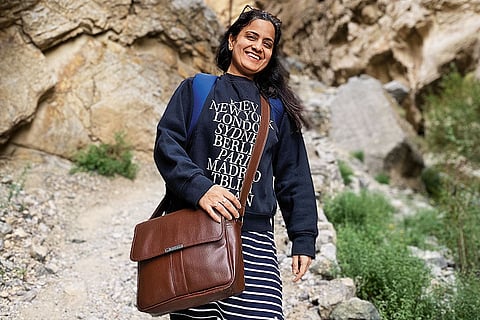
The author in Tar
From Leh, we proceeded to our first stop for the night—Uley Eco Resort, located a few kilometres from where the trek to Tar begins. The majestic hills of Ladakh, the barren topography, that feeling of being humbled by the mightiness of its mountains—all came rushing back to me. I was home.
Our days and evenings in Tar were witness to the spectacle of autumn unveiling itself in all its glory
The next day, after having acclimatised at the wonderful resort at the edge of the Indus, we were ready to begin our journey to reach our final destination, Tar. After an hour’s drive along the road that meandered in sync with the aquamarine, pristine waters of the Indus, we reached the base of the gorge, where the first track for vehicles ended.
Dorjay was there to receive us, and his warm, genuine welcome was just the right precursor to what awaited us ahead. As I looked at the tiny trail flanked by the mighty mountains, whose rugged texture shone a resplendent gold in the sunlight, boy, was I blown away! I felt like I was standing at heaven’s door, waiting to be let in to witness the wonders that lay on the other side. We felt like minions, ascending the trail, dotted with wooden bridges that crossed streamlets, and carving waterfalls here and there. Dorjay patiently showed us all the rock formations and sacred spots along the way.
Advertisement
That spectacular one-hour climb is a sight I will never, ever forget. As we made our way into the village, a beautiful map of the village on a wooden board, highlighting all the 12 houses and the main spots such as the monastery, the community centre, and the village school, welcomed us.
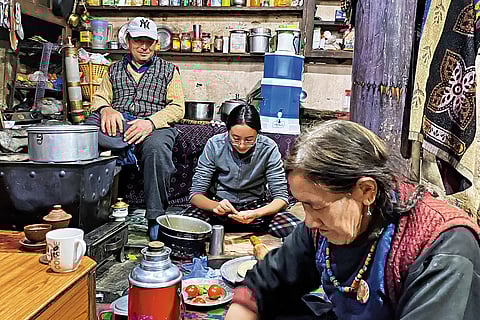
The homestay host, Sonam (centre), prepares dinner with her grandparents in the family kitchen Shweta Modgil
Dorjay led us to the house of one of the locals who served us mint tea while conversing with us in the few Hindi words she knew. Her warmth equalled that of the deliciously refreshing tea we were served. We met Kavya, who is supporting Dorjay in this initiative, and Zoey, an Australian traveller who has been visiting Ladakh for the last three years and is filming her first documentary on the region.
Energised and fully at home, we made our way to our designated homestay.
It was a cosy Ladakhi home, where our host, Sonam, a schoolteacher, stayed with her lovely grandparents. Piping hot rice served with veggies, our first meal in the kitchen, was just the beginning of many meals we would share with the family over the course of the next two days.
Advertisement
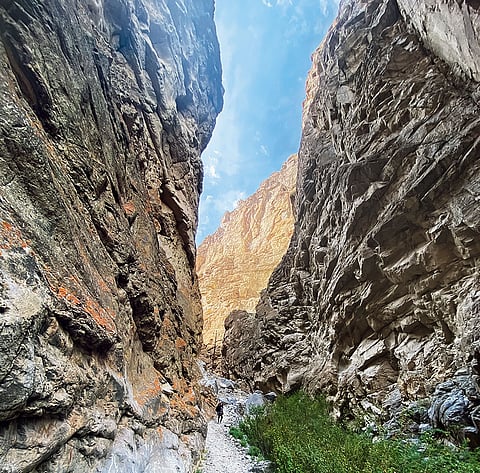
To reach Tar, visitors need to hike for an hour through this imposing gorge Shweta Modgil
Prepared by her grandmother, who we affectionately addressed as Appi, we were fed to our heart’s content and, often, more, with a different dish for every meal. From Ladakhi soups to momos, pasta, and the delicious Ladakhi bread, khambir, to a unique barley soup laden with Ladakhi cheese and accompanied by sattu, we were overwhelmed by Appi’s urge to feed us like we were her own kids. Grandmothers everywhere are the best.
Our days and evenings in the village were witness to the spectacle of autumn unveiling itself in all its glory. We took long, meandering walks through the mountains, gazed at the spectacular fall foliage of yellows and oranges, sighting many walnut and apricot trees and gushing streams. We collected wild mint from the forests while Dorjay and his friends made tea for us in the wild, as we engaged in endless banter on the beauty of Tar and Ladakh. We watched footage of snow leopard sightings recorded by Dorjay in the community centre, and realised how lucky we were to partake of this beauty, thanks to the genuine warmth and generosity of the locals. We ended our nights with warm food in the kitchen, conversing with our hosts over butter tea, milk tea, and the home-brewed chaang.
Advertisement
But more than anything, the resolve of the villagers to protect their natural resources, and live in harmony with nature was the real eye-opener. Tourists are expected to take their plastic trash back with them; dry toilets are the norm, and no superfluous comforts are promised. You are expected to live like the locals to appreciate their way of life.
Thanks to the resolve of people like Dorjay, the community believes that the village is not there for tourists; the tourists are there for the village. And this is exactly how the whole ecosystem of Ladakh should be treated and cared for.
The Information | Tar Village, Ladakh
Tar, Ladakh: Tar Village, named India’s best tourism village by the government, is also Ladakh’s most remote and isolated community.
Getting There: Tar Village is about a two-hour drive from the city of Leh in Ladakh, which is easily accessible by road and flights from Delhi. Located approximately 10 km from the village of Nurla, Tar is accessible only by a 3.5 km trek starting from a point near Nurla.
Advertisement
Stay: Accommodation for travellers is available in the 12 homestays in the village.
Tips: Pack warm clothes and layers and secure an Inner Line Permit online before your trip.
Best Time to Visit: Summer and the early autumn month of September will give you great views.
Author Bio
Shweta Modgil thrives on the intersection between tech, talent, and the future. Her book, "Riding Through Rangdum," chronicling her 10-day bike trip to the Zanskar region in Ladakh, was published last year.
Looking for more such exciting and meaningful stories? Grab our latest issue on Amazon
Published At: