A powerful earthquake struck off the north-eastern coast of Japan, triggering immediate tsunami warnings and urgent evacuations within minutes. The quake, measuring between 7.4 and 7.9 in magnitude, prompted the Japan Meteorological Agency (JMA) to warn of dangerous waves along the coastline.
Urgent Tsunami Warnings Issued After Powerful Offshore Earthquake In Japan
A powerful offshore earthquake off north-eastern Japan triggered immediate tsunami warnings, prompting evacuations and alerts across coastal regions as authorities warned of waves reaching up to three metres

Advertisement
Authorities ordered residents in coastal areas to move to higher ground straight away. A tsunami of up to 3 m (about 10 ft) was forecast for parts of Iwate Prefecture, as well as areas of Hokkaido and Aomori. In other parts of north-eastern Japan, officials issued an advisory warning of waves reaching up to 1 m (around 3.3 ft).
The US Tsunami Warning System initially recorded the offshore earthquake near Japan’s eastern Honshu coast at a magnitude of 7.4. A tsunami alert was issued at 8:52 UTC (4:52 a.m. ET) shortly after the event. Japan’s agency later revised the quake’s strength to 7.5 magnitude. It is still unclear why this differs from the earlier US estimate, and officials say the figures are being checked again as more information comes in.
Warning For Coastal Areas
People living along Japan’s coastal areas were told to evacuate immediately, with broadcaster NHK issuing urgent instructions as the tsunami threat developed. Officials warned that those in low-lying and shoreline regions should leave at once and move to higher ground without delay.
Advertisement
NHK said tsunami waves were already moving towards the coast and could arrive in quick succession. Residents were repeatedly advised not to wait, as the situation could change rapidly and danger could increase within minutes.
Authorities also cautioned people to stay well away from beaches and river mouths, which could quickly flood as water levels rose. Even if conditions appeared to stabilise, residents were told to remain in safe areas until all warnings and advisories were fully lifted. The estimated arrival times were only forecasts, and waves could reach land earlier or later than predicted, with the potential to be stronger than expected.
Tsunami Waves Observed
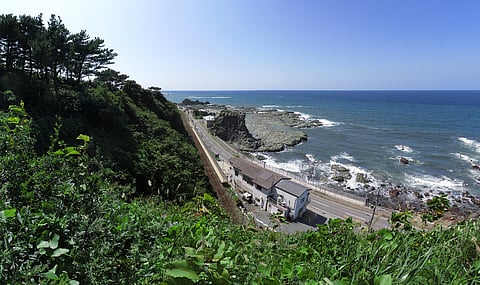
Full tsunami warnings are in place for Hokkaido, Aomori and Iwate prefectures Aomorikuma/Wiki Commons
Tsunami waves have been seen along parts of Japan’s coast, and warnings are still in place for Fukushima, Iwate and Aomori prefectures, along with Hokkaido. Officials are continuing to watch the situation as water levels change in different areas.
NHK showed live coverage from the coast as alerts were being repeated on air. People were being told again and again to leave straight away and get to higher ground, with no time to wait as conditions were getting more dangerous.
Advertisement
The earthquake struck offshore at a depth of roughly 10 km shortly before 5 PM local time. It was recorded at an upper-5 level on Japan’s seismic intensity scale, strong enough to make it hard for people to stand and to cause furniture and unsecured objects to topple.
Earthquake Details So Far
The quake occurred at 4:53 PM local time with an epicentre in the Pacific Ocean at a shallow depth of 10 km. It measured "upper 5" on Japan's seismic intensity scale, making it difficult for people to remain standing and causing some walls to collapse.
Tsunami waves were recorded at multiple locations, including 80 cm at Kuji Port and 40 cm at Miyako Port.
Bullet train services between Tokyo and Aomori were suspended. No abnormalities have been reported at nuclear plants, including Fukushima Daiichi and Onagawa, which are being closely monitored.
Residents in coastal and riverside areas are urged by Prime Minister Sanae Takaichi to move to higher ground immediately.
Full tsunami warnings are in place for Hokkaido, Aomori and Iwate prefectures.
Waves of up to 3 m are expected in some coastal areas.
The Japan Meteorological Agency (JMA) warns that the first waves may reach northern coastal areas almost immediately, and further waves are likely to follow in multiple surges.
Residents are being told to evacuate at once to higher ground or designated evacuation sites and to avoid all river mouths and low-lying coastal zones.
Advertisement
FAQs
What happened in Japan?
A strong offshore earthquake triggered tsunami warnings across parts of north-eastern Japan.
When did it happen?
The earthquake struck in the late afternoon local time and warnings were issued within minutes.
How quickly were warnings issued?
Tsunami alerts were released almost immediately after the quake was detected. Waves were observed in several coastal areas, confirming the risk.
How strong was the earthquake?
It reached an upper-5 level on Japan’s seismic intensity scale, strong enough to make standing difficult. Different monitoring agencies used separate calculations, and the final figure is still being reviewed.
Which agency issued the tsunami warning?
The Japan Meteorological Agency issued the main warnings and advisories.
Could more waves still arrive?
Yes, authorities warned that tsunami waves often come in multiple surges.
How long do warnings stay in place?
Warnings remain active until officials confirm that the tsunami threat has passed.

Published At:
Tags