When Union Finance Minister Nirmala Sitharaman presents the Union Budget 2026 in February, all eyes will once again be on infrastructure, especially roads, highways and rural development, as the government’s most dependable growth lever. With higher US tariffs squeezing Indian exports and job creation still a concern at home, public investment is expected to do the heavy lifting. Framing it all is the government’s long-term ambition of turning India into a developed economy by 2047, a benchmark against which this Budget’s spending choices will inevitably be judged.
Union Budget 2026: What Is The Travel And Tourism Industry Expecting
As Union Budget 2026 approaches, the travel and tourism industry is watching roads, regional connectivity, GST clarity and destination development that could reshape domestic travel and hospitality growth across India

Advertisement
Roads Continue To Anchor Public Capex
Roads and highways have been the single largest focus of capital expenditure in recent years, and there is little sign of that changing. Actual spending on roads stood at INR 2.76 lakh crore in 2023–24, edged up to INR 2.81 lakh crore in the revised estimates for 2024–25, and has been budgeted at INR 2.87 lakh crore for 2025–26. The steady rise throws light on the government’s belief that road-building delivers quick and visible economic returns, while improving logistics efficiency, creating jobs, and stimulating activity across semi-urban and rural India.
Railways, by contrast, appear to be entering a phase of consolidation. Expenditure rose from INR 2.46 lakh crore in 2023–24 to INR 2.55 lakh crore in the revised estimates for 2024–25, but the allocation for 2025–26 is largely unchanged. Rural development, however, is gathering momentum. Allocations climbed from INR 1.64 lakh crore in 2023–24 to INR 1.76 lakh crore in 2024–25, with a sharper increase to INR 1.90 lakh crore budgeted for the current year, signalling continued emphasis on rural infrastructure, livelihoods and employment.
Advertisement
What The Travel Industry Wants From Budget 2026
Industry expectations broadly align with this investment-led approach. The Confederation of Indian Industry has called on the government to sustain high central capex, step up financial support to states, and roll out a refreshed National Infrastructure Pipeline. It has also pitched for targeted tax incentives and compliance relief for companies investing in clean energy, electronics, semiconductors and logistics, along with faster depreciation benefits to encourage technology upgrades.
“As the Union Budget 2026 approaches, the travel and tourism sector looks forward to policies that can further strengthen domestic tourism in India. One of the key areas that needs attention is tourism infrastructure development. Better roads, improved rail and air connectivity, and enhanced facilities at tourist destinations can make travel easier and more affordable for Indian travellers. Another important expectation from the Budget is greater clarity on GST rules for hotel room tariffs, especially since pricing often fluctuates based on demand and seasonality. Clear and practical guidelines will help reduce confusion for both hotels and travel platforms, ensure fair taxation, and allow businesses to adopt flexible pricing without compliance challenges,” shared Elton Rodrigues, director, HostMyTrips.
Advertisement
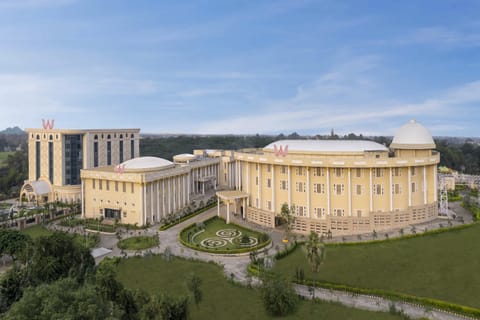
Welcomhotel by ITC Hotels, Bodhgaya, Hotel & Convention Centre Supplied
The scale of India’s road expansion over the past decade has been striking. As of March 2025, the country’s road network spans over 63 lakh kilometres. National highways alone have grown by nearly 60 per cent since 2013–14, expanding from 91,287 km to 1,46,204 km. Construction speed has tripled, from about 11.6 km a day a decade ago to roughly 34 km a day now. Spending has risen just as sharply. Investment by the road transport and highways ministry is 6.4 times higher than it was in 2013–14, while the sector’s budget allocation jumped nearly six-fold between 2014 and 2023–24.
“The next phase of growth for hospitality will be driven by domestic travel rather than international inflows alone. Budget 2026 is expected to recognise this shift by supporting destination development beyond metros. Budget 2026 can materially influence this by improving urban infrastructure, transport connectivity, and civic services across Tier 2 and Tier 3 cities. In our view, when city ecosystems mature, hotel investments become both scalable and sustainable. We expect the Union Budget 2026 to reinforce the hospitality sector’s recovery by announcing targeted incentives for regional tourism circuits, which will boost demand in tier-II and tier-III markets and accelerate inclusive growth,” shared Kunal Gala, partner, Deal Value Creation Services, BDO India.
Advertisement
Hotel development decisions are increasingly shaped by execution certainty rather than demand potential alone. “Budget 2026 has an opportunity to support the sector by improving investment visibility through stable regulations, faster approvals, and better access to long-term financing. Clarity on infrastructure financing, especially in airport, rail connectivity and road linkages to key tourist destinations, will be a defining theme for unlocking long-term investments into India’s hospitality ecosystem,” he added.
Expressways And Capacity Upgrades
High-speed corridors have become a defining feature of this push. From just 93 km in 2014, India now has around 2,474 km of expressways, with nearly 3,600 km built in the last five years alone. Four-lane and wider national highways have expanded from 18,278 km to 45,947 km. These upgrades are aimed at cutting travel time, lowering logistics costs and improving freight efficiency, making roads a viable alternative to rail for certain types of cargo. Much of this expansion is being driven by the Bharatmala Pariyojana, which envisages 34,800 km of highways at an estimated cost of INR 5.35 lakh crore. By March 2025, over 26,000 km had been awarded and more than 20,000 km completed. Complementing this is the PM GatiShakti National Master Plan, launched in 2021 to improve coordination across ministries. Built on a GIS platform with over 1,600 data layers, it has already been used to evaluate more than 200 large projects worth INR 15.4 lakh crore, helping streamline alignments, clearances and last-mile connectivity to industrial corridors.
Advertisement

Road trippers beware, India is home to some of the most dangerous roads in the world Deposit Photos
Projects Reshaping The Map
The government’s highway portfolio now includes landmark projects such as the Atal Tunnel, the Eastern and Western Peripheral Expressways, the Bogibeel and Dhola–Sadiya bridges, Maitri Setu and the Sonamarg Tunnel. Ongoing projects include the 1,824-km Frontier Highway in Arunachal Pradesh, the Delhi–Mumbai Expressway, now over 80 per cent complete and expected by October 2025, and the Char Dham road programme, where more than three-quarters of the planned length has already been built.
Other major corridors linking Ahmedabad–Dholera, Bengaluru–Chennai, Delhi–Amritsar–Katra and Kanpur–Lucknow are progressing, with completion timelines largely clustered between FY25 and FY26.
“The government’s decision to raise the LRS TCS threshold to INR 10 lakh has meaningfully reduced the upfront tax burden on outbound remittances. However, there remains a need to rationalise the tax treatment across international spending instruments. Forex cards, which are purpose-built for overseas travel and offer transparent, pre-loaded exchange rates, continue to attract TCS beyond the threshold, while international credit card spends remain outside the TCS ambit. This creates an uneven playing field between instruments used for the same purpose and often nudges consumers towards opaque pricing structures with hidden markups. While TCS is adjustable at the time of filing returns, the upfront cash outflow continues to impact travellers’ liquidity. As outbound travel from India continues to grow, a harmonised and clearly defined TCS framework across international payment instruments would promote transparency, simplify compliance, and ensure fair treatment for Indian travellers,” said Gagan Malhotra, chief operating officer, BookMyForex.
Advertisement

Safety is paramount for women travellers while planning a trip Shutterstock
The macroeconomic backdrop strengthens the case for continued public investment. In 2025, the Reserve Bank of India cut policy rates by a cumulative 125 basis points, the sharpest pivot in six years, bringing the repo rate down to 5.25 per cent. Inflation fell sharply, touching a record low in October, while GDP growth remained robust at over 8 per cent in the first half of FY26. At the same time, external pressures have intensified. Higher US tariffs have weighed on exports, the rupee has slipped past INR 91 to the dollar, and economists caution that sustaining momentum will depend heavily on domestic investment, job creation and policy continuity.
Against this backdrop, infrastructure, particularly roads, remains one of the government’s most reliable economic instruments. Beyond headline growth numbers, roads expand market access for farmers, lower costs for manufacturers and improve connectivity across regions. As Budget 2026 approaches, expectations are firmly anchored around a capex-driven strategy, one that supports growth today while laying the groundwork for a more competitive and resilient economy over the long run.
Advertisement

Published At: