On July 31, an adult female Amur tiger named Umit, whose name means “hope” in Kazakh, was released into the wild at the Ile-Balkhash State Nature Reserve in southeastern Kazakhstan. This is the first time in more than seven decades that a tiger has been allowed to roam freely in the country, marking the beginning of an ambitious rewilding programme that aims to rebuild a self-sustaining tiger population in the region.
Kazakhstan Releases First Tiger Into The Wild After More Than 70 Years
The release of the Amur tiger Umit into Kazakhstan's Ile-Balkhash State Nature Reserve marks the culmination of more than a decade of ecological restoration, international cooperation and scientific planning

Advertisement
For conservationists, this moment is not about releasing just a single animal. It represents the culmination of more than 10 years of habitat restoration, prey recovery, scientific research, and cross-border cooperation. Kazakhstan has spent the past decade rebuilding an ecosystem capable of supporting one of nature’s most demanding apex predators.
Rebuilding An Ecosystem Before Releasing A Predator
Tigers disappeared from Kazakhstan by the middle of the 20th century after decades of habitat destruction, expanding agriculture, uncontrolled hunting, and the collapse of wild prey populations. Once common across the dense tugai forests and floodplains of the Ili and Syr Darya rivers, the Turan or Caspian tiger gradually lost both the cover and food it needed to survive. The last reliably documented tiger in Kazakhstan was killed in 1948.

The moment of the release Instagram: @minecology_kz
Restoring the species required restoring its habitat first. Kazakhstan announced plans for tiger reintroduction back in 2010. The Ile-Balkhash State Nature Reserve was officially established in 2018 across the Ili River delta and the southern shores of Lake Balkhash, one of the tiger's former strongholds.
Advertisement
Since then, conservation work has focused on rebuilding the landscape from the ground up. More than 120 acres of native floodplain forest have been restored, while populations of wild prey have been steadily increased. Between 2018 and 2024, authorities released 205 Bukhara deer into the reserve and relocated more than 100 kulans, or Asiatic wild asses. Wild boar and roe deer populations have also recovered, ensuring a more stable prey base for future tigers.
The reserve has also developed specialised adaptation enclosures, veterinary facilities, monitoring systems and trained wildlife teams capable of tracking tigers, responding to emergencies and managing potential encounters with nearby communities. The philosophy has remained consistent throughout, a tiger can only survive if given a suitable ecosystem.
Why Amur Tigers Are Returning To A Caspian Landscape
Although Kazakhstan's original tiger population became extinct decades ago, modern genetics offered an unexpected solution. Research published in 2009 demonstrated that the extinct Caspian, or Turan tiger and the surviving Amur tiger from Russia's Far East are genetically almost identical, differing by only a single nucleotide in their principal mitochondrial DNA. That discovery was a realistic conservation strategy.
Advertisement
In May this year, four wild-caught Amur tigers arrived from Russia's Khabarovsk region. The group included the adult male Amur, the female Umit, and two cubs named Turan and Ussuri. All four were placed in specially designed adaptation enclosures inside the reserve, where veterinarians and wildlife specialists monitored their health, hunting instincts and behaviour around humans.
Before her release, Umit underwent extensive veterinary examinations and behavioural assessments to determine whether she could survive independently. Once cleared, she was fitted with a GPS/GSM satellite collar that now allows specialists to monitor her movements around the clock using satellite data, camera traps and field observations. The monitoring will help researchers understand how she establishes territory, selects resting sites, hunts prey and avoids human settlements.
Officials deliberately chose to release the female first because female tigers generally establish smaller territories closer to their release sites, making the initial phase of monitoring more predictable. The adult male Amur remains under observation and will only be released after further behavioural assessments confirm that he is ready for life in the wild. The younger cubs will continue living in specialised enclosures until they are at least 18 months old, after which each will undergo individual health and behavioural evaluations before any release decisions are taken.
Advertisement
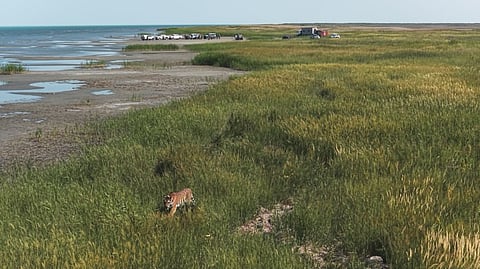
Umit after the release Instagram: @minecology_kz
A Long-Term Vision Beyond One Historic Release
Umit's release is only one part of a much larger programme that seeks to establish a viable population of around 50 wild tigers in the Ili delta and southern Lake Balkhash region by 2035.
The project also includes two captive Amur tigers, Bogdana and Kuma, transferred from a wildlife sanctuary in the Netherlands in September 2024 as part of a WWF-supported breeding programme. Unlike the wild-caught Russian tigers, they will remain in managed enclosures. Their offspring, if considered suitable, may eventually be trained for survival in the wild before being released into the reserve.
Equally important has been preparing people for the tiger's return. Authorities have introduced GPS-based alert systems that notify residents if a tracked tiger approaches within five kilometres of homes or settlements. A public hotline has been operating since May 2025, while dedicated response teams stand ready to deter, tranquilise or capture animals if required. A compensation herd has also been established to reimburse livestock owners in the event of predation, reducing the likelihood of retaliatory killings and maintaining community support.
Advertisement
The programme itself reflects years of international collaboration. Kazakhstan and Russia signed a memorandum on tiger restoration during the International Tiger Conservation Forum in Vladivostok in 2022, followed by a joint working group that oversaw infrastructure inspections, specialist training and the transfer of animals. Kazakh wildlife experts also completed field training in Russia during late 2025 and early 2026 before the first release took place.
With Umit now exploring the floodplains of the Ili delta, Kazakhstan has entered a new phase in its conservation journey. The success of the project will ultimately depend not on a single release, but on whether future generations of tigers can once again live, breed and thrive in a landscape that had forgotten them for more than 70 years.
FAQs
1. Why is Kazakhstan's tiger release considered historic?
The release of the female Amur tiger, Umit, on July 31 marks the first time in more than 70 years that a tiger has been released into the wild in Kazakhstan. It is the culmination of over a decade of habitat restoration, prey recovery and international conservation efforts.
Advertisement
2. Why are Amur tigers being introduced instead of Caspian tigers?
The Caspian (or Turan) tiger became extinct in the region decades ago. Genetic research has shown that the extinct Caspian tiger and the surviving Amur tiger are almost genetically identical, making the Amur tiger the closest living substitute for restoring the species in Central Asia.
3. Where was the tiger released?
Umit was released into the Ile-Balkhash State Nature Reserve in southeastern Kazakhstan. The reserve, established in 2018, lies across the Ili River delta and the southern shores of Lake Balkhash, an area that was once a natural habitat for tigers.
4. How is Kazakhstan ensuring the tigers can survive in the wild?
Before releasing any tiger, Kazakhstan restored floodplain forests, increased populations of prey such as Bukhara deer and kulans, created adaptation enclosures, equipped released animals with GPS collars, and established wildlife monitoring and rapid-response teams. Local communities are also supported through compensation schemes and early-warning systems.
Advertisement
5. What are Kazakhstan's long-term plans for tiger restoration?
The programme aims to establish a self-sustaining population of around 50 wild tigers by 2035 in the Ili delta and southern Lake Balkhash region. Future releases will include additional wild-born and carefully assessed captive-bred tigers as the ecosystem continues to recover.
Published At:
Tags