There was a time when trekking in the Himalaya came with a rough sense of seasonal certainty. Spring meant consolidated snow and blooming rhododendrons. October brought crisp skies and stable post-monsoon weather. Ladakh, shielded by the rain shadow of the Greater Himalaya, remained dry through summer. Experienced trekkers and guides knew what to expect, and so did the mountains, more or less. That rhythm is now breaking down.
Is Climate Change Reshaping The Future Of Trekking In The Himalayas?
Himalayan trekking seasons are shifting as rising temperatures reshape snow, rain, trails and mountain access

Advertisement
Across the Indian Himalaya, climate change is rewriting the rules of mountain travel in ways that are increasingly visible not just to scientists, but to trekkers, guides, homestay owners, and rescue teams on the ground. Trails are changing shape, glaciers are shrinking, snowfall patterns are turning erratic, and roads that once remained open deep into autumn are shutting overnight after heavy rain or landslides.
The clearest example came in Ladakh last August. A rare interaction between western disturbances from the Mediterranean and the Indian monsoon brought relentless rainfall to one of India’s driest regions. Ladakh recorded over 80 mm of rain through the month, nearly 20 times its usual August average. Instead of the short cloudbursts the region occasionally experiences, this was sustained rain that continued for days, triggering flash floods, landslides, road collapses, and widespread disruption across trekking routes and villages.
Several trekking groups found themselves stranded along the Markha Valley trail as river crossings became dangerous and sections of the route disappeared under landslides and swollen streams. Access roads near Chilling and Skiu were damaged, forcing groups to walk long distances through unstable terrain to return to Leh. Operators familiar with Ladakh for nearly two decades described conditions unlike anything they had previously encountered.
Advertisement
Melting Mountains Faster
Scientists have been warning about these shifts for years, but the pace of change is becoming difficult to ignore. Studies now show that the Himalaya is warming faster than many parts of the world, especially above 4,000 metres. As snow and ice shrink, darker rock surfaces absorb more heat, accelerating warming further in a cycle known as elevation-dependent warming.
The effects are visible across major trekking regions. The Gangotri Glacier in Uttarakhand has retreated dramatically over the past few decades, leaving behind unstable moraine fields and rapidly shifting meltwater channels around Gaumukh. In Sikkim, glaciers feeding the Teesta basin continue to lose mass, while high-altitude snow cover across the Hindu Kush Himalaya region recently dropped to its lowest level in two decades.
At the same time, warmer air is carrying more moisture into the mountains. That has created a strange paradox: less consistent snowfall overall, but more intense weather events when storms do arrive. Trekkers now report heavy snow in periods that were once considered relatively stable, while monsoon systems are extending later into autumn in parts of Sikkim, Nepal, and Darjeeling.
Advertisement
The consequences go beyond mountaineering. Glacier retreat is also increasing the risk of glacial lake outburst floods, or GLOFs. The South Lhonak disaster in Sikkim in October 2023 remains one of the starkest examples. A moraine collapse released massive volumes of water downstream, destroying bridges, damaging highways, and cutting off access routes that thousands of trekkers and tourists depend on every year.
Trails Under Stress
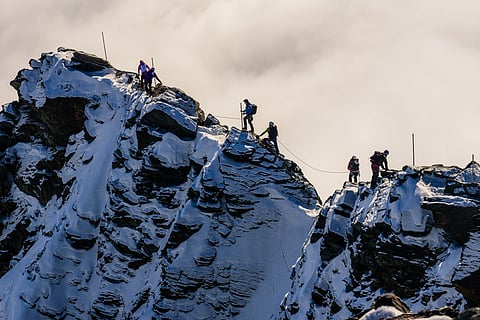
(Representational Image) Rising temperatures are altering traditional trekking seasons Ondrej Bucek/Shutterstock
What makes these changes particularly difficult for trekkers is unpredictability. Earlier, guides could estimate snow conditions, pass crossings and rainfall windows with reasonable accuracy based on seasonal cycles. Today, those assumptions no longer hold.
Many trekking operators are now shifting departure windows altogether. Some Ladakh treks are being moved from August to September in the hope of avoiding unstable weather. In the eastern Himalaya, November is increasingly replacing October as the preferred trekking month because monsoon withdrawal has become less reliable.
Roads, more than trails themselves, are emerging as the biggest vulnerability. Intense rainfall events in Uttarakhand, Himachal Pradesh, and Sikkim frequently damage highways and mountain roads leading to trailheads, disrupting itineraries for days at a time. Flexible schedules and buffer days, once considered optional, are becoming essential for Himalayan travel.
Advertisement
At the same time, conservation authorities are tightening access in ecologically sensitive regions. The permitted endpoint on the popular Goechala trek in Sikkim has gradually shifted further back due to environmental concerns within the Kanchenjunga National Park landscape. Elsewhere, changing wildlife movement patterns and fragile ecosystems are influencing how trekking routes are managed.
Rethinking Adventure
For experienced mountain guides and climbers, the answer is not to stop exploring the Himalaya, but to approach it differently. Better preparation, stronger equipment, weather monitoring, offline navigation tools and realistic itineraries are now critical parts of planning. There is also an increased emphasis on trekkers to understand their own limitations before attempting high-altitude or technical routes. The Himalaya has always demanded respect. Climate change is simply making that demand sharper.
And yet, for all the uncertainty, the mountains continue to draw people in. The appeal of walking through alpine meadows, crossing high passes or waking up beneath snow peaks has not faded. What is changing is the mindset required to experience them responsibly. The modern Himalayan trekker must now travel with flexibility, patience, and an awareness that the landscape beneath their boots is changing faster than it once did.
Advertisement
(With inputs from various sources)
FAQs
1. Why are Himalayan treks becoming more unpredictable?
Climate change is disrupting traditional weather patterns, leading to erratic rainfall, delayed snowfall and frequent landslides.
2. Which Himalayan regions are most affected by climate change?
Ladakh, Uttarakhand, Himachal Pradesh and Sikkim are among the regions witnessing visible climate impacts.
3. What is a GLOF?
A Glacial Lake Outburst Flood occurs when a glacier-fed lake bursts, releasing massive amounts of water downstream.
4. Has the best trekking season changed in the Himalaya?
Yes. Many operators now report shifting trekking windows due to extended monsoons and unstable weather conditions.
5. Are Himalayan treks still safe for travellers?
Yes, with proper planning, flexible itineraries, weather monitoring and experienced guides, trekking remains safe and rewarding.
Published At: