India has been placed sixth among the world’s most polluted countries for fine particulate matter in the 2025 World Air Quality Report released by Swiss company IQAir. The assessment is based on average annual PM2.5 levels, a widely used measure of air pollution linked to serious health problems. The latest position is slightly better than in recent years. Even so, air quality across the country remains a major concern, with several Indian cities continuing to record very high pollution levels.
India’s Air Crisis Laid Bare: Sixth Most Polluted Globally, Worst Capital, And Most Polluted City
India ranks as the world’s sixth most polluted country and is home to both the most polluted capital and the most polluted city on the planet. Despite years of warnings and worsening air quality, there is little sense of urgency on the ground

Advertisement
New Delhi Most Polluted Capital City
Meanwhile, New Delhi has retained its position as the world’s most polluted capital for the eighth consecutive year. Its annual average PM2.5 concentration was recorded at 82.2 micrograms per cubic metre—more than 16 times higher than the World Health Organization’s recommended safe limit of 5 µg/m³.
Most Polluted City
India is also home to the world’s most polluted city. In 2025, Loni in Ghaziabad recorded an annual average PM2.5 concentration of 112.5 µg/m³—over 22 times higher than the World Health Organization’s recommended limit.

India has consistently ranked among the worst affected by air pollution in the world Shutterstock
India has had little to take comfort from in recent years, with the country consistently ranking among the worst affected by air pollution. The World Air Quality Report 2024, released in March 2025, found that 74 of the world’s 100 most polluted cities were in India in 2024—an improvement from 83 in 2023. Delhi was also named the most polluted capital for the sixth year in a row.
Advertisement
The Worst Cities And Countries
Pakistan ranked as the most polluted country in 2025, with an average PM2.5 concentration of 67.3 μg/m³. Bangladesh followed closely at 66.1 μg/m³, reflecting severe air quality conditions across the region. Tajikistan placed third with 57.3 μg/m³, while Chad ranked fourth at 53.6 μg/m³. The Democratic Republic of Congo came fifth, registering an average level of 50.2 μg/m³.
In the world’s most polluted capital city category, New Delhi was followed by Dhaka in Bangladesh at 68 µg/m³, and Dushanbe in Tajikistan at 57.3 µg/m³. The report said that the world’s 25 most polluted cities were all located in India, Pakistan, and China, with India home to three of the four most polluted.
“Major capital cities such as Dushanbe, Dhaka, and Delhi faced particularly extreme conditions in 2025, with each city recording at least two months where concentrations surged above 100 µg/m³. Given the high population density in these urban centres, these sustained pollution levels represent a constant and significant threat to public health,” the report noted.
Advertisement
The Best Countries And Cities
Húsavík on the northeast coast of Iceland jlrphoto/Shutterstock
According to the IQAir 2025 World Air Quality Report, only 13 countries/territories met the WHO annual PM2.5 guidelines, including French Polynesia, Iceland, and Australia. The cleanest city was Nieuwoudtville, South Africa. Only 14% of cities globally met the safe 5 g/m³ air quality standard, with most of the world facing worsening air quality.
Best Countries (Met WHO Guidelines in 2025)
Only 13 countries and territories met the strict annual WHO air quality guidelines:
Top Territories: French Polynesia, Puerto Rico, US Virgin Islands, New Caledonia, Bermuda, Réunion.
Top Countries: Australia, Iceland, Andorra, Estonia, Barbados, Grenada, and Panama.
Cleanest Cities (2025)
Nieuwoudtville, South Africa: Identified as the single cleanest city, with an annual average
of only 1 g/m³.
Other low-pollution locations: Various cities in Oceania and island territories (e.g., in French Polynesia) consistently ranked best.
Oceania was identified as the least polluted continent, while Asia recorded the highest pollution levels.
Lack Of Any Real Effort
Advertisement
The Indian government has faced sustained criticism over its handling of the rising air pollution crisis. Authorities have pointed to measures such as the National Clean Air Programme (NCAP), which targets a 40% reduction in particulate matter by 2026, alongside initiatives promoting electric vehicles, tighter industrial emissions monitoring, and the Graded Response Action Plan (GRAP). However, questions remain over how these efforts are being implemented in practice.
“Despite the National Clean Air Programme’s goal to reduce pollution by 40% by 2025-2026, 64% of funding has been dedicated to road dust reduction; only 15% of funding has been used to reduce biomass burning, 13% for vehicle emissions, and only 1% to counter industrial pollution,” the report noted. It said that the programme’s emphasis on reducing PM10, rather than the more harmful PM2.5 particles, remains a key concern.
The report flagged weak enforcement of vehicular and industrial emission norms. It also showed that relaxed sulphur limits for coal-fired power plants are likely contributors to worsening air quality.
Advertisement
For ten years now, India’s biggest cities have lived under a permanent film of grey, a haze so familiar that many stopped noticing it, even as it silently reshaped daily life. An analysis by a New Delhi organisation Climate Trends, based on long-term CPCB data across 11 major metros, has now confirmed the uncomfortable truth: from 2015 to 2025, not a single Indian city recorded air that could be called ‘safe’. Read more about the report here.
Fast Track To Environmental Crisis
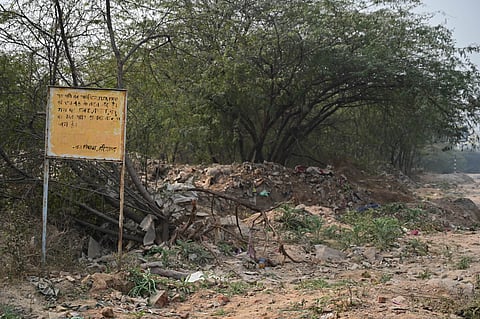
Decades of deforestation, mining, livestock grazing and human encroachment have severely degraded the Aravallis Sudarshan Jha/Shutterstock
According to reports, the Indian government is relaxing environmental rules and accelerating forest diversion for industrial growth by amending the Forest Conservation Act (FCA) 2022/2023. Key changes include removing the requirement for Gram Sabha (village council) consent before destroying forests and exempting private developers from paying compensation for cutting trees in certain areas.
Key Environmental Rule Relaxations:
Removing Tribal & Community Rights: The Forest Conservation Rules of 2022 allow the central government to approve forest land diversion before obtaining the legally required consent from local forest-dwelling communities (Gram Sabhas). This effectively overrides the 2006 Forest Rights Act.
Advertisement
Accelerating Private Access to Forests: The government now allows private entities to take over forest land, including for commercial plantations. Changes in 2023 amended the 1980 Act to narrow the definition of forests, limiting protections mainly to areas officially recorded as forests, which could exclude vast tracts of forested land.
Waiver of Fees: New rules allow private companies to undertake "compensatory afforestation" projects on forest land without paying the required Net Present Value (NPV), which is a fee intended to compensate for the lost ecological value of trees.
Streamlining Industrial Approvals: The government has reduced the processing time for high-risk ("red category") industries to get permits for air and water pollution, from 120 days to 90 days.
Reduction of Green Cover Requirements: Recent guidelines have reduced the required dense green cover within industrial estates,
FAQs
What does the 2025 World Air Quality Report show about India?
India is ranked sixth among the world’s most polluted countries in terms of average PM2.5 levels.
Advertisement
Which is the most polluted capital city?
New Delhi remains the most polluted capital city globally, with an average PM2.5 concentration of 82.2 µg/m³ in 2025.
Which is the most polluted city in the world?
Loni in Ghaziabad recorded the highest PM2.5 levels in 2025, making it the most polluted city globally.
Which countries have the worst air quality?
Pakistan ranked first, followed by Bangladesh, Tajikistan, Chad, the Democratic Republic of Congo, and India in sixth place.
How many of the world’s most polluted cities are in Asia?
The report notes that the world’s 25 most polluted cities are located in India, Pakistan and China, with India home to three of the four most polluted.
What is the main pollutant measured?
The report focuses on PM2.5, fine particulate matter linked to serious respiratory and cardiovascular health risks.

Published At: