There has been much controversy in India of late over the imposition of certain food and dietary restrictions. The latest flashpoint in this debate has emerged on the railways, centering on the food served to passengers during long-distance train journeys.
Food, Faith And Choice: Railways Revisit Vegetarian-Only Menu On Howrah-Guwahati Vande Bharat Express
The Vande Bharat Sleeper Express linking Kolkata and Kamakhya sparked debate after initially serving only vegetarian food, overlooking the deep-rooted non-vegetarian food culture of Bengal and Assam

Advertisement
What's The Issue?
On January 17, the country’s first sleeper service of the Vande Bharat Express was inaugurated, connecting the poll-bound States of West Bengal and Assam through the Howrah–Guwahati (Kamakhya) route. The launch was projected as a major boost to rail connectivity between eastern and northeastern India.
However, soon after the start of the service, it ran into trouble when passengers raised concerns over the absence of non-vegetarian options on the menu. Travellers on the overnight route pointed out that the lack of such choices was particularly striking given the dietary preferences prevalent in the regions the train passes through.
Ignoring Regional Food Practices
According to reports, the initial decision by the Indian Railways to offer only vegetarian food on the Howrah–Guwahati Vande Bharat Sleeper Express stemmed from an internal policy applied to routes associated with religious destinations. The train was a pilgrimage-friendly service, linking major Kali temples in Kolkata—including Kalighat and Dakshineswar—with the Kamakhya Temple in Guwahati.
Advertisement

The striking Kamakhya Temple in Guwahati Rahul D'Silva/Shutterstock
In fact, at the inauguration, Prime Minister Narendra Modi had highlighted the train’s role in facilitating religious travel, stating that it would enable devotees from West Bengal and Assam to visit each other’s sacred sites with greater ease and comfort.
Diverse Culinary And Religious Traditions
Critics who object to the state’s interference in dietary choices argue that these approaches reflect a limited understanding of India’s diverse culinary and religious traditions. Both West Bengal and Assam have long-established non-vegetarian food cultures, where fish and meat are integral to everyday diets.
More significantly, critics point out that there are no religious prohibitions on the consumption or offering of non-vegetarian food at the temples connected by the route. At Kamakhya, one of the most prominent Shakti peethas in the country, fish and meat are traditionally offered as prasad—mirroring practices followed at several Kali temples in Bengal.
Therefore, framing the route as a “vegetarian pilgrimage corridor” not only overlooks regional customs but also imposes an interpretation of religious practice that does not align with lived traditions of the region.
Advertisement
So Long, And Thanks For All The Fish
According to reports, on January 23, West Bengal BJP president Samik Bhattacharya backed the Trinamool Congress’s demand for the inclusion of non-vegetarian food on the train. However, a senior BJP source said that it was still not clear whether the Railways would go as far as offering fish as part of the onboard menu.
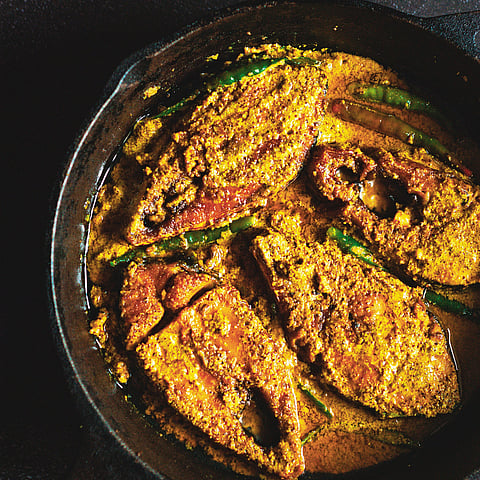
A popular Bengali preparation of ilish, shorshe maach Shutterstock
In Bengal, fish is not merely a dietary preference but a near-sacred presence, and the notion that Bengali passengers would willingly endure a long journey without it has been likened by some to culinary sacrilege. In a culture where fish is woven into daily life as much as ritual and memory, the idea that Bengali travellers would simply do without it carries a faintly absurd note — a quiet echo of farewell, as if one were being asked to move on and leave the fish behind.
(With inputs from various sources.)
Advertisement
FAQs
What is the issue?
According to reports, Indian Railways applied a policy used for trains connecting religious destinations, aiming to position the sleeper as a pilgrimage-friendly service linking Kali temples in Kolkata and Kamakhya in Assam.
Why did passengers and politicians object to the vegetarian-only menu?
West Bengal and Assam have strong non-vegetarian food cultures, with fish and meat being staples. There are also no religious restrictions at the temples connected by the route against consuming non-vegetarian food.
Will non-vegetarian meals now be available on the train?
Yes. Following passenger feedback and political pressure, Indian Railways has decided to include non-vegetarian options on the Howrah–Guwahati Vande Bharat Sleeper Express.
What is the Howrah–Guwahati Vande Bharat Sleeper Express?
It is India’s first sleeper version of the semi-high-speed Vande Bharat Express. It connects Kolkata in West Bengal with Guwahati in Assam.
Which major cities and stops does the train cover?
The train starts at Howrah (Kolkata), stopping at towns like Bandel, Bardhaman, Durgapur, New Jalpaiguri, New Alipurduar, New Bongaigaon, before reaching Guwahati.
Advertisement
Published At: