Dubai, a city that rarely pauses, has found its skies unexpectedly stilled. In a move that has sent ripples across global aviation, authorities in the emirate have suspended landing permissions for all foreign airlines at both Dubai International Airport (DXB) and Al Maktoum International Airport (DWC), triggering widespread cancellations, diversions, and uncertainty for travellers—especially those flying in from India.
Flights To Dubai Cancelled As Airspace Restrictions Disrupt Global Routes
Flights to Dubai face cancellations and diversions as authorities halt foreign landings amid rising regional tensions

Advertisement
The disruption follows a reported drone strike near DXB that led to a fire in a fuel tank facility, forcing aviation authorities to act swiftly. What began as an emergency response has now evolved into a broader precautionary measure, as officials cite a volatile regional security situation and prioritise safety above all else. For now, the timeline for resumption remains unclear.
Sudden Airspace Halt
The suspension of landing permissions has effectively closed Dubai’s doors to foreign carriers, at least temporarily. Flights en route were either placed on hold, rerouted to nearby airports, or turned back mid-journey. Aircraft approaching Dubai were diverted to alternative destinations across the region, while some returned to their origin cities in India and beyond.
Even as partial operations resumed for select UAE-based carriers like Emirates and flydubai later in the day, the larger disruption continues to affect international airlines. Indian carriers—including Air India, Air India Express, IndiGo, and SpiceJet—have scaled back or cancelled services to Dubai, with only limited operations to other West Asian cities like Muscat and Jeddah continuing.
Advertisement
The impact has been immediate and visible. Passengers have been left stranded, rebooked, or forced to reconsider travel plans altogether. For a route as heavily trafficked as India–Dubai, the sudden halt feels less like a delay and more like a temporary severing of a crucial air bridge.
Ripple Effect Widens
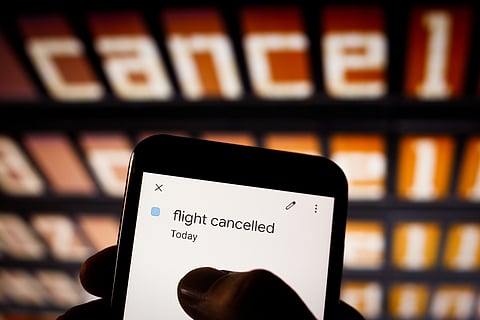
Flights have been cancelled on account of the ongoing crisis Shutterstock
Dubai’s significance as a global transit hub means the disruption extends far beyond point-to-point travel. As one of the busiest airports in the world, DXB connects Asia, Europe, and North America through a dense web of routes. Any interruption here inevitably cascades across the aviation network.
Airlines are now rerouting flights to avoid restricted airspace over the Gulf, leading to longer flight times and increased operational costs. Cargo movement, too, is feeling the strain, with delays expected in shipments that rely on Dubai’s logistical efficiency.
What adds another layer to the situation is the backdrop of escalating geopolitical tensions in the region. In recent weeks, missile and drone activity linked to the Iran–US–Israel conflict has targeted key infrastructure across the Gulf, including ports and energy facilities. The incident near Dubai airport appears to be part of this broader pattern, raising concerns about the vulnerability of even the most secure travel hubs.
Advertisement
Interestingly, the aviation slowdown had already begun before this latest development. Airlines were reporting unusually low passenger loads on Dubai-bound flights, particularly from Europe and the United States, as travellers grew wary of the region. In some cases, wide-body aircraft were flying nearly empty—a rare sight on otherwise high-demand routes.
Travel Advisory
For travellers, the message at the moment is simple: stay updated and stay flexible. Airlines are continuing to adjust schedules in real time, and passengers are being advised to check flight statuses before heading to the airport. Rebooking options and refunds are being offered, though availability may be limited as demand shifts to alternative routes.
The disruption is particularly significant for Indian travellers, for whom Dubai serves not just as a destination but also as a key transit point for onward journeys. With multiple daily connections now suspended, the ripple effects are likely to be felt across itineraries, travel plans, and even ticket prices in the coming days.
Advertisement
For now, Dubai’s usually seamless connectivity has hit an unexpected pause. When it resumes—and how smoothly—will depend on how quickly stability returns to the region. Until then, the city that thrives on movement is, quite unusually, waiting.
(With inputs from various sources.)
FAQs
1. Why have flights to Dubai been cancelled?
Flights were cancelled after Dubai suspended landing permissions for foreign airlines following a drone-related incident near DXB.
2. Which airports are affected in Dubai?
Both Dubai International Airport (DXB) and Al Maktoum International Airport (DWC) are impacted by the suspension.
3. Are Indian airlines operating flights to Dubai?
Most Indian carriers have cancelled or reduced flights, with limited operations continuing to nearby Gulf cities.
4. Are any flights still operating to Dubai?
Some UAE-based airlines like Emirates and flydubai have resumed partial operations, but restrictions remain.
5. What should travellers do now?
Passengers should check flight status before departure and stay updated with airline advisories for changes or cancellations.
Advertisement

Published At:
Tags