Delhi’s ever-expanding metro network added another major milestone on Sunday afternoon, with the launch of two new corridors that promise to reshape the way commuters move across the capital. Prime Minister Narendra Modi inaugurated the new stretches earlier in the day, marking a significant expansion of the Delhi Metro Rail Corporation’s (DMRC) network and introducing what is now being called India’s first operational “Ring Metro”.
Delhi Metro Expands Again As New Corridors Open And First Ring Line Becomes Operational
New Pink and Magenta Line stretches open in Delhi, boosting metro connectivity and creating India’s first operational Ring Metro

Advertisement
Train services on the newly opened corridors began at 3 pm, bringing into operation a 12.3-kilometre section of the Pink Line between Majlis Park and Maujpur-Babarpur, and a 9.9-kilometre extension of the Magenta Line connecting Deepali Chowk to Majlis Park. Together, these additions improve connectivity between north, north-east and north-west Delhi, while also strengthening links to several existing metro lines across the city.
The expansion is expected to shorten travel times, reduce dependence on road transport, and make cross-city journeys more seamless for thousands of daily commuters.
Completing The Loop
The most notable highlight of the expansion is the completion of the Pink Line loop, which now stretches roughly 71.5 kilometres across Delhi. With the Majlis Park–Maujpur-Babarpur section now operational, the line effectively forms a circular route around large parts of the city, creating India’s first fully functional Ring Metro network.
This ring alignment allows commuters to travel between multiple corridors without necessarily passing through heavily crowded central interchange stations. In practical terms, it means passengers can move across different parts of the city more efficiently, particularly when travelling between outer neighbourhoods.
Advertisement
The Majlis Park–Maujpur-Babarpur corridor itself includes eight elevated stations and connects several densely populated areas in north and north-east Delhi. Areas like Burari, Jagatpur-Wazirabad, Khajuri Khas, Bhajanpura, Yamuna Vihar, and nearby housing areas should see improvements. For a while, residents have mostly used roadways to get to the wider metro system.
Building The Crossing
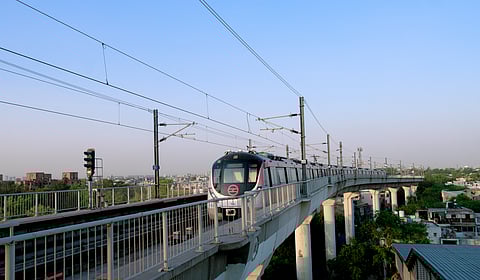
Two new metro corridors are now operational in Delhi, strengthening connectivity across several northern and eastern neighbourhoods Shutterstock
This new Pink Line part does more than just help people move around easier. The way it was built is pretty unique. The route has a fresh bridge over the Yamuna River and an interesting double-decker structure. This structure holds both a metro line and a road flyover.
This is the fifth metro bridge to cross the Yamuna. It's one of the tougher building projects the Delhi Metro has done. The dual-level design allows both rail and road traffic to move simultaneously, helping optimise limited urban space in a densely built city.
The second newly inaugurated corridor, the Deepali Chowk–Majlis Park extension of the Magenta Line, adds another important link to the capital’s transport grid. This elevated stretch includes seven stations and extends the Botanical Garden–Krishna Park Extension Magenta Line further into north-west Delhi.
Advertisement
Stations along this corridor include Deepali Chowk, Madhuban Chowk, Uttar Pitampura-Prashant Vihar, Haiderpur Village, Haiderpur Badli Mor, Bhalswa and Majlis Park. Parts of this route rise nearly 28 metres above ground level, making it one of the highest elevated sections within the Delhi Metro network.
Future Expansion Plans
Alongside the inauguration of the two corridors, the next phase of Delhi Metro expansion also moved forward with the laying of foundation stones for three additional routes under Phase V-A of the project. These proposed corridors together span about 16.1 kilometres and aim to strengthen connectivity to key administrative, residential and transport hubs.
One of the most prominent among them is the underground Central Vista corridor linking Ramakrishna Ashram Marg to Indraprastha. The route will pass through important landmarks such as Shivaji Stadium, Central Secretariat, India Gate, the War Memorial–High Court complex, Baroda House and Bharat Mandapam, improving access to central Delhi’s government and cultural district.
Advertisement
Two extensions of the Golden Line are also planned. The first will run underground from Aerocity to Indira Gandhi International Airport’s Terminal 1, improving airport connectivity for travellers arriving from different parts of the city. The second extension, an elevated corridor from Tughlakabad to Kalindi Kunj, will strengthen links between south Delhi and nearby NCR regions.
Once completed, these lines are expected to make travel easier for commuters coming from areas such as Noida and Faridabad, while also offering faster connections to the airport and central Delhi.
As the metro network grows, planners hope the expanded system will reduce road congestion, encourage greater use of public transport and contribute to lowering pollution levels in the capital. For Delhi’s commuters—who rely on the metro for millions of journeys every day—the new corridors signal not just added convenience, but a steadily evolving urban transport backbone.
(With inputs from various sources.)
FAQs
1. What is India’s first Ring Metro?
Delhi Metro’s Pink Line has become India’s first operational Ring Metro, forming a loop around large parts of the city.
Advertisement
2. Which new Delhi Metro corridors were inaugurated?
The Majlis Park–Maujpur-Babarpur corridor on the Pink Line and the Deepali Chowk–Majlis Park extension of the Magenta Line.
3. When did services start on the new corridors?
Train services on the newly inaugurated stretches began at 3 pm on Sunday.
4. Which areas will benefit from the new metro corridors?
Neighbourhoods such as Burari, Bhajanpura, Yamuna Vihar, Khajuri Khas, Pitampura and Bhalswa will see improved connectivity.
5. What new metro corridors are planned next?
Three corridors are planned under Phase V-A, including Ramakrishna Ashram Marg–Indraprastha, Aerocity–Terminal 1 and Tughlakabad–Kalindi Kunj.
Published At: