“Late-night travel stopped feeling intimidating and started feeling like freedom.”
Are More Women Flying Alone At Night? What Delhi Airport’s Data Reveals About India’s New Traveller
Women are flying more, travelling alone more often, and increasingly choosing red-eye flights. Delhi Airport’s latest passenger data offers a glimpse into how India's changing gender dynamics are reshaping the way women move

Advertisement
For 20-year-old Aaradhita Dey, an Economics student at King’s College London, that freedom often crops up around midnight at Delhi Airport. Frequently flying between Delhi and London, she has grown accustomed to red-eye departures. She arrives hours before boarding, picks up a coffee, wanders through the terminal, and settles in for the wait.
“I would rather sleep on a plane than lose an entire day to travel,” she says.
Her routine might have seemed unusual a decade ago. Today, it is becoming increasingly commonplace.
At 2 AM, Delhi Airport’s Terminal 3 is a study in movement. Students headed overseas scroll through lecture notes near departure gates. Business travellers answer emails before long-haul flights. Families gather around charging stations, waiting for early-morning departures. Among them are women travelling alone, many with hours to spare before boarding.
What makes this scene remarkable is not that women are travelling. It is where and when they are doing it.
Advertisement
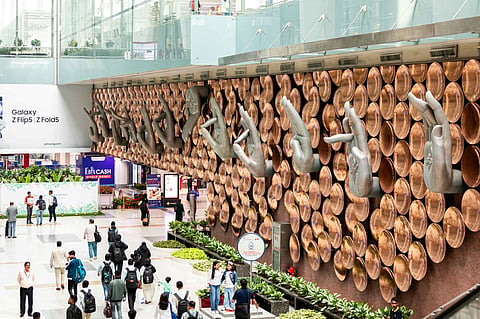
Inside Delhi Airport T3 Delhi International Airport Ltd
For years, conversations around women’s mobility in India have centred on restrictions. Which routes are safe? Is it advisable to travel alone after dark? How late is too late? Yet every night, hundreds of women are arriving at airports well past midnight, navigating terminals on their own, and choosing to spend hours there before their flights.
Delhi Airport’s latest passenger data suggests this is no longer a niche phenomenon. Women are flying more frequently, travelling solo in greater numbers, and increasingly claiming the late-night hours once considered the least desirable time to be on the move.
The question is not whether women are travelling more. The numbers already answer that. The more interesting question is why one of India’s busiest airports has become a space where so many women appear comfortable being alone after dark—and what that says about changing ideas of mobility, independence, and public space in contemporary India.
Advertisement
What appears anecdotal at first glance is backed by a noticeable change in passenger patterns.
Women accounted for 20.5 per cent of passengers passing through the airport in 2023. By 2025, that share had climbed to 23.3 per cent. Quarterly figures show even sharper growth, touching 27 per cent in some periods. Put differently, nearly one in four passengers at the airport today is a woman, and in some quarters, the proportion comes close to one in every three-and-a-half travellers.
The figures become more revealing when viewed alongside another trend. Solo travel is rising rapidly across categories. According to Delhi Airport’s Passenger Profile Study, the proportion of passengers travelling alone grew from 72.7 per cent in 2024 to 82.3 per cent in 2025. Within that segment, women recorded some of the strongest gains. In October 2024, women accounted for 17.6 per cent of solo travellers. A year later, the figure stood at 27.3 per cent.
Advertisement
The data throws light on a broader shift that is underway. More women are travelling alone, more frequently, and with greater confidence than previous generations. Airports are among the first places where such changes become visible.

Passengers at self check-in desk at Delhi Airport T3 Delhi International Airport Ltd
Who’s Flying Alone?
The image of the lone traveller moving through an airport has long been associated with the corporate executive rushing between meetings. That profile is changing.
Delhi Airport’s data indicates growth among younger travellers, particularly in the 18–25 age group. Many are flying for education, work opportunities, holidays, or simply to visit friends and family. International solo travel has emerged as one of the fastest-growing behavioural categories at the airport, with women forming an increasingly significant share of that movement.
For Aaradhita, regular travel between Delhi and the UK and late-night flights have become part of the rhythm of student life.
“Red-eyes are my thing now, especially when I am flying abroad,” she says.
Advertisement
She typically arrives hours before departure, not out of concern about missing a flight, but because she values the time.
“That buffer is genuinely mine. No rushing, no panic,” she says. “Even at midnight, the terminal feels secure. There is bright lighting, visible security personnel, and staff around at every step.”

Passenger dwell times have risen sharply in recent years, turning terminals into spaces for shopping, dining, and relaxation. Delhi International Airport Ltd
For many women who came of age before app-based transport and round-the-clock connectivity, such travel routines were often approached with greater caution.
That generational difference emerges clearly in conversations with older travellers.
Dr Simrat Gulati, a consultant and visiting faculty member who frequently travels across India for teaching and research assignments, says airports have become considerably easier to navigate than they were in the past.
The transformation, she notes, is not confined to the terminal itself.
“The availability of prepaid taxis, app-based taxis, and metro connectivity has added to making travel safer, more certain, and comfortable,” she says.
Within the airport, she rarely feels vulnerable, even during late-night waits.
Advertisement
“Airport waiting areas are fairly safe places most of the time, and even if it is late at night, I have not felt unsafe or insecure there,” she says.
The Airport Exception
The rise of women travelling alone at unconventional hours raises an obvious question. Why do airports appear to inspire a level of confidence that many other public spaces struggle to provide?
Part of the answer lies in design.
Unlike railway stations, markets, parks or commercial districts that experience fluctuations in activity, major international airports operate continuously. There is no closing time. Security personnel remain visible. Retail outlets stay open. Passenger movement continues through the night.
According to Videh Kumar Jaipuriar, executive director, business transformation, airport sector, GMR Group, safety is rarely the result of a single intervention.
“At Delhi Airport, Terminal 3 functions as a fully active 24/7 ecosystem,” he says. “Lounges, retail, food and beverage outlets, sleeping pods, and passenger assistance services remain operational through the night.”
Advertisement
That constant activity matters.
“A woman travelling alone at 2 AM is not navigating an isolated space, but a continuously active public environment,” he adds.

Inside Delhi Airport: For many travellers, a few hours at the airport now means coffee, shopping and time to unwind before boarding Delhi International Airport Ltd
Behavioural data appears to support that assessment.
One of the most striking findings from Delhi Airport’s passenger surveys concerns dwell time. In 2023, fewer than one in five passengers arrived more than three-and-a-half hours before departure. By 2025, that figure had risen to 43 per cent.
If passengers were anxious about airports, logic would suggest they would minimise their time there. Instead, many are doing the opposite.
Among solo travellers, the preferred arrival window now falls between two-and-a-half and three-and-a-half hours before departure. Travellers are spending that time shopping, dining, working, reading or simply waiting comfortably inside the terminal.
The airport is increasingly being used as a space to occupy rather than merely pass through.
A Different Relationship With Public Space
A woman waiting alone at an airport after midnight is unlikely to draw a second glance. The same woman waiting alone at a deserted bus stop or on a poorly lit street might think twice about it herself.
Advertisement
That contrast sits at the heart of Delhi Airport’s passenger data. While conversations around women’s safety continue to shape how many navigate Indian cities, airports seem to inspire a different kind of confidence.
The reasons are not difficult to spot. Flights operate around the clock. Security personnel remain visible. Shops stay open. Passengers keep coming and going. Even at odd hours, there are people around.
Media academic and author Gayatri Srivastava believes the sense of comfort extends beyond infrastructure alone.
“I am not sure it is only the infrastructure that makes airports safer for women passengers,” she says. “I think it is also about the quality of fellow passengers.”
Her observation points to something often overlooked in discussions around safety. People respond not only to physical conditions but also to social environments.

Inside T1, Delhi Airport Delhi International Airport Ltd
An airport lounge at midnight feels different from an empty street, not simply because of cameras and security personnel, but because hundreds of travellers occupy the same space with a shared purpose.
Advertisement
That distinction helps explain why some women who avoid late-night travel elsewhere are willing to spend hours inside an airport after dark.
Mobility On Their Own Terms
The growth in solo female travel does not mean concerns around safety have disappeared.
Several travellers interviewed for this story drew a distinction between travelling at night and travelling alone at an airport at night. The two, they suggested, are not necessarily the same thing.
An airport offers something that many public spaces struggle to provide after dark: predictability. There are staff at information counters, security personnel on patrol, passengers waiting for flights, and transport options operating through the night.
For women travelling alone, those details can make a considerable difference.

Airports provide the security many public spaces cannot Shutterstock
Perhaps the clearest sign of change lies not in the airport itself but in the people moving through it.
In 2011, women accounted for roughly one in eight passengers at Indian airports. By 2019, that figure had doubled to one in four. The pandemic briefly interrupted that trajectory, but recent figures suggest growth has resumed.
Advertisement
The women contributing to this rise do not fit a single profile.
Some are students flying overseas for university. Others are professionals squeezing the most out of a work trip by taking a red-eye. There are mothers travelling to visit children living abroad, friends heading off on long-awaited holidays, and older women joining organised group tours.
Srivastava points to a trend she has witnessed within her own family. Her aunt, now in her seventies, recently travelled to Kazakhstan as part of a group tour.
“Earlier, that would have sounded unusual,” she says. “Now, it doesn’t.”
Travel companies have taken note. Women-only departures, small-group tours, and curated itineraries aimed at solo travellers have multiplied over the past few years, catering to a market that appears far more willing to travel independently than before.
The change is visible at the airport long before boarding begins.
A student catches up on coursework before an international flight. A consultant responds to emails before an early-morning departure. A solo traveller settles into a lounge with a coffee and a book. They are travelling for different reasons, but they share a familiarity with the process that feels increasingly commonplace.
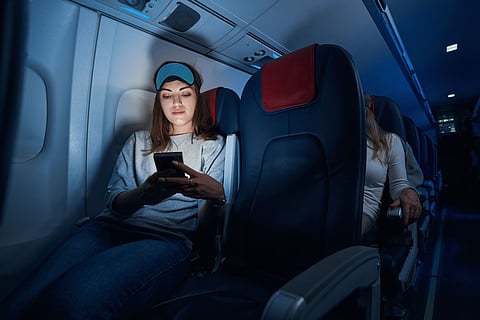
A woman on a night flight Shutterstock
For airport operators, these travellers show up as data points—an increase in solo journeys, longer dwell times, a larger share of female passengers. On the terminal floor, they are simply part of the crowd.
And perhaps that is the more telling shift. Travelling alone is no longer remarkable enough to attract attention. It has become another way of moving through the world.

For many women, travelling late night gives a sense of freedom Shutterstock
FAQs
Q1. Are more women travelling alone in India?
Yes. Delhi Airport's latest passenger data shows a significant rise in solo female travellers. Women accounted for 23.3 per cent of passengers in 2025, up from 20.5 per cent in 2023, while their share among solo travellers also increased substantially.
Q2. Why are more women choosing late-night flights?
Many women prefer red-eye flights because they save time, fit work and study schedules, and allow travellers to maximise their day. Improved airport infrastructure and transport connectivity have also contributed to greater confidence in late-night travel.
Q3. Is solo female travel growing in India?
Yes. The growth of women-only tours, international education, professional travel and independent leisure trips indicates that solo female travel is becoming increasingly mainstream across India.
Q4. Why do airports feel safer for women travelling alone?
Airports operate around the clock, maintain visible security, offer well-lit environments and have continuous passenger activity. These factors create a sense of predictability and comfort that many other public spaces may lack after dark.
Q5. What does Delhi Airport's data reveal about changing travel trends?
The data highlights rising female participation in air travel, increasing solo journeys, longer airport dwell times and a growing preference for independent travel, reflecting broader social and economic changes in India.

Published At: