

Scholars are slowly uncovering a concealed universe in northern Canada formed by seclusion through its limestone caves and jaggedly rugged karst hillsides. The wealth of biology within this area is impressive. Just as important is the recognition that it is now critical to conserve these areas before they suffer permanent harm.
The discoveries come from a series of biological field surveys carried out across the karst landscapes of Battambang Province and Stung Treng Province between December 2023 and July 2025. The work was led by Fauna & Flora Cambodia in partnership with the Ministry of Environment and a group of specialists.


Researchers focused on four main groups—bats, cave invertebrates, herpetofauna and snails—while a wider camera-trap programme tracked mammals and ground-dwelling birds. Each part of the survey was documented separately, building a layered picture of life across these landscapes.
Field teams explored 64 caves and 10 karst hills, concentrating on relatively accessible areas such as Banan and Phnom Proek in Battambang and Thalabarivat in Stung Treng. Even so, the picture remains incomplete. Some surveys took place only during the dry season, suggesting that more species are likely to surface with further study.
New Species Emerge From Isolated Cave Systems
Across these broken limestone formations, scientists identified at least 11 species new to science. Seven have already been formally described, while four are still being studied.
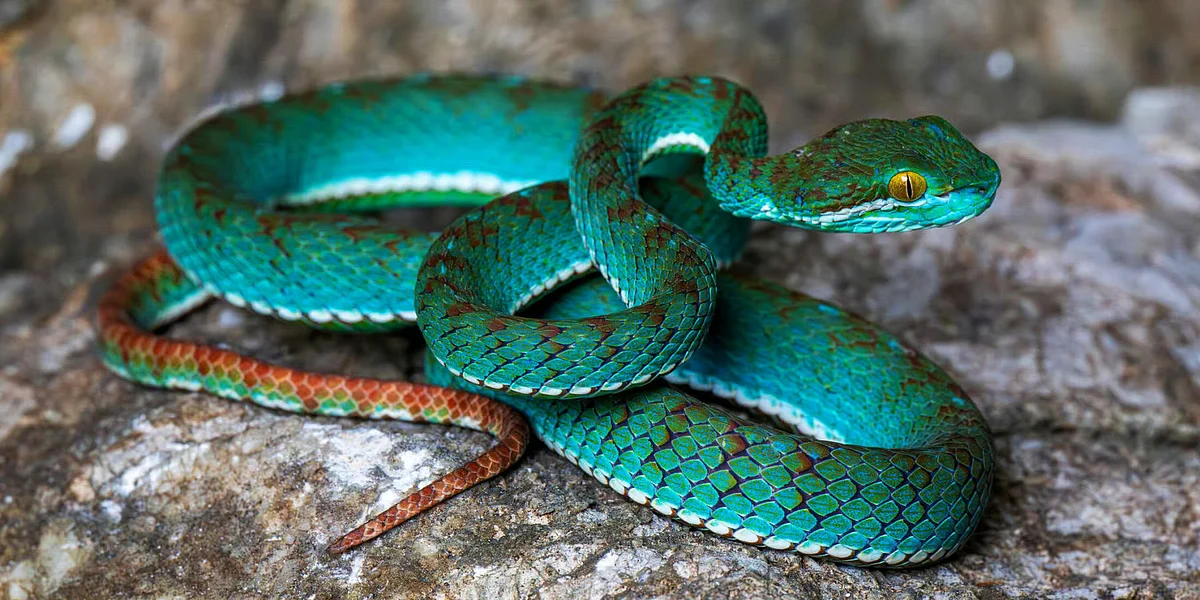
Among the standout finds is a turquoise pit viper from the Trimeresurus genus, along with several geckos, micro-snails and millipedes that have adapted to life in darkness. Newly recorded reptiles include geckos from the genera Cyrtodactylus, Hemiphyllodactylus and Dixonius, while land snails from Clostophis and Chamalycaeus add to the region’s diversity.
One of the smallest discoveries is Clostophis udayaditinus, a micro-snail measuring less than 2 millimetres across. Another is Orthomorpha battambangiensis, a millipede species found in a cave in Battambang. Alongside these are sightings of a flying snake and several reptiles that are yet to be formally classified. A striking new pit viper species from the Trimeresurus genus was recorded during the survey and is now in the process of being formally described. Known for their triangular heads, these highly venomous snakes use heat-sensitive pits behind their nostrils to detect and hunt warm-blooded prey.
Taken together, the findings show how karst landscapes function like natural islands—cut off from the outside world and allowing species to evolve in ways seen nowhere else.

Rare Wildlife And Conservation Gaps
The survey also offered rare glimpses of wildlife that are already known, but not often seen. Camera traps picked up the critically endangered Sunda pangolin, along with the Indochinese silvered langur, long-tailed macaque, green peafowl, northern pig-tailed macaque, mainland serow, and Bengal monitor lizard.
The findings also highlight how important the karst areas in western Battambang Province, especially around Phnom Proek, are from an ecological standpoint, adding weight to calls for stronger protection.
At the same time, signs of disturbance are hard to ignore. Evidence of forest fires, quarrying activity and even poaching highlights the growing pressure on these already fragile systems. Across the world, only a small share of karst landscapes currently fall under any form of protection.
What has been documented so far is only part of the story. Many caves remain unexplored, and seasonal gaps in the research mean that species inventories are far from complete.
Even within this limited window, the discovery of new geckos, snails and millipedes across a relatively small area points to just how rich these ecosystems are. It also underscores how little is known—and how easily species confined to a single cave could disappear before they are ever recorded.
(With inputs from various sources)
FAQs
1. What was discovered in Cambodia’s karst caves?
Researchers identified 11 previously unknown species, including geckos, micro-snails, millipedes, and a new pit viper.
2. Where are these karst caves located?
The discoveries were made in northern Cambodia, mainly in Battambang and Stung Treng provinces.
3. Why are karst landscapes important for biodiversity?
Karst systems act like isolated ecosystems, allowing species to evolve uniquely due to limited interaction with the outside environment.
4. What threats do these ecosystems face?
Quarrying, forest fires, poaching, and habitat disturbance are major risks to these fragile cave systems.
5. Are more species expected to be discovered?
Yes, researchers believe many caves remain unexplored, and further surveys—especially across seasons—could reveal more species.