



Prime Minister Narendra Modi will inaugurate the first phase of Noida International Airport in Jewar, Gautam Buddha Nagar district, on Saturday, March 28, 2026. This marks a significant expansion of aviation infrastructure in northern India. The project is expected to ease pressure on Delhi’s existing airport and strengthen connectivity across the National Capital Region (NCR).
Programme Schedule And Security Arrangements
According to details shared by the Press Information Bureau (PIB), the Prime Minister is scheduled to arrive at the airport premises at approximately 11:30 AM. Upon arrival, he will inspect the newly built terminal and then formally inaugurate the facility around 12 noon as part of a well-coordinated programme.
Following the inauguration, he will address a gathering in the presence of senior leaders, including Uttar Pradesh Chief Minister Yogi Adityanath.
To facilitate the visit, authorities have implemented extensive security protocols, including regulated entry points, surveillance, and traffic diversions along key routes such as the Yamuna Expressway to ensure smooth movement during the event.
Why Noida International Airport Matters
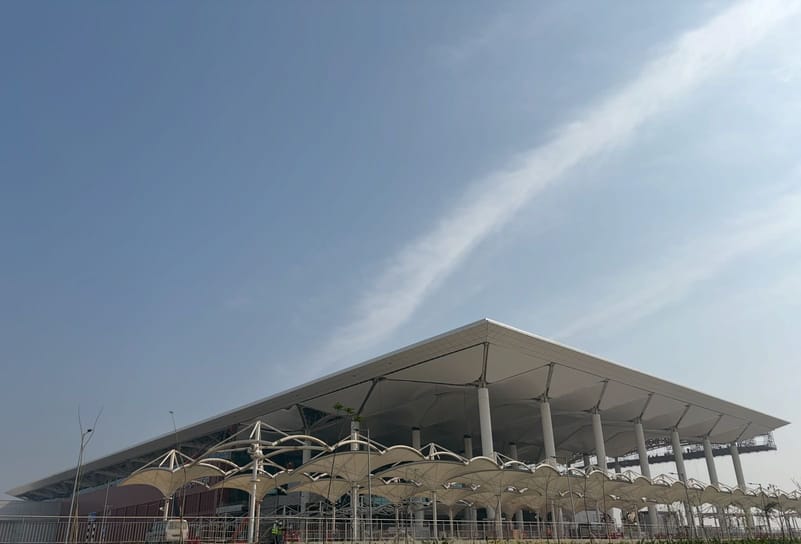

The Noida International Airport is set to become the second international airport serving the Delhi-NCR region, complementing operations at Indira Gandhi International Airport.
With both airports expected to function in tandem, officials anticipate a more balanced passenger load and improved efficiency. This addition is seen as a strategic move to position the NCR among major global aviation hubs and address long-standing congestion challenges.
Alok K Singh, Chairman & CEO, SNVA Traveltech (Travomint), said the inauguration is a “progressive step” that will enhance connectivity and improve the travel experience for millions. He noted that the additional airport in NCR is expected to ease congestion at Delhi Airport, leading to shorter queues, smoother check-ins, and greater passenger comfort. “It will save time and make air travel more seamless and convenient,” he added.
With this development, Uttar Pradesh will emerge as the only state in India with five international airports, reflecting its growing aviation footprint.
Investment And Project Framework
The initial phase of the airport has been completed with an investment of around INR 11,200 crore, executed through a Public–Private Partnership (PPP) model.
The project is being developed by Yamuna International Airport Private Limited (YIAPL), backed by Zurich Airport International AG in coordination with Noida International Airport Limited (NIAL), the state government’s implementing agency. As the project progresses, the total investment is projected to reach INR 29,560 crore.
Inside Noida Airport Phase I: Key Features

In its first operational stage, the airport is designed to handle 1.2 crore passengers annually, with long-term expansion plans targeting a capacity of up to seven crore passengers per year.
A key infrastructure component is its 3,900-metre runway, built to accommodate large, wide-body aircraft. The facility is equipped with modern aviation systems including:
Instrument Landing System (ILS)
Advanced runway lighting
Round-the-clock operational capability in varied weather conditions
In addition to passenger services, the airport includes a comprehensive cargo and logistics ecosystem. The on-site cargo hub is designed to process over 2.5 lakh metric tonnes annually in the initial phase, with flexibility to scale up to 18 lakh metric tonnes as demand grows.
Plans also include a 40-acre Maintenance, Repair, and Overhaul (MRO) facility, expected to strengthen India’s domestic aviation servicing capabilities and reduce reliance on overseas maintenance operations.
Integrated Transport Connectivity
Located along the Yamuna Expressway, the airport is conceptualised as a multi-modal transport hub, linking various modes of travel. Planned connectivity includes:
Expressway access to Delhi and Noida
Rail and metro linkages
Regional transit systems
This integrated network is expected to significantly cut travel time and enhance logistical efficiency for both passenger and cargo movement.
Focus On Sustainability And Design
In line with contemporary aviation trends, the airport has been developed with a focus on sustainability and is planned to operate as a net-zero emissions facility. Energy-efficient technologies and environmentally conscious design principles guide all aspects of its construction and operations.
Architecturally, the terminal draws on Indian cultural influences, taking inspiration from traditional structures such as ghats and havelis and blending heritage elements with modern design.
Economic And Regional Impact
With the launch of the airport, economic activity across western Uttar Pradesh, particularly in and around Gautam Buddha Nagar, is expected to grow. Improved connectivity is expected to benefit trade, tourism, and regional development.
In a message shared ahead of the inauguration, Prime Minister Narendra Modi highlighted that the airport would enhance connectivity, support commerce, and help decongest Delhi’s existing aviation infrastructure.
As the first phase becomes operational, Noida International Airport is set to play a pivotal role in reshaping air travel and logistics in northern India.
(With inputs from various sources)
FAQs
1. When is Noida International Airport Phase I being inaugurated?
Noida International Airport Phase I is scheduled to be inaugurated on March 28, 2026, by Prime Minister Narendra Modi.
2. Where is Noida International Airport located?
Noida International Airport is located in Jewar, in Gautam Buddha Nagar district of Uttar Pradesh, along the Yamuna Expressway.
3. What is the passenger capacity of Noida International Airport Phase I?
The first phase is designed to handle around 1.2 crore passengers annually.
4. How will Noida International Airport benefit Delhi-NCR?
It will ease congestion at Indira Gandhi International Airport and improve regional connectivity.
5. What are the key features of Noida Airport?
Noida International Airport includes a 3,900-metre runway, cargo hub, MRO facility and advanced navigation systems.



.jpg?w=320&auto=format%2Ccompress&fit=max&format=webp&dpr=1.0)