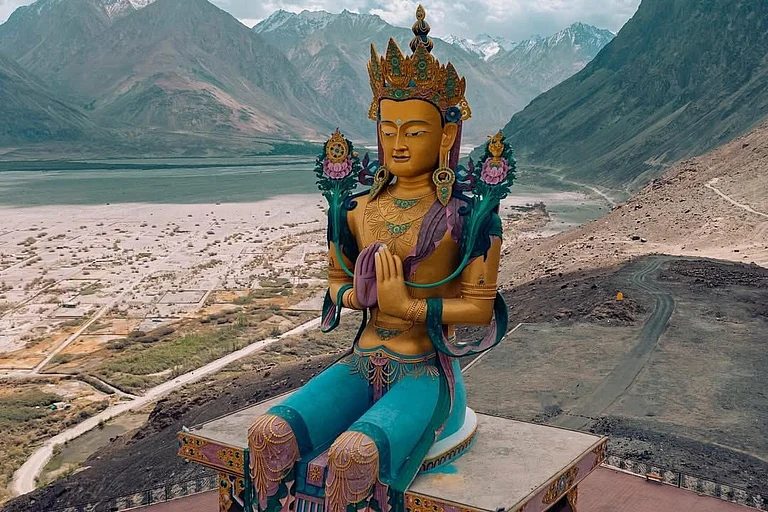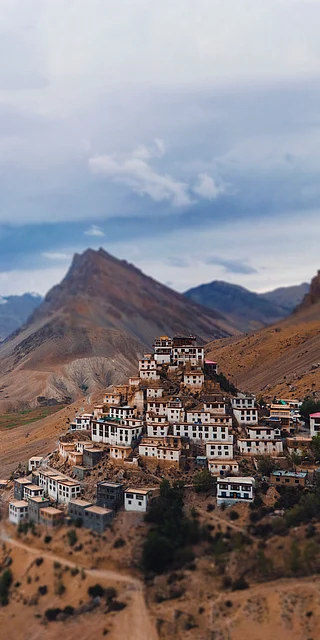


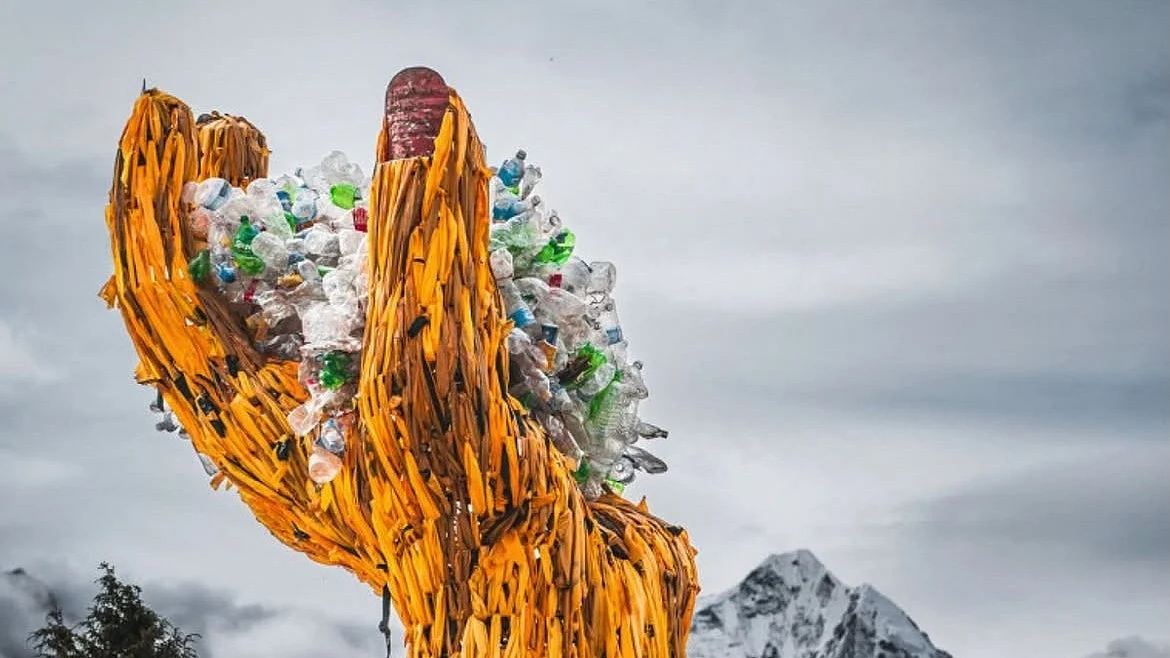
There is no one address of a museum or gallery for this. The exhibition unfolds across mountain villages, monastic settlements, heritage sites, and public landscapes spread over the Leh-Kargil corridor, where travelling between the artworks is as much of an experience as witnessing them. Running from August 1 to 10, 2026, the third edition of the initiative is staged at more than 3,000 meters above sea level across eight locations, making it the world’s highest regenerative land art biennale.
This year’s theme is “Signals from Another Star,” and it brings together artists from Ladakh and abroad to explore questions of ecology, memory, regeneration, climate and community through works created specifically for the landscapes in which they are installed.
Founded in 2023, sā has evolved from an annual exhibition into a biennale designed around long-term engagement rather than a single event. The organisers describe it as a non-white cube biennale, positioning contemporary artistic practice within Ladakh's ecological and cultural realities instead of conventional exhibition spaces. The format also reflects this philosophy: entry is free, there are no opening or closing ceremonies, and visitors are encouraged to move through the sites at their own pace, discovering up to three site-specific artworks at each location alongside public programmes and film screenings.
When The Landscape Becomes The Exhibition
The biennale extends over eight locations stretching from Old Leh Town, Basgo, Likir, Nurla, Lamayuru, Henasku, Mulbekh, and Hunderman. Each site has been selected for its historical, ecological, or cultural significance, allowing artists to respond directly to the character of the place instead of adapting works to gallery walls.
In Old Leh Town, installations draw upon Ladakhi folklore, vernacular architecture and inherited beliefs. Basgo's former capital and monastery complex becomes a setting for works examining ecological rhythms and collective conservation practices. Likir responds to the village's pottery traditions, while Nurla uses bridges, stone and clay to reflect on ecological change and ancestral knowledge. Lamayuru's Moonland terrain hosts works that examine impermanence, resource extraction and changing climates, while Henasku, Mulbekh, and Hunderman focus on disappearing water systems, medicinal landscapes, weaving traditions, border histories and community memory.
Because many installations are created using locally sourced materials and are intended to weather, transform or eventually disappear, the exhibition itself becomes tied to seasonal cycles and the landscape's own processes. The biennale's emphasis on site-responsive commissions, minimal-footprint artistic practices and collaboration with local communities places the location at the centre of the artistic experience rather than treating it as a backdrop.

Artists Responding To Place Rather Than Space
The participating artists span Ladakh and international contemporary practice, but their projects are rooted in specific local contexts rather than universal exhibition themes. Many works begin with oral histories, craft traditions, architecture or ecological systems that already exist within the region.
In Old Leh Town, Jigmet Angmo reinterprets the Ladakhi folklore of Dungjonma through an installation exploring memory and domestic space, while Arunima Dazess Wangchuk examines inherited systems of protection and belonging. Tashi Namgial draws upon a local folktale associated with rainbows and fortune, and Tenzin Olden focuses on the vernacular knowledge embedded within the old town's built environment.
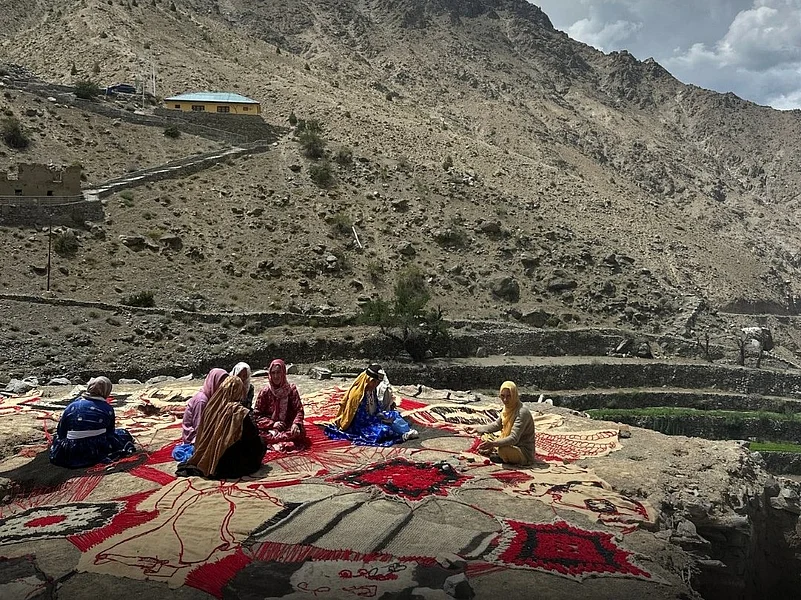
Elsewhere, artists engage directly with environmental questions. Stanzin Tsepel visualises glacier-dependent landscapes altered by climate change in Henasku, while Ayan Biswas's installation in Mulbekh examines medicinal plants, indigenous healing traditions and ecological vulnerability. Zahara Batool's project in Hunderman brings together local women artisans working with embroidery, knitting, crochet and textile traditions to create a collaborative installation across the village's fragile architecture, linking acts of repair with community memory.
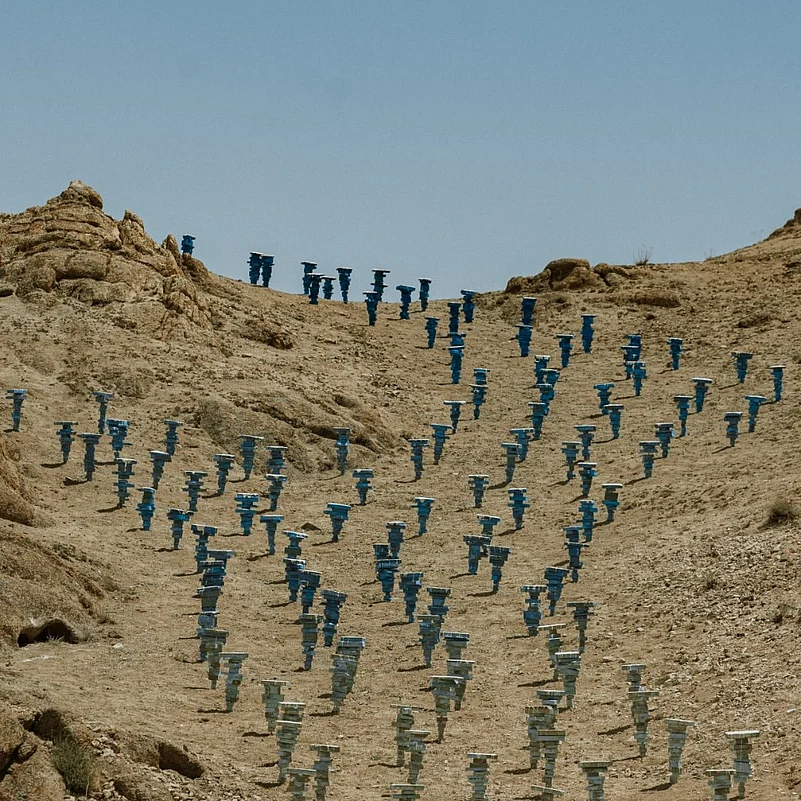
Other works investigate changing relationships between people and landscape through different materials and methods. Skarma Sonam Tashi reflects on disappearing snow and ecological fragility through a flag installation in Lamayuru, while Studio Eidola's "Ground Control" considers the speculative future of lithium extraction using wool gathered from nomadic communities, natural dyes and locally collected twigs. Shupiwe Chongwe's "Vessel" in Likir explores pottery traditions through locally sourced clay that gradually changes under exposure to sun, wind, and rain, making environmental forces part of the artwork itself.
For Raki Nikahetiya, artist and co-founder of sā Ladakh Biennale, "At its core, sā is not an event or a spectacle. It is a long-term commitment to building an institution rooted in mindfulness. We believe art has a responsibility to listen before it speaks: to landscapes, to communities, and to the knowledge that already exists within them. More than an exhibition, it is a process of continuous learning that evolves through dialogue, care and place."
Beyond Installations: Film, Public Programmes, And Slow Travel
While site-specific installations form the core of the biennale, the programme also includes film screenings held across Leh, Likir, Lamayuru, and Kargil. The selected films, many in regional Himalayan languages including Ladakhi and Tibetan, continue the broader conversations around memory, place and landscape. Alongside these are public activations that take place at selected sites during the biennale, reinforcing its emphasis on participation rather than passive viewing.
The visitor experience is intentionally designed around slowing down. Every installation requires walking, and visitors are encouraged to spend at least 48 hours acclimatising in Leh before travelling through the exhibition route. Rather than following a prescribed sequence, the guide encourages people to begin at any site and move at their own pace, discovering each location alongside its surrounding village, monastery or landscape. With no ticketing, opening ceremony or closing event, the biennale removes many of the conventions associated with large international art festivals, replacing them with an itinerary shaped by altitude, geography and local rhythms.
Rethinking The Biennale Format
The sā Ladakh Biennale ultimately proposes a different model for what a large-scale art event can be. Instead of treating Ladakh as a dramatic backdrop, it places the region's ecological systems, communities and cultural histories at the centre of artistic production. The emphasis is not on permanent objects or spectacular displays, but on works that respond to specific places, use local materials where possible, and often acknowledge impermanence as part of their life cycle.
That approach also reflects the biennale's broader objectives. Alongside contemporary art, it foregrounds education, accessibility, mindful tourism and engagement with differently abled communities, while encouraging long-term collaboration between local knowledge systems and international artistic practices. By dispersing artworks across villages, monasteries, historic settlements and mountain landscapes instead of concentrating them inside galleries, the biennale asks visitors to encounter Ladakh through its lived environments. In doing so, it shifts the focus from the exhibition as a destination to the region itself, where art becomes one way of understanding the relationships between landscape, culture, and community.
FAQs
1. What is the sā Ladakh Biennale?
The sā Ladakh Biennale is a contemporary art biennale that takes place across villages, monasteries, heritage sites and landscapes in Ladakh. It focuses on site-specific, environmentally responsive artworks rather than traditional gallery exhibitions.
2. When is the sā Ladakh Biennale 2026 being held?
The third edition of the sā Ladakh Biennale is being held from August 1 to August 10, 2026, across eight locations in Ladakh.
3. Why is the sā Ladakh Biennale unique?
Unlike conventional biennales, it has no central museum or exhibition hall. Artworks are spread across mountain villages and heritage sites, encouraging visitors to experience both the landscape and the art. It is also recognised as the world's highest regenerative land art biennale.
4. What is the theme of the 2026 edition?
The 2026 edition is themed "Signals from Another Star," bringing together artists from Ladakh and around the world to explore ecology, memory, regeneration, climate and community through works created specifically for their locations.
5. Which places host the sā Ladakh Biennale?
The biennale is spread across Old Leh Town, Basgo, Likir, Nurla, Lamayuru, Henasku, Mulbekh and Hunderman, with installations, film screenings and public programmes integrated into each site's cultural and natural landscape.