The world famous evolutionary biologist Sir Julian Huxley, whose zoologist grandfather had been a friend and supporter of Charles Darwin, the author of The Origin of Species, came to Delhi in November 1958 for a conference on world population. Many people were already concerned about the likely dangerous effects of its rapid growth indeed, the world&rsquos population, and that of India, are now more than twice the numbers in 1958, and the natural world has suffered.
An American ornithologist at the conference joined us. Because he was disabled, I drove right to the shore of the jheel, hoping that the birds would not take off. Many did take off, but not to fly away. Ducks, geese, pelicans, sandpipers, shanks... Every bird imaginable was in the air, on the water and around us, in an astonishing display. Sir Julian was as amazed as I was.
I told Sir Julian about the wonders of the Bharatpur Ghana, a rich nesting area, especially for water birds. He eagerly agreed to a visit, and early on a Sunday, he and I, accompanied by our wives, Juliette Huxley and Adrienne, set off in our car. In those days, few people visited the Ghana and I was able to drive around freely. Although monsoon nesting had ended, there were still some storks and other species on nests and we paddled out in my inflatable boat to see them closely.
The highlight was seeing a small flock of the beautiful white Siberian cranes. Although they had been seen in the Ghana from time to time in the past, these were the first to be seen for some 20 years. At the time little was known about their breeding area in Siberia, but later it was discovered to be on the Ob river, east of the Ural mountains. From there they were flying over 8,000km to India every autumn, passing by the Caspian Sea and with a &lsquorefuelling&rsquo halt in the Amu Darya wetlands, east of Kabul &mdash and flying back in the spring. Visiting flocks grew during following years, but then declined, thought to be due to poaching en route. In 2002, a man admitted shooting a white crane at Amu Darya, and, in 2004, only a single crane came to the Ghana, the last to appear in India. A few still visit the southern shore of the Caspian in Iran.
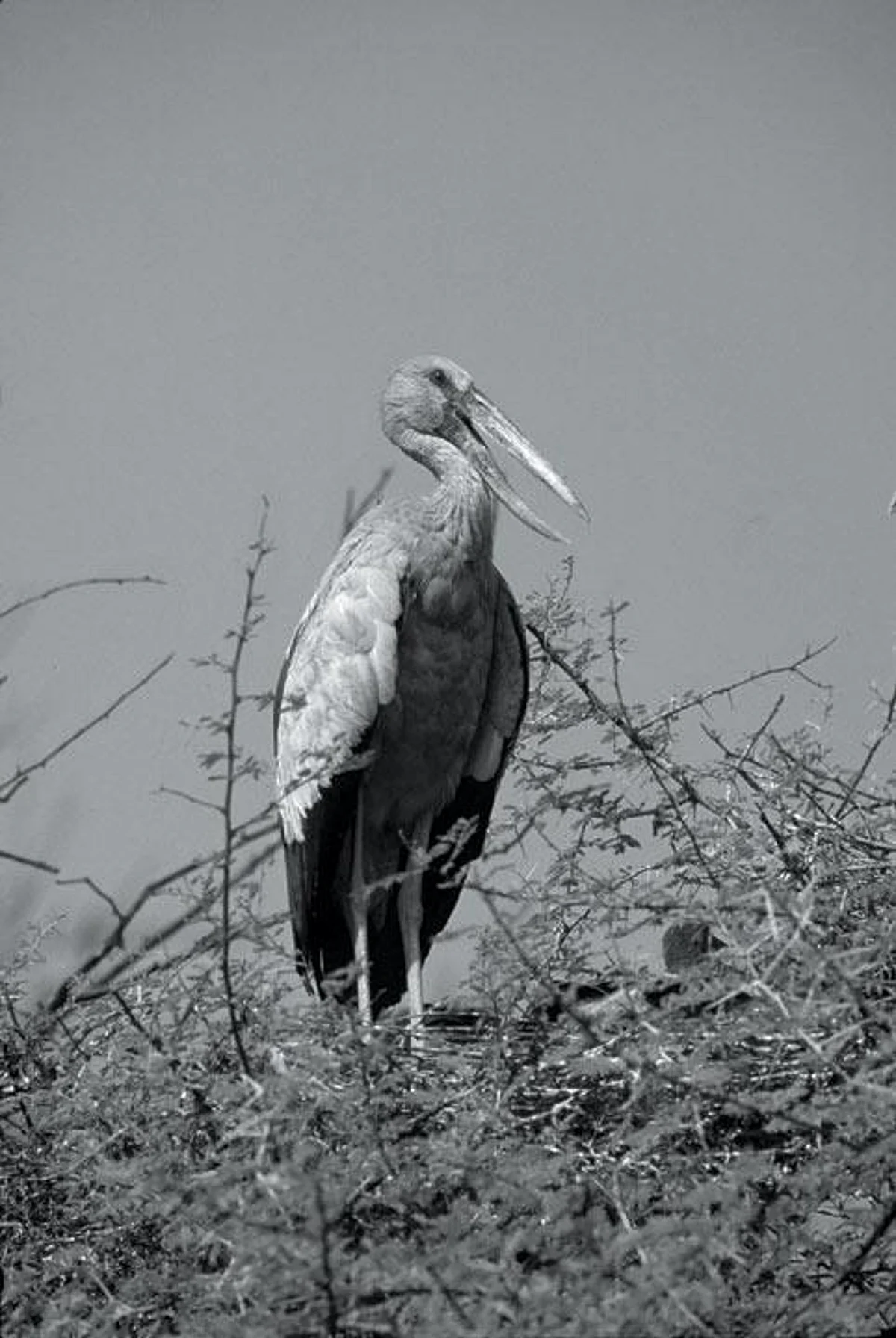
Although delighted to see the cranes, Sir Julian was particularly interested in the open-bill storks, having seen their cousins in Africa. He asked me questions about them, most of which I couldn&rsquot answer. At the end of a wonderful day, we counted the number of species we had seen &mdash over 100. For me it was a usual figure, not only for Bharatpur, but also around Delhi. For Sir Julian it was special the first time he had seen more than 100 bird species in a day, despite his many visits to Africa, whose bird population rivals India.
Huxley said that openbill storks fed on large molluscs (water snails), and described the bill as &ldquoa beautiful adaptive mechanism, enabling the bird to hold the prey firmly while first crushing it and then washing the shell fragments away before swallowing the body&rdquo, adding that stork stomachs had been found to have whole snail bodies but no shell fragments. He said that African open-bills (all black) had a stouter bill with a slightly larger gap than Asian open-bills (white with black on wings and tail).
Sir Julian died in 1975, aged 88. Among his many achievements was to promote the founding of the World Wildlife Fund as a result of two articles in a British newspaper on the urgent need for conservation of African wildlife.
Peter Jackson was correspondent for Reuters in India in the 1950-60s. He became interested in birds and other wildlife, leading to his leaving Reuters to work for wildlife conservation.