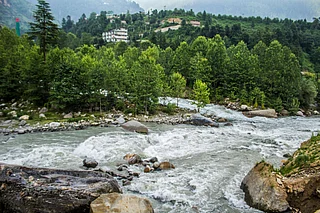


I was sitting in the middle of a stream, wearing gum boots, waiting for breakfast.
The table had been set in shallow water. The chairs stood on the stony bed. The stream moved under my feet while breakfast was prepared and served in front of me. There was juice, eggs, homemade preserves, coffee, and enough food after a morning walk in the hills.
It was not the usual hotel breakfast. I was not looking at nature from a balcony or through a large window. I was in it, boots included.
That is a useful way to understand The Sen by Nakul Sen. The hotel matters, but the stay is not only about the hotel. The road, the forest, the nearby village, the food, the staff, and the hillside all become part of the experience.
The Sen is near Velda Bada, close to Lansdowne in Uttarakhand, a hill station known for its pine and oak forests, old-cantonment character, and links to the Garhwal Rifles. It sits on four acres of private forested land and has only four suites, along with a lounge, an outdoor pool, a dining area, a kitchen garden, and a few sit-outs. The small scale matters. There is no large lobby, no busy restaurant, and no corridor full of identical rooms. It feels more like a private house in the hills than a resort.


The Village
The drive from Delhi takes around five-and-a-half to six hours. By the time the road starts climbing, the city has fallen away in stages. The route passes forested slopes, rocky valleys, streams, and small villages before reaching The Sen’s rustic gate. From there, a path of stacked riverbed stones climbs through the trees into the property.
Soon after I arrived, Chand Babu, the General Manager, suggested a nature walk. It seemed odd to leave the property before even spending time inside it, but it turned out to be the right place to begin.

We drove to a nearby ridge and started walking. Babu pointed out pine needles, pine cones, bird calls, and signs of movement in the trees. The area around The Sen has recorded over 238 bird species, including Kalij pheasants, Himalayan warblers, red-billed blue magpies, and white-crested laughing thrushes. But Chand did not make it feel like a lecture. He just helped me notice more.
When he spoke about the long-tailed broadbill, Babu said, “Wildlife photographers wait for almost a week or two to spot that bird at the same point.”
At one stage, the climb made me realise I was not as fit as I liked to think I was. Babu laughed and said, “You don’t have to go to the gym. You can stay here for a week, and you’re good to go.”

The walk ended at a small hilltop temple dedicated to Goddess Durga and Lord Bhairava, who is revered locally as a guardian of the mountains. During Holi and Diwali, people from nearby villages come here to pray and celebrate. It was not a stop added only for guests. It was part of the local life around the property.
From there, Babu suggested a detour to Jhatri village. We reached it slowly, walking down stone steps past old homes built of stone and wood, with sloping slate roofs. Some houses looked empty. Some still carried signs of the older way of building in the hills.
In one courtyard, I met a woman who had lived in Jhatri for 48 years, since she got married. When I asked how old the village was, she said, “Oh, it’s very old.”
There were vegetable patches around us, with beans still growing on the vines. When I asked what people grew here, she said, “All kinds of vegetables, cauliflower, beans, peas.” Then she added, “But what’s the use? The wild animals destroy the crops.”
That made the village feel real, not like a stop created for guests. It had clean air, old homes, and good weather, but also crop damage, migration, and houses people had moved away from. Pointing to an old structure, she said it had already been that way when she first came to Jhatri. “People used to live here together,” she said, “but now they make other arrangements and move away.”
The Sen’s connection with Jhatri is most evident in food. Ingredients such as onions, ginger, turmeric, mustard seeds, hemp seeds, French beans, and other local produce are sourced from the village and nearby areas. That gives the hotel’s local sourcing a practical meaning.
The Design
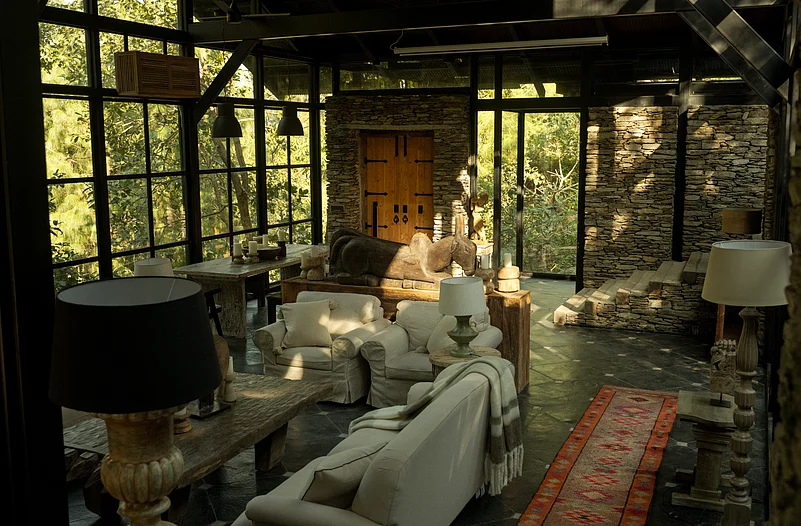
The Sen was built and designed by fashion designer Nakul Sen, with the interiors closely shaped by his wife, Shagun Khanna, who has spent nearly three decades in the luxury and design space. That could easily have made the property feel showy, but it does not. The design is controlled.
Nakul described the retreat as personal. “The Sen is an extension of who I am, my identity, sensibilities, and most importantly, my design philosophy,” he said. What interested him, he said, was bringing together “ruggedness and luxury.”
That is visible across the property. The ruggedness is in the slope, the stone, the trees, the flowing water, and the buildings placed at different levels. The luxury is in the space, service, linen, food, furniture, and the way everything has been planned.
Nakul’s childhood in Old Delhi also finds its way into The Sen. He grew up around havelis, courtyards, jharokhas, chequered floors, and artisans. Here, those references do not appear as direct replicas. They show up more quietly: in the proportions, the handmade details, and the way the rooms open to the outside.
“Luxury isn’t always about adding more; sometimes it’s about creating a feeling of openness, light, and ease,” Nakul said.
The property took four years to complete. Its buildings follow the contours of the hillside instead of cutting through them. “The land dictated almost everything,” Nakul said. “Not a single tree was cut during the making of The Sen.”

I stayed in The Sen-Suite, the largest of the four suites. A glass façade opened the room to the foliage outside. There was indoor seating, a balcony, a fireplace, a study table, and an anteroom leading to the bathroom. The room had a Kashmiri-style chimney, specially designed furniture, and smaller pieces like the desk, chair, and lamps, all carrying a handmade quality.
The bathroom had a rain shower set against glass windows that looked out onto the green outside. The usual luxury comforts were there too: curated tea and coffee, an espresso machine, Marshall speakers, personalised butler service, and 600 thread-count linen.
Across the property, slate stone, sustainably sourced wood from Uttarakhand and Himachal Pradesh, Kadappa stone from Andhra Pradesh, glass, fabric, and handcrafted artefacts and carpets from Rajasthan are used through the rooms and common areas. The interiors were closely overseen by Shagun Khanna, Nakul’s wife, who has spent nearly three decades in the luxury and design space.
The result is detailed, but not crowded. There is enough to notice, but not so much that the design starts competing with the hill.
The Food
Food is the strongest part of The Sen’s connection to the place around it.
The stream breakfast was the most unusual setup, but the larger dining programme is also important. The kitchen uses produce from its own organic garden and works with farmers from neighbouring villages for dairy and vegetables. Meals are planned not just as food service, but as experiences with changing tables, locations, crockery, linen, flowers, and small details.

The team has over 12 different table setups. A meal can be arranged by the stream, under the pines, near the pool, at the long communal table, or in a more private corner of the property. Sometimes the setting is formal. Sometimes it is more relaxed, with handmade crockery, linen, cutlery, flowers, and small changes that shift the mood of the meal without making it feel excessive.

This matters because the food does not arrive alone. Where you sit, what you hear, how the table is laid, and how the staff build the setting around the meal all shape the way you remember it.
The culinary direction is led by Chef Pankaj Sharma. The dinner I had was prepared and presented by Chef Manendra Parmar. He brought out a traditional Pahadi thali and walked me through it. The meal, he said, was “heavily inspired by local ingredients and preparations.”
The thali included mooli ki thechwani, tamatar-dhaniya shorba, Pahadi home-style chicken curry, bichhu ghas ka saag, gehat ki daal, and madua ki roti. There were chutneys, pickles, and smaller sides as well.
The food worked because it did not try too hard. It tasted rooted in the region, but the presentation was clean and polished. The dishes had simple ingredients, strong flavours, and enough variety without losing their connection to home-style cooking.
There are other experiences too: picnics under the pines, forest drives, guided treks, birdwatching walks, river trails, and yoga in the forest. But The Sen is not for travellers who want a large resort with constant activity. Its small scale is the point, but it is also the filter. It will suit couples, families, small groups, design-focused travellers, and people who are comfortable with a slower pace.
What stayed with me was not one big moment. It was how each part of the stay pointed to something beyond the room: Babu explaining birds and pine cones, a woman in Jhatri talking about crops and wild animals, breakfast by the stream, the thali at dinner, and a designer trying to build without overpowering the land.
Nakul said he would want guests to remember “how it felt.”
That is probably the clearest way to describe The Sen. It is a hotel, but the better experience is learning to notice what sits around it.
The Information
Getting there: The Sen is located near Velda Bada, close to Lansdowne in Uttarakhand. By road, it is about a five-and-a-half-hour drive from Delhi, roughly 200 km via NH-534 through Kotdwar. The nearest airport is Dehradun, around 140 km away, followed by a drive of about three-and-a-half hours. The nearest railway station is Kotdwar, about 40 km away, followed by a drive of around one-and-a-half hours.
Best time to visit: April, May, June and September are good months to visit Lansdowne. The post-monsoon period is also useful if you want clearer views and greener surroundings, while winter works for travellers who prefer colder weather.
For more information, visit thesen.in