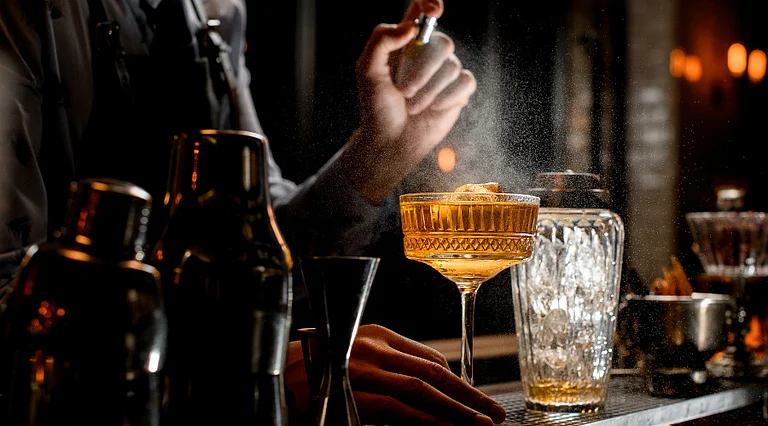


Delhi is always latching onto trends, especially in socialising, food, and cocktails. Whether it was the rise of speakeasies and cocktail bars or today’s obsession with Mahjong, there is never a dull day in Delhi. This time, we are talking about another trend in the city: young and old alike signing up to move from bar to bar in a locality, without settling at one, and enjoying a drink or two wherever they stop. We call them pub crawls, and Delhi’s foodies are not just participants but also organisers. From GK1 M Block Market and Vasant Vihar to Connaught Place, if you find a group entering one bar after another, know that they are on a bar crawl—and you may want to join them.
What Are Pub Crawls?
A pub crawl is a night built around more than one bar. Instead of settling into a single drinking establishment for the evening, participants move from one cocktail bar to another, usually following a pre-planned route. The crawl can be among friends who have decided to hop from one bar to another, or with a host who leads them on a fixed itinerary, where they enter a specific venue, sip a drink, and move on to the next. In Delhi, organised crawls are on the rise in the city's nightlife vocabulary, while neighbourhoods with clusters of bars also make spontaneous, self-guided crawls possible.
But the appeal of a pub crawl isn't necessarily about drinking more. For many, it is about turning a night out into an experience. Each stop offers a different menu, music selection, crowd and atmosphere, allowing participants to sample several sides of a city's nightlife in one evening. It can also make going out more social: organised crawls bring together people who may not know one another, and the movement between venues creates a sense of discovery.
In India, the format has found an audience alongside a broader shift towards experience-led nightlife. Bars are increasingly selling more than alcohol, with food, music, cocktails, design and social interaction becoming part of the proposition.
What Is The History Of Pub Crawls?
The pub crawl is older as a practice than it is as a popular nightlife format. Britain's centuries-old pub and tavern culture provided the setting: when drinking establishments were clustered within walking distance of one another, moving from one to the next was a natural extension of an evening out. The phrase itself has an unusual early history. Research into historical newspaper records traces the expression "pub crawl" to 1909 Britain, where it initially referred to organised political canvassing or propaganda carried out from pub to pub, rather than the recreational drinking tour the term means today.


Over the 20th century, however, "pub crawl" came to mean what we recognise today—a social drinking tour involving several pubs or bars. University towns and student culture helped popularise the format, turning a simple evening of pub-hopping into an organised group activity.
India's relationship with the format developed alongside its modern bar culture. As metropolitan nightlife moved beyond hotel clubs into standalone pubs, lounges, cocktail bars, and neighbourhood destinations, hopping between venues became increasingly feasible. Delhi provides a useful example.
Why Is Delhi Falling For It Now?
Delhi has been hopping between bars for years; what feels newer is the way the pub crawl is being packaged and consumed. The city's nightlife has expanded from traditional clubs and hotel bars into a sprawling network of cocktail bars, breweries, lounges, restaurants, and late-evening destinations. Hauz Khas Village was an early pub-crawl hotspot, while Connaught Place, Greater Kailash, and Vasant Vihar have since developed dense clusters of venues that make bar-hopping possible within a neighbourhood.
There is also a change in what Delhiites expect from a night out. India's bar scene has become increasingly experience-led, with premium cocktails, homegrown spirits, food and distinctive interiors giving consumers reasons to visit venues beyond simply ordering a drink. Industry research has also identified social engagement and experiential formats as important drivers of the café and bar sector.
Then there is the social factor. A pub crawl offers a ready-made itinerary and, in organised versions, a ready-made group. That matters in a city where nightlife discovery is increasingly digital and younger consumers are looking for experiences centred on music, food, and meeting people. A recent report on urban youth found that nightlife is increasingly associated with experiences, social energy, and community rather than alcohol alone, with social media and digital platforms playing a significant role in discovering nightlife experiences.
Delhi's current fascination with pub crawls, then, may be less about discovering the concept and more about rediscovering the city through it—one neighbourhood, bar, and cocktail at a time.