There are more than 38,900 unique and excellent reasons why golfers tend to travel a lot more than any other sports fans.
According to the National Golf Foundation, that is the estimated number of golf courses worldwide. Unlike most sporting venues, a golf course is not limited by concrete boundaries, which helps an architect include, and even accentuate, natural elements when designing it.
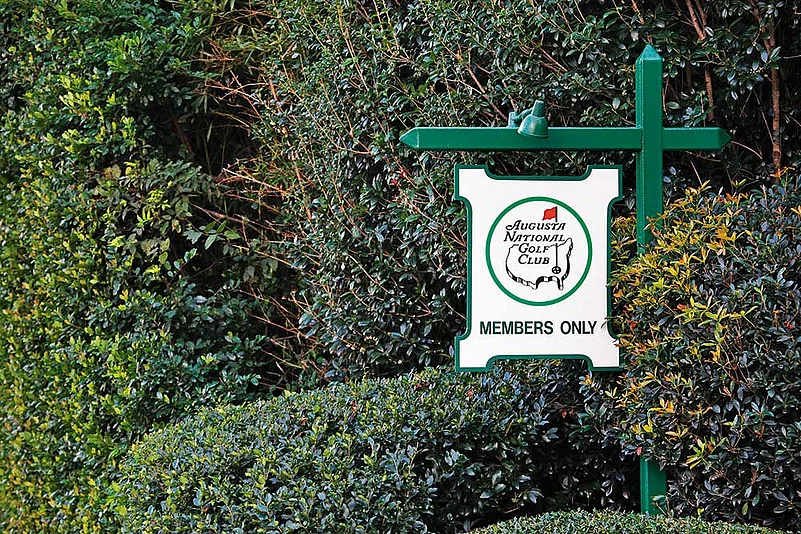
Unless it is a highly exclusive private club, like the Augusta National Golf Club, the permanent host venue of the Masters; Michael Jordan’s Grove XXIII, which is only open to His Airness’ guests; or the mystical Ellerston at Hunter Valley Down Under, which was built by Kerry Packer and can only be accessed by his family members or their invited friends and business partners, most clubs welcome the casual golfers. Some of them, especially if they have hosted a memorable championship or if they have a unique natural feature or past history, become a part of fans’ bucket lists.
Delhi Golf Club is a great example, with its several Lodhi Dynasty tombs from the 14th century adding mysticism to the verdant course. The seventh hole of the Royal Srinagar Golf Club, with the vista of Dal Lake in its foreground, can evoke the spirit of Amir Khusrow in most visitors. The Musselburgh Links near Edinburgh, built in 1672 and considered the oldest existing golf course in the world, is a huge attraction. At Dubai’s Emirates Golf Club, everyone wants to take a video of their swing on the eighth tee to capture the stunning Dubai Marina skyline which they have seen so many times on television.
Golf courses also fall in certain categories that appeal to different players–like the seaside links courses in the UK, or the famous sandbelt courses near Melbourne. They are also identified by the signature styles of their architects.
Dr Alister MacKenzie became so famous for creating Augusta National and Royal Melbourne that many groups want to play on each of his courses. Pete Dye, the man who thought of the island green 17th hole of TPC Sawgrass, is known for designing intimidating and demanding courses like Medalist and the appropriately named Teeth of the Dog in the Dominican Republic, and has fan groups of his own.
For many years, golf tourism has been a well-established pillar of sports tourism. It may not have the numbers like football, which swells during events like the FIFA World Cup or the European League, but golf is a year-long phenomenon, and tournaments are not the only reason tourists travel.
Events are excellent drivers. Last year, the Open Championship, one of the four majors of the year, was held in Portrush, a town of fewer than 7,000 people located at the northernmost tip of Northern Ireland. That one single week, the economic impact for the region was USD 375.17 million. As many as 2,78,000 fans bought everything that could be rented in Portrush. Even in Belfast, nearly 90 km away, 97 per cent of hotels had "No Vacancy" boards.
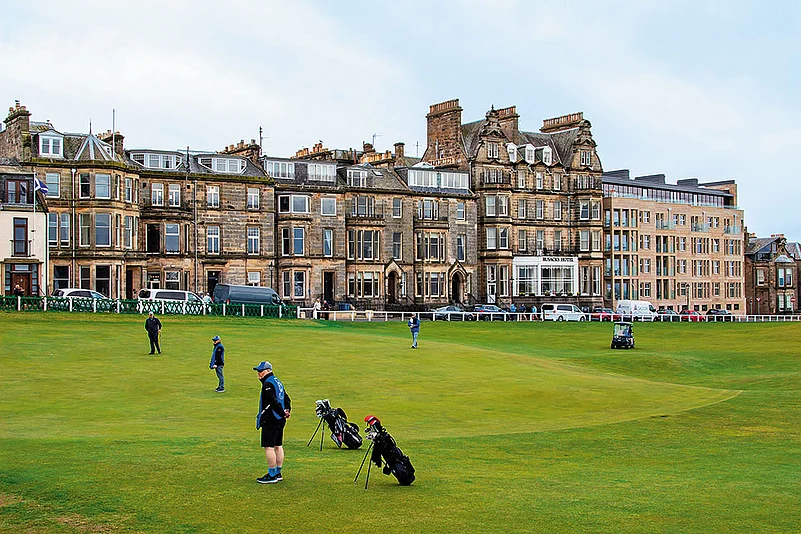
But more than tournament attendees, it is the fans who want to participate and experience these courses that make golf tourism so different. While many popular sports–football, cricket, tennis, rugby–are limited to spectatorship, golf forms the biggest chunk of participatory, or "active" tourism. St Andrews in Scotland is probably not a great example to quote here because it would have been successful anywhere as the "Home of Golf" with the most revered Old Course and some of the finest links courses around a 25-km perimeter, but it exemplifies what a golf course can do if the marketing is done well. The town has a population of 18,950, with nearly 12,000 students at the University of St Andrews. However, it gets more than 2,000 visitors every day because of golf, bringing in USD 402.25 million to the local economy annually, and creating 4,300 golf-related jobs.
Golf tourists are typically affluent; they book quality accommodations and contribute handsomely to the local economy. Various research has valued golf tourism at around USD25 billion in 2025, which is expected to grow at a CAGR of 6.5 per cent.

The biggest golf tourism market in the world is the United States, which has over 16,750 golf courses, and state golf and tourism associations integrating well with the developers.
Other highly developed golf tourism markets are Scotland, Ireland, England, Spain, Portugal, Thailand and Japan, and countries like New Zealand, Australia, South Africa, the United Arab Emirates and Saudi Arabia have made a major push in recent times.
As more women and younger players take up the game, the fairways are only going to get busier
In the strictest sense of the term "golf tourism," India is still in a nascent stage. The biggest challenge is the paucity of the most basic requirement–golf courses.
According to the 2024 Participation report by the R&A, the world governing body outside the United States and Mexico, there are just 289 courses in India, including nine-hole courses. A majority of these are in army cantonments and are inaccessible to civilians and tourists. Comparatively, a much smaller country like Vietnam, by population, economy and golf history, has 75 golf courses, and 51 are either planned or being constructed.
Quite remarkably, Madhav Misra and Ajit Mohandas cofounded their award-winning golf travel business GolfTripz in 2009 after both went on a golf trip to Thailand the year before. Since then, they have seen golf tourism grow in India, and in the wider region, through their new headquarters in Singapore in 2018.
“Because we really have an inventory of just about 60-70 golf courses that we can offer to inbound tourists, most people make golf an addition to their wider India experience,” explained Misra.
“There are only a handful of cities, like New Delhi and Bengaluru, where there are multiple golf courses they can play and even those are heavily booked.
“It is difficult on other fronts as well. Even something like a 16- or a 20-seater luxury van, which is ideal for such groups, is difficult to find. You struggle for good drivers and guides, whereas, in places like Scotland and Ireland, the driver would probably be a golfer himself. However, the potential in India is huge if we combine itineraries and make it an overall experience. There are golf courses in Delhi, Jaipur and Agra, which can be combined with other Golden Triangle attractions. Rounds of golf can also be combined with Indian Premier League (IPL) tickets and other cricket tournaments,” he said.
While inbound tourism has its challenges, outbound from India is becoming big.
Mumbai-based VS Hariharan, 55, is a serial entrepreneur and an obsessive golfer. He is part of two groups that usually make three trips every year. "OB" (out of bounds in golf parlance) comprises 16 members and makes two four-day trips every year, and the other group meets mostly in the US.
“It’s the most fun thing we do every year. And with 16 odd people travelling, we also get some great deals. The one place we go to every year is Thailand, and we prefer places like Phuket, Pattaya and Hua Hin because the golf courses are nearby and the resorts are great. We then pick and choose the second destination. Vietnam is definitely worth going to multiple times,” said Hari, who estimated a quality four-day golf outing in both countries, excluding airfare, should not be more than USD 1,200. Misra agreed with Hari’s assessment on Thailand and Vietnam as two Asian countries that have embraced and elevated golf tourism.
“Both these countries are definitely value for money. The Tourism Authority of Thailand (TAT) fill us in on new courses, resorts and golf packages every quarter and we agree on targets. In Vietnam, it’s not the government, but the private organisations that are doing a brilliant job in coordinating with tour operators,” Misra explained.
There are several reasons for golf tourists to outpace the expected global CAGR of 6.5 per cent in the coming years. Golf benefited during the pandemic because it was among the first government-approved sporting activities as a contactless sport where social distancing was easily maintained. The other factor is that golf tourism, so far dominated by men, is changing. Over the past few years, the number of women golfers has skyrocketed. As more women and younger players take up the game and discover it is not an elite pursuit but a social, travel-worthy experience, the fairways are only going to get busier. For markets like India, the challenge is real, but so is the opportunity. With a better incentive for course development and smarter integration with culture golf can move from a niche add-on to a serious tourism pillar.
Five Golf Courses On Most Bucket Lists
Augusta National Golf Club, USA:
The permanent home of the Masters, this golf course in Augusta, Georgia will easily rank as the most beautiful venue in all sports because of its flora and mint condition in which it is maintained. However, getting on the course is not easy. You will have to tap in on some extremely influential members to become their guests.
Old Course at St Andrews, Scotland:
The Mecca for golf. This is how the sport was supposed to be played–completely exposed to natural challenges like the wind whipping up from the adjacent North Sea and the pot bunkers. Easy to get on and very well priced, but you have to be lucky as there is a lottery system involved.
Pebble Beach Golf Links, USA:
Set on the famed 17 Mile Drive in the Monterey Bay area in California, Pebble Beach Golf Links is often called the greatest confluence of land and sea. Home to seven stunning public courses, all within a few miles of each other. The green fee at the main Pebble Beach course, with its iconic par-3 seventh hole, is upwards of USD 675.
Royal Melbourne Golf Club, Australia:
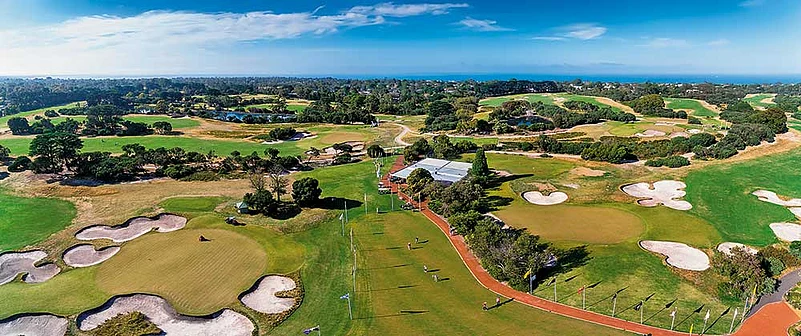
Around Melbourne, you get this loamy sand with deep subsoil. This soil drains exceptionally well and compacts beautifully to make for some of the fastest fairways and greens with edgy bunkering. It requires a different set of skills to conquer them. If you want an even harder sell, Royal Melbourne is Tiger Woods’ second favourite golf course after the Old Course. Green fee can go up to USD 500.
Leopard Creek Golf Club, South Africa:
Flora and fauna is expected on any golf course, but Leopard Creek takes it to a different level. Built on the edge of the Kruger National Park, this Gary Player-designed course has added hazards in the form of leopards, crocodiles, hippos, and elephants. The par-5 13th hole, with its elevated green, is virtually a safari hole. The costliest course in South Africa, it can set you back by USD 450.
(Dubai-based Joy Chakravarty is one of Asia's foremost golf journalists.)
Looking for more such exciting and meaningful stories? Grab our latest issue on Amazon.