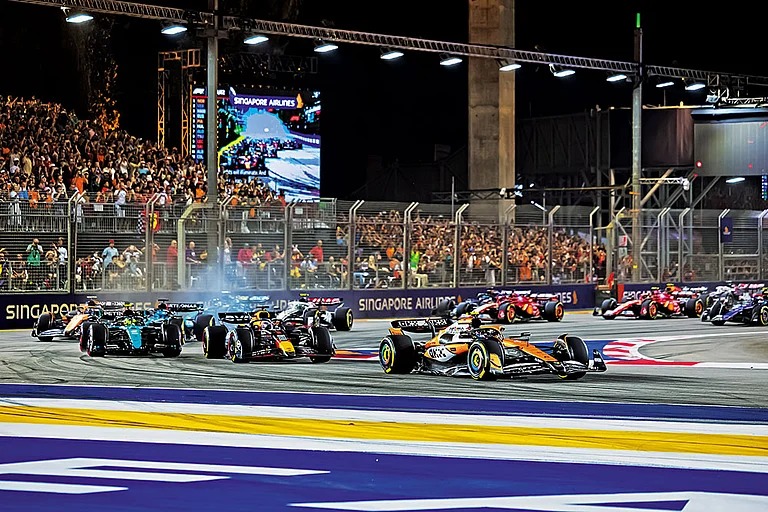


“Because it’s the World Cup!”
That’s the standard answer to the question I’ve asked fans I’ve met at the FIFA World Cup: It’s expensive, it’s a long way from home, why are you here? Fans from Panama and Egypt in Russia; from Bangladesh in Brazil; from Pakistan on the streets of Moscow; from Cameroon in Manaus, deep in the Amazon rainforest; a mining businessman on the flight from Qatar to Sao Paulo, they all gave me the same answer—it’s the World Cup.
If you, dear reader, are debating whether to go or not to the 2026 World Cup, worrying about the spend (it won’t be cheap) and all the logistical hassles, here’s my advice: Don’t think twice, just go. There is no bigger sporting event than the World Cup. Not even the Olympic Games.
Comparisons can be odious, but if the Olympics can boast of the highest number of countries participating (though FIFA seems set to overtake that figure, given current expansionist trends), and throws up sporting greats and great sporting moments, the World Cup wins the debate simply because football is the true global sport. Nothing can match the heartbeat rising when Messi, Ronaldo, Mbappe or Salah have the ball at their feet and are running at the opposition. Even my former boss, Sambit Bal, Mr Cricinfo himself, admitted as much: “A good 90 minutes of football would beat the three-hour game of cricket hands down.” And the World Cup is football’s undisputed pinnacle. We can (and do) curse FIFA for its crass commercialism, its rampant corruption and even its very dodgy Peace Prize, but its premier tournament remains pristine.
It’s a superb spectacle to watch on TV, but on the ground, at the venues, the experience is next level. And that’s because of the fans. First, the home fans are usually delighted that the party is coming to their town. The last six tournaments—this writer was lucky enough to cover five of them—have been a sort of coming-of-age event for the host countries: Japan and South Korea, the first Asian hosts; South Africa, the first African hosts; Russia, hosting for the first time; Qatar, the first hosts from the Arab world. Even Germany and Brazil, though they’d hosted before, were showcasing their new avatars.
The usually reticent Japanese chanted, loudly and endlessly, the triumphal march from Verdi’s Aida whenever their team played; German fans, mirroring their team’s newfound playing style, shed their stereotypical stern image and partied in the stands (and everywhere else) in an especially sunny summer. Angela Merkel, everyone’s favourite smiling aunt, seemed to be everywhere. South African fans introduced the world to vuvuzelas, and even the Russians smiled and joked.
In Brazil, fans defied the system by singing the second verse of the national anthem, once banned by the dictatorship; it was a surreal scene: the PA system cut out, but the fans (and some players) kept singing. They partied, quarrelled and despaired in equal measure, aware it could all come crashing down—as it did, spectacularly, when their team lost 7-1 to Germany. That was the first time I experienced a deafening silence.
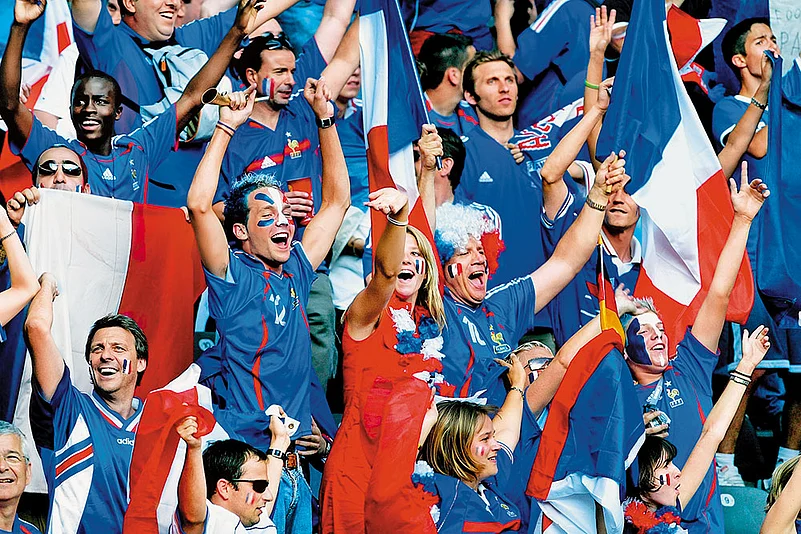
Then, the fans who’ve travelled to watch their teams play. They come in their thousands, noisy, colourful, excited, exuberant, taking over streets, plazas, stations, trains, waving banners and chanting. It’s largely friendly and inclusive. The excitement among debutant nations is palpable; in Russia, around 18,000 Egyptian fans travelled to Ekaterinburg for their country’s (and Mo Salah’s) first-ever World Cup match. Panama’s fans that same year included the country’s president, who travelled all the way to Sochi, on the Black Sea, for their match against Belgium. And the Iceland fans won many hearts with their Viking Thunderclap and general friendliness.
I still remember the several hundred Senegal fans at the opening match of the 2002 World Cup: Senegal vs France (then the reigning champions), the former colony playing its first-ever World Cup match against its erstwhile colonisers. When Senegal won, 1-0, that group of fans exploded (and partied late into the Seoul night). Behind me, though, was a Senegalese journalist who just threw open his arms and beamed the widest smile ever.
Go for the football, stay for the vibe and the feeling of being at the centre of the universe
Every set of fans is different. Those from northern/western Europe are the most confident, armed with the strongest currencies and decades of practice at global travel; they will be methodical in their approach: Arrive early at the city centre, drink, drink some more, sing loudly, march to the stadium, drink even more, and sing loudly through the match. They can also be the most intimidating; in Germany, I once had a post-match train ride back to my base where I was the only person of colour in a carriage full of drunk and increasingly aggressive fans, all of whom were a foot taller and broader than me. Those from Africa are the most musical and colourful (and inclusive); Asians tend to stick together and watch from the sidelines; the Brazilians, when in the mood, will bring their samba beat.

Nothing, though, beats the boisterous, garrulous Argentina fans. In 2014, their delight at making the final was amped up by schadenfreude at their hated rivals Brazil’s defeat. They literally invaded the country in their thousands, their cars and camper vans taking over Rio de Janeiro, their loud (and usually rude) chants echoing everywhere. The most popular was to the tune of "Bad Moon Rising," asking Brazilians what it felt like to have their daddy at home and asserting that Maradona was greater than Pele. It was provocative in extremis, but the Brazilians, to their eternal credit, turned a deaf ear (or maybe they were still in shock at that defeat).
Finally, the neutrals—those who are there for the love of football, no matter that their team hasn’t made it. It’s not an easy decision; World Cup time is when travel and accommodation prices go through the roof. (In Rio, 2014, I paid 200 euros a night for a single room in a homestay; in Volgograd/Stalingrad, 2018, I paid INR 40,000 per night for a tiny room in a very dodgy building that looked like it had been abandoned during the siege in World War II.) But still the fans come, having saved for years, finding dormitories and Airbnbs (and now couchsurfing), taking in the very heady vibes and happy to be part of the party.
But nothing I encountered matched the Chatterjees, literally the epitome of “football crazy.” When I met them in Moscow, Pannalal was 85 and his wife, Chaitali, was 79; it was their tenth World Cup. They’d been to each one since 1982, meeting Pele twice, and seemed to have the energy for several more (sadly, he died in 2019). How do you do it, I asked them. A lot of budgeting, a special fund and other typical means. But to redress any shortfall, they have this one last measure: “To make up for that, we go without fish for a month [fish is the Bengalis' daily staple] and have just puffed rice and peanuts for dinner."
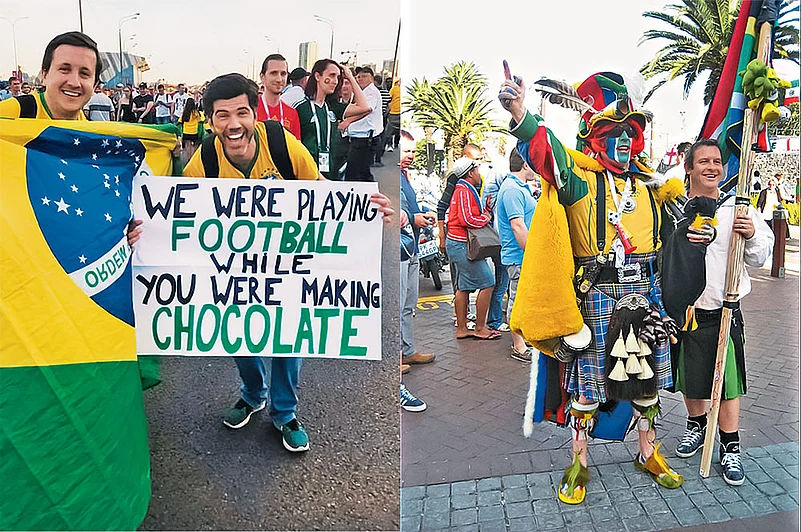
The World Cup isn’t only football, of course. There’s history to be seen, food and drink and all the other culture. Every host nation (okay, maybe not Qatar) has a wealth of tourism and cultural sideshows. In Japan I went off-route to Hiroshima; in South Africa I saw the Gandhi ashram near Durban; in Brazil I went swimming with the pink dolphins in the Amazon (in fact I took a week off the tournament and, knowing I would probably never return to South America, went to Messi’s hometown in Rosario, Argentina, and then up to the Galapagos). In Russia, two nights on the Trans-Siberian Express.
And then there’s the stadiums themselves—often overlooked but sometimes stars in their own right. My favourite? The Olympic Stadium in Berlin, history in every nook and cranny; here’s where Hitler addressed his Nazi rallies, where Jesse Owens burst the bubble of Aryan racial superiority—and, finally, where Zinedine Zidane headbutted Marco Materazzi. Others on the list are Sapporo’s Superdome, with its retractable roof and interchangeable pitches for football and baseball; Soccer City, outside Johannesburg, a multicoloured monolith almost in the middle of nowhere, and the Allianz Arena in Munich with its exteriors that change colour.
Most stadiums for the 2026 World Cup will be a bit short on history and football culture, but the Azteca in Mexico City makes up for all of that: It is where Pelé won his third World Cup and Maradona was crowned in 1986.
So, how will the 2026 World Cup pan out? There are three very different host nations: Canada, making its debut in a sport that isn’t its top priority; Mexico, hosting for the third time; and the USA, where football has grown massively since it hosted in 1994 (for one, Messi plays here!). Three very different cultures, too, but trust FIFA’s processes and protocols to make the experiences far more homogenous. If I had a choice, I’d opt for Mexico, the two Texas venues (Houston and Dallas) and Seattle. The East Coast cluster (New York/New Jersey, Boston, and Philadelphia) is the most obvious choice, especially for first-time US visitors—history, culture, football and enough of a desi vibe should you feel homesick.
There’s no guarantee that a football World Cup will produce great football. The miserable quality of play in 2010, when Spain scored all of eight goals in seven matches en route to the title, is etched in my mind; Russia and Qatar gave us two hugely entertaining (and contrasting) finals. But go anyway. Go for the football, stay for the vibe, the food, the fan zones, the feeling, when a big match is on and millions the world over are watching, of being at the centre of the universe, even if for a moment. Nothing else will give you that kick.
The FIFA Pass Explained
The US has launched the FIFA Pass, letting confirmed 2026 World Cup ticket holders book priority B1/B2 visa interviews. Apply only after purchasing tickets via fifa.com, then access priority scheduling through the US visa portal at travel.state.gov. Approval is not guaranteed; standard screening applies.
Disclaimer: The views expressed are those of the author and do not necessarily reflect the views of the publication.
(Jayaditya Gupta is Consulting Editor with ESPN.in.)
Looking for more such exciting and meaningful stories? Grab our latest issue on Amazon.