

From a distance, Jejuri looks almost unreal, a hill washed in yellow, as if someone spilled sunlight across stone steps and sky. As you draw closer, the colour sharpens into turmeric, thick in the air, clinging to skin, clothing, eyelashes. Chants rise and fall—Yelkot Yelkot Jai Malhar!—and suddenly you realise this isn’t just a temple town, but a living ritual. Tucked about 50 kilometres southeast of Pune, Jejuri is one of Maharashtra’s most powerful yet under-the-radar pilgrimage sites, dedicated to Lord Khandoba, the region’s warrior-deity and protector. Sacred, sweaty, chaotic, and deeply moving, it’s a place where devotion is not quiet, it’s thrown, sung, climbed, and celebrated.
Perched at 718 metres above sea level, the Khandoba Temple crowns a windswept hill like a fort of faith. Locals call it Sonyachi Jejuri, Golden Jejuri, not for wealth, but for belief ground into turmeric powder. And few places in India wear belief as boldly as this.
Hill Of Belief


The climb begins at the base, where daily life hums with flower sellers, turmeric vendors, and pilgrims preparing themselves, mentally and physically, for the ascent. Nearly 200 steps (some insist it’s closer to 450 on festival days, when detours appear like tests of endurance) wind upward through 18 arched gateways and rows of deepmalas, or lamp pillars. Each step feels deliberate. Many devotees climb barefoot; some carry their children; some, in one of Jejuri’s most striking traditions, hoist their spouses onto their shoulders—a public vow of commitment, strength, and prayer.
The temple complex itself resembles a hill fort, a reminder that Khandoba is no gentle, distant god. Known as Malhari Martand or Khanderay, he is believed to be an avatar of Shiva, fierce, accessible, and rooted in the lives of farmers, shepherds, Dhangars, Kunbi-Marathas, and nomadic communities of the Deccan. For many Maharashtrians, he is their kuladevata, the family deity invoked during marriages, childbirth, and turning points of life.
Within the stone-walled courtyard sits a brass-coated tortoise, 20 feet wide, solid and patient—a symbol of endurance. The sanctum houses multiple forms of Khandoba: as a linga, as a mounted warrior, always smeared in turmeric. Bells ring overhead—some of them once belonged to Portuguese churches, brought here by Chimaji Appa after the Maratha victory at Vasai in the 18th century. It’s history layered into worship, conquest folded into prayer.
From the hilltop, the view stretches across dusty plains and distant villages. The wind carries chants upward. You don’t rush here. Jejuri demands that you pause.
Warrior God Lore

The mythology of Khandoba is woven from folk legend, Shiva worship, and local memory. Stories say he descended to defeat the demon brothers Mani and Malla, who terrorised the region. One was slain; the other, forgiven and absorbed into worship, his idol placed within the temple itself. The lesson is unmistakable: power tempered by mercy.
Khandoba’s worship does not fit neatly into rigid religious boxes. He is revered across caste and community lines, including by some Muslim families who see him as a protector. Offerings here look different, too. While the temple serves vegetarian naivedya, folklore remembers Khandoba as a non-vegetarian god, with goat sacrifice performed outside the temple precincts during major rituals. It’s raw, rural, and refreshingly unpolished.
Architecturally, the temple follows the Hemadpanthi style that is functional, fortress-like, and built for resilience rather than ornamentation. Constructed and expanded between the 12th and 18th centuries, with contributions from Maratha rulers and later Peshwa patronage, Jejuri reflects Maharashtra’s political and spiritual history in stone. Even Mughal influences peek through in arches and courtyards, reminders that this land has always been layered.
But the true drama lies not in walls, but in worship.
Turmeric And Thunder

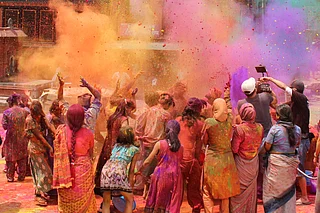
If Jejuri is powerful on an ordinary day, it is otherworldly during the Bhandara festival. Held on Somvati Amavasya—a no-moon Monday that occurs two or three times a year—the ritual transforms the entire hill into a golden storm. Devotees fling turmeric powder into the air, at the deity, at each other, at the sky itself. Within minutes, visibility drops, skin glows yellow, and the temple becomes a living, breathing sunburst.
Bhandara is not gentle. It is loud, physical, overwhelming, joyful. Turmeric here symbolises prosperity, protection, and gold, not material wealth, but spiritual abundance. The chants grow wilder. Drums thunder. At peak moments, the palkhi procession carries Khandoba’s image down to the Karha River for a ceremonial bath, drawing thousands who strain for a touch, a glimpse, a blessing.
And yet, even in the frenzy, there is rhythm. Order in chaos. Women navigate the crowds with confidence. Elderly devotees sit quietly on turmeric-stained steps, watching generations collide. By evening, as the crowd thins, the deepstambhs stand coated entirely in yellow, glowing softly against the darkening sky.
Outside festival days, Jejuri settles back into itself. Mornings are hushed, perfect for slow climbs and unhurried prayer. Dussehra sees a symbolic sword-lifting ritual. Champa Shashthi brings measured celebration rather than madness. Each visit offers a different face of the same devotion.
Jejuri doesn’t ask whether you believe. It simply asks you to arrive with open eyes, sturdy legs, and a willingness to be changed. You may leave with turmeric on your clothes, dust in your hair, and chants stuck in your head. But you’ll also leave with something harder to name: the feeling of having stood in a place where faith isn’t whispered—it’s thrown into the air and allowed to settle, gently, over everything.
The Information
How to Reach:
Jejuri is about 50 km from Pune. Drive down (1.5–2 hours), or take an MSRTC bus or taxi from the city. Jejuri Railway Station lies on the Pune–Miraj line with regular local trains. Pune International Airport, around 55 km away, is the nearest air link.
Best Time to Visit:
October to March is ideal for comfortable weather. Visit during Somvati Amavasya for the Bhandara festival, when the temple is drenched in turmeric. For fewer crowds and calmer darshan, opt for early mornings on weekdays.
Nearby Attractions:
Near Jejuri, you'll find historical forts like Purandar Fort & Mallhargad Fort, scenic spots such as Pingori Lake & Karha River Dam, and cultural sites like Raje Umaji Naik Birthplace, with many farms and viewpoints offering rural experiences, all easily accessible from nearby towns like Saswad.