When life gives you lemons, make galgal ki chaat out of them!
Galgal, Good Views, And Great Tea: A Slow Hill Escape To The Chamomile Estate In Guniyalekh
Galgal ki chaat with sweeping Himalayan views, sunset tea tastings, village walks, folk music, and a movie under the stars—this leisurely escape to The Chamomile Estate in Guniyalekh is mountain living at its most mindful

Advertisement
Up in Guniyalekh, this aphorism acquires a certain Himalayan gravitas. The galgal (local pahadi lemon) is brazen and bright, all citrus swagger, best eaten with a view of mountains that look as though they were composed by a particularly indulgent landscape artist.
I was sitting inside the glass enclosure outside my room at The Chamomile Estate when that thought crossed my mind, plate balanced carefully, fingers sticky with salt and spice. The wind had picked up just enough to keep the afternoon cool. Below, the valley stretched out in soft green folds. There was no traffic noise, no rush, just the occasional birdcall, and the distant sound of someone chopping wood.
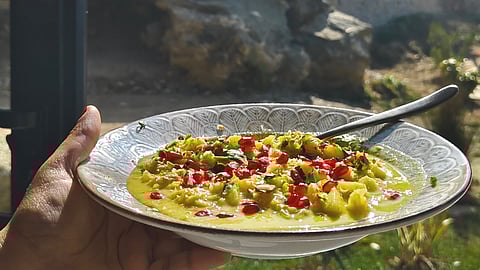
Galgal ki chaat Anwesha Santra
Guniyalekh itself feels like a place that prefers staying off the map. It sits near Mukteshwar in Uttarakhand, surrounded by forested slopes, orchards, and village paths. The drive up winds past small homes, grazing cows and sudden clearings that open to wide Himalayan views. By the time you arrive, your phone signal has weakened, but your mood has improved.
Advertisement
The estate blends into this setting without trying too hard. Built across a hilltop, it looks out over layers of mountains that change colour through the day. Mornings are pale and misty. Afternoons are bright and clear. Evenings turn everything gold before fading into a deep blue that makes you want to stay outdoors a little longer.
Inside My Stay At The Chamomile Estate
I reached The Chamomile Estate on Valentine’s Day, and the weather seemed determined to play along. The sun was out, the sky was a bright blue, and there I was, seated inside the glass enclosure after a long, indulgent Kumaoni lunch. The thali was generous and comforting: Kumaoni chicken, mustard fish, paneer butter masala, hara saag, kadi pakoda, mix dal tadka, bhatt ki churkani, steamed rice, assorted Indian breads, a warming bowl of gehat dal soup, and millet kheer to finish.

A traditional Kumaoni thali for lunch at The Chamomile Estate Anwesha Santra
From the first glimpse, The Chamomile Estate feels more like someone’s ruminative cottage in the hills than a generic resort. Set on a calm 2.5-acre hilltop in the tea-growing village of Guniyalekh, the place is dotted with chamomile flowers and framed by expansive Himalayan views that greet you from nearly every corner.
Advertisement
Instead of a long corridor of numbered rooms, there are seven individual spaces, each with its own character and theme inspired by a specific tea blend—Lavender, Oolong, Jasmine, Hibiscus, Sage, Amaranth, and Buransh—and every one comes with a private balcony or patio looking straight out at the hills. Interiors are simple and modern, with big windows so you never lose sight of the mountains.
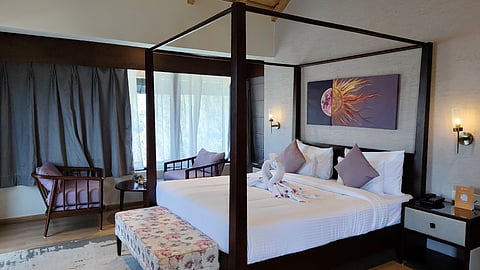
The Lavender Room at The Chamomile Estate Anwesha Santra
I was put up in the Lavender room, tucked away on the first floor of the property. Spread across 575 sq ft, it opened out to clear Himalayan views and came with its own ensuite glass room that quickly became my favourite corner. True to its name, the space carried soft lavender touches through the décor. Large windows lined one side, framing the hills so completely that it almost felt like the mountains were part of the room.
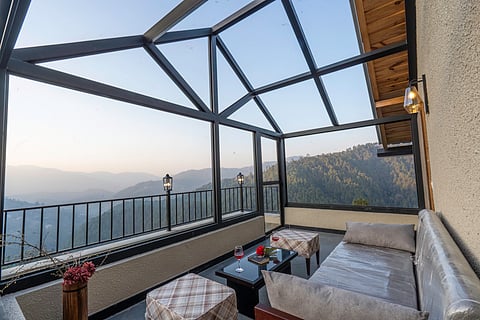
The glass ensuite for the Lavender room Supplied
Tea-Tasting Experience At The Chamomile Estate
Evenings arrive early in the mountains. The light begins to thin before you realise it, and the air turns sharp just as you start getting comfortable. After lunch, it was time for the estate’s signature tea-tasting session. I came down from my room and settled into a cosy spot, watching the hills slowly shift in colour as the afternoon drifted by.
Advertisement
The tasting menu was extensive without feeling overwhelming. There was Oolong, Blooming Tea that unfurled gently in hot water, Hibiscus with its deep ruby hue, and the ever-soothing Chamomile. Kashmiri Kahwa added warmth, Apple Cinnamon brought a familiar sweetness, and the classic Masala CTC delivered comfort in a cup. Then came the thematic blends with names like Stressbuster, Forever Young, and Throat Rescue, each with its own flavour profile and wellness pitch. Alongside the teas were plates of cookies, dry cakes and mathri, assorted pakoras fresh from the fryer, and neatly done bruschetta that disappeared quickly.
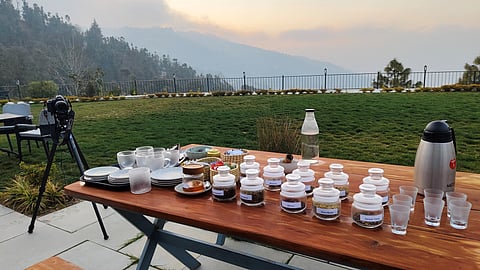
Tea tasting experience at The Chamomile Estate Anwesha Santra
Once the cups were empty and the snacks polished off, we wandered into the game room for a round of Scrabble. The property has a dedicated space called The Den for board games and indoor fun. There is also a small creche with a ball pit for children, reading lounges on both floors for quieter moments, and a Jacuzzi and steam room that look out towards the mountains. It is easy to spend an entire day within the estate without feeling the need to step out.
Advertisement

Game of Scrabble Anwesha Santra
By the time night settled in, it was clear the day was not done yet. Dinner came with an experience that most people secretly hope for on a mountain getaway: a movie under the stars. A bonfire crackled in the open upper-ground space, a giant screen stood against the dark sky, and we settled in to watch Zoya Akhtar’s "Zindagi Na Milegi Dobara". Dinner was served alongside the film, with plates of murgh kali mirch tikka, fish fingers, chilli paneer, pasta, sautéed vegetables, green Thai curry, and assorted vegetables in black bean sauce. Wrapped in a shawl, plate in hand, mountains fading into the night around us, it was one of those evenings that makes you forget the world beyond the hills.

Movie under the stars at The Chamomile Estate Anwesha Santra
The Nature And Village Experience
The next morning began with the kind of chill that makes you wrap your hands around a cup a little longer. Armed with a walking stick more for effect than necessity, we set off on what was described as a trek. It was not the lung-bursting, summit-chasing kind. This was gentler, more about taking in the land than conquering it. The path curved easily around the hillside, brushing past low shrubbery that still held on to drops of dew. The sun was already out, bright and generous, casting a clean light across everything it touched.
Advertisement

We set off for a trek early morning Anwesha Santra
Bright red rhododendrons stood out against the green like small bursts of celebration, and patches of wild chamomile swayed quietly along the trail. Tall pines and old oak trees lined the edges of the mountain, their shadows stretching across the narrow path. Every now and then, the trees would part just enough to reveal a wide view of the valley below, layered and still.
We kept walking until the trail led us to a small settlement where a village family lived. There was no formal welcome, just warm smiles and the easy hospitality the hills are known for. We sat down for tea in their courtyard, cups passed around without fuss. Conversations flowed slowly. We heard about their daily routines, the crops they tended, the winters that tested patience, and the small joys that marked their year. There was laughter, a bit of playful banter, and stories that made the place feel less like a destination and more like a lived-in world. By the time we turned back toward the estate, the mountains felt different, not just scenic, but personal.
Advertisement
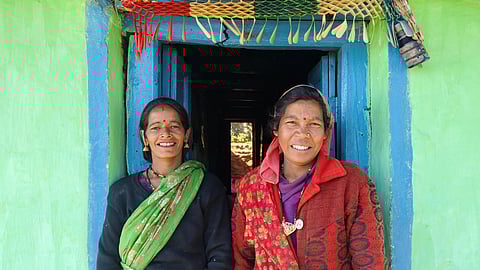
We shared homely conversations with the villagers at Guniyalekh Anwesha Santra
The Picnic And Kumaoni Music Experience
Back at the estate, once we had washed off the dust of the trail and changed into something comfortable, we were told that lunch would not be at the restaurant. It would be outdoors, and a short walk away. That was all the information offered. Curious, we followed the staff along a narrow path that curved around the hill.
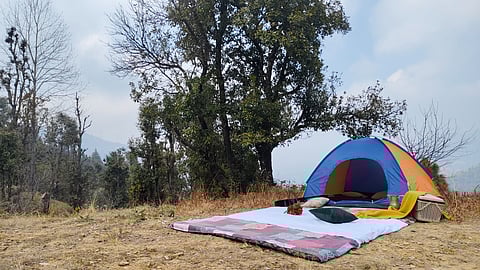
Tent set up for picnic lunch Anwesha Santra
Waiting for us was a bright blue tent pitched right at the edge, facing the valley. Inside were books stacked casually, board games laid out, and even a guitar resting against a cushion as if someone had just finished playing. And then there was a generous spread of Greek salad, sweet potato chaat, nimbu chaat, biryani with raita, veg kathi rolls, fresh fruit juice, brownies, and the local favourite, bal mithai. We ate slowly, plates balanced on our laps, the wind cool against our faces and the mountains stretching endlessly ahead. It did not feel staged. It felt like someone had thought about what a perfect afternoon in the hills should look like and simply made it happen.
Advertisement
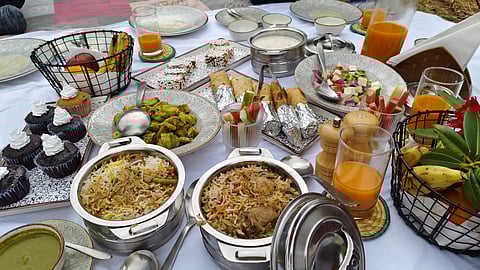
The picnic lunch Anwesha Santra
As we made our way back down towards the property, the experience continued. A group of local musicians was waiting for us. “They’ll be performing Kumaoni music,” someone said, and soon the hillside filled with sound. One musician played the mashakbaja, also known as the mashak beena, a traditional bagpipe-like instrument from Uttarakhand. The word mashak refers to the leather bag that forms part of its design, once used to carry milk or water. Its sound, rich and steady, blended beautifully with the deep beats of the damroo, both central to Kumaoni folk music.
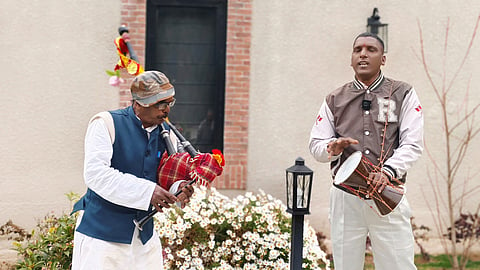
Kumaoni music at The Chamomile Estate Anwesha Santra
With another cup of chamomile tea warming my hands, I sat back and listened. The hotel staff joined in, clapping along, some even breaking into dance. Before long, we were all on our feet. Laughter echoed across the open space as we tried to keep up with the rhythm. We danced until the sun slipped quietly behind the hills and the sky turned a soft grey-blue, carrying the music with it.
Advertisement
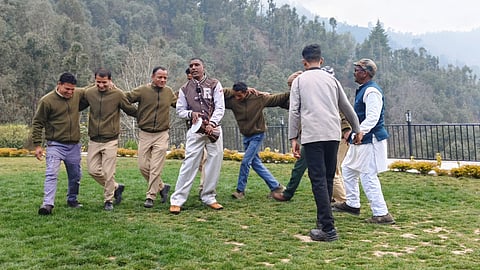
Joining the musical performance Anwesha Santra
A Gentle Return To The Real World
All good mountain stories, like all good cups of tea, must eventually come to an end. We left the next morning, bags packed but spirits conspicuously reluctant. The hills were still wrapped in that early light which makes everything look gentler than it really is. At The Chamomile Estate, the goodbyes were unhurried, almost ceremonial, as though the place knew it had quietly rearranged something within us.
On the drive back, we stopped by Bhimtal Lake. For a brief moment, it felt possible to stretch the pause a little longer. But cities have a way of reclaiming their people. Soon enough, we were back on the road, heading toward deadlines, notifications, and familiar chaos.
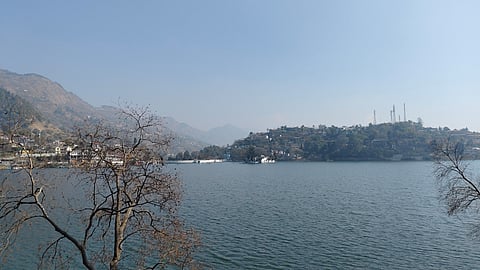
The Bhimtal Lake, Uttarakhand Anwesha Santra
Yet something lingered. Perhaps it was the taste of galgal still sharp in memory, or the echo of damroo and mashakbaja carried by the wind. Perhaps it was the calm assurance that there exists, tucked away in Guniyalekh, a hilltop where afternoons are allowed to stretch out without agenda. The Chamomile Estate does not just host you; it gently detoxes you from urgency. And long after returning to your city life’s fervour, you find yourself plotting an escape, convinced that mountains, like well-brewed tea, are best revisited often.
Advertisement

Chamomile tea at The Chamomile Estate in Guniyalekh Anwesha Santra
The Information
How To Reach The Chamomile Estate
The property can be accessed easily by air, road or rail. The nearest airport is Pantnagar Airport, 80 km away, followed by Bareilly Airport at 150 km, Jolly Grant Airport in Dehradun at 300 km, and Indira Gandhi International Airport in Delhi at 330 km. Kathgodam Railway Station, located 45 km away, is the closest railhead. The estate is well connected by road and has a private access road leading directly to the property. Private parking is available on site and the estate is wheelchair accessible.
Nearby Attractions
From The Chamomile Estate, you can easily explore nearby attractions such as Jim Corbett National Park (100 km), Nainital (40 km), Bhimtal and Naukuchiatal (25 to 30 km), Mukteshwar (30 km), and Kainchi Dham (35 km), all within comfortable driving distance.
Tariffs
Tariff for two per night, inclusive of breakfast, starts at INR 12,500 plus taxes for the Sage room, which is the base category.
The Lavender room with an ensuite glass cabin is priced at INR 14,500 plus taxes per night for two, inclusive of breakfast.
To book, visit www.thechamomileestate.com or call +91 87507 50500.
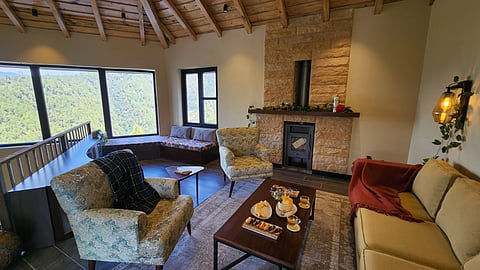
Reading lounge at The Chamomile Estate Supplied
FAQs
1. Where is The Chamomile Estate located?
The Chamomile Estate is located in Guniyalekh, a quiet hill village near Mukteshwar in Uttarakhand, surrounded by orchards, forested slopes and sweeping Himalayan views.
2. What makes The Chamomile Estate unique?
The estate offers tea-themed rooms, sunset tea tastings, village walks, outdoor movie nights, Kumaoni folk performances and curated picnic experiences, making it one of the most mindful boutique stays in Kumaon.
3. How much does it cost to stay at The Chamomile Estate?
Tariffs start at INR 12,500 plus taxes per night for two for the base category, while the Lavender room with a glass cabin is priced at INR 14,500 plus taxes, inclusive of breakfast.
4. How do you reach The Chamomile Estate?
The nearest airport is Pantnagar Airport. The closest railway station is Kathgodam, around 45 km away. The estate is also well connected by road from Delhi and other North Indian cities.
5. What are the nearby attractions from Guniyalekh?
Guests can explore Bhimtal Lake, Nainital, Jim Corbett National Park, Kainchi Dham and Mukteshwar, all within driving distance.

Published At: