In modern India, tattoos may be seen as a Western concept, but they are deeply ingrained in India’s culture and traditions. Godna, the tattoo art of India, has been practised for centuries across central and eastern India, particularly among Adivasi (tribal) and Dalit communities. Godna is a cultural, spiritual, and social practice, carried out using natural ink and sharp tools by women or traditional tattooing castes like the Dom and Nat.
Do You Know That In India, Tattoos Aren’t Just About Fashion But Centuries-Old Stories Inked Into Identity?
For many communities across India, tattoos are not a trend but a lifelong symbol of faith, identity, and belonging passed down through generations.

Advertisement
Body marking and tattooing likely originated in prehistoric India, as part of ritualistic and tribal identity practices. Godna was deeply ingrained in the ritual life of many indigenous communities. In tribal cosmology, Godna was believed to ensure safe passage into the afterlife, marked the body so that the soul would be recognised by ancestral spirits.
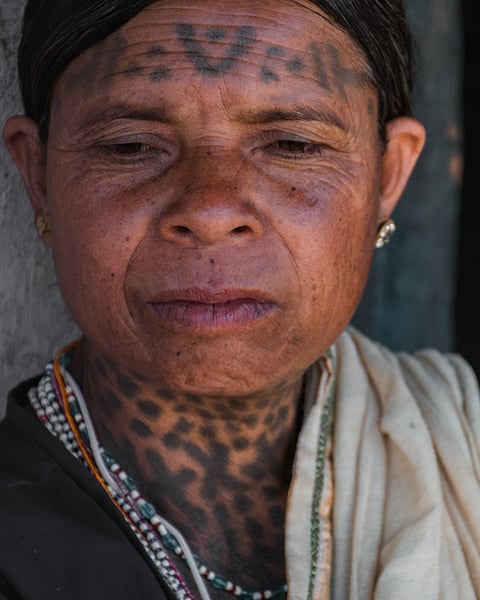
Baiga tribe women in India, known for their art of tattooing or Godna Wikimedia Commons
Godna is more than fashion for the Baiga and Bhunjia of Madhya Pradesh, Chhattisgarh, and Odisha, it serves as a spiritual key to the afterlife; for the Gond, Oraon, and Santhal, it marks clan ties, fertility, protection, and beauty. In Dalit communities such as the Dusadh, Chamar and Mushahar, Godna acted as “permanent jewelry,” a visible claim to dignity and adornment when caste rules barred metal ornaments. Nomadic groups like the Dom, Nat, Badhiya, Bedia, and Kanjar community used it for identity, craft, sisterhood, and resilience, blending survival, resistance, ancestral memory, and sacred tradition.
Missionaries and certain colonial reformers frequently denounced traditional body practices such as Godna as “superstitious” or “backward.” The spread of Victorian ideals of modesty and respectability among urban Indian elites created new social pressures that rendered visible body markings undesirable in mainstream colonial society. These shifts made it increasingly challenging for Indians, particularly those seeking upward mobility to openly maintain such traditions. Nevertheless, rural, tribal, and subaltern communities continued to practice Godna, preserving it as an essential element of their cultural identity.
Advertisement
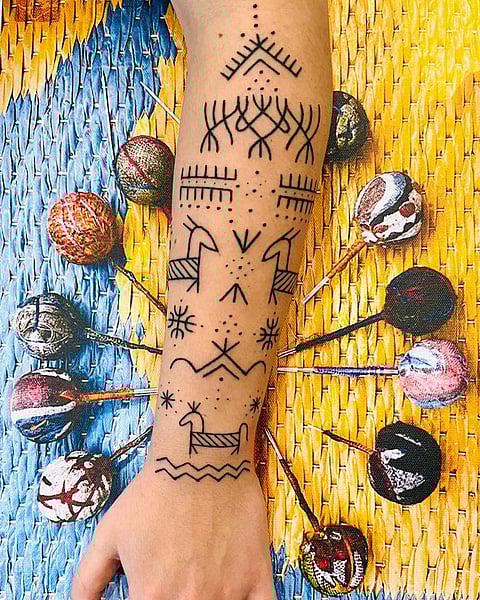
Godna handpoke tattoo bluebloodtreetattoo
Women have always been the heart of the Godna tradition, both as bearers and creators of its motifs. Among Dalit, Adivasi, and nomadic groups, tattooing was often the only adornment permitted to women denied jewellery by caste norms. Each mark for marriage, protection, fertility, or identity became a silent act of defiance, inscribing dignity on their own bodies. Dalit Dusadh women in Madhubani transformed Godna into tattoo painting not merely as decoration, but as deliberate reclamation of autonomy. When barred from sacred images and jewellery, they inscribed their own cultural identity.
The Bhunjia of Odisha and Chhattisgarh use geometric forms like triangles and chevrons for ancestral protection and agricultural harmony. The Gond of Madhya Pradesh, Maharashtra, and Chhattisgarh use peacocks for beauty, tigers for courage, snakes for spiritual safety, and clan markers for identity. The Dusadh of Bihar and Uttar Pradesh favour Mithila-inspired fish for fertility, parrots for love, and village scenes as living adornments. The Oraon of Jharkhand employ fine dots, curved lines, and floral trails to symbolise beauty, womanhood, and forest ties, with V shape forehead marks denoting marital status and sun motifs for protection.
Advertisement
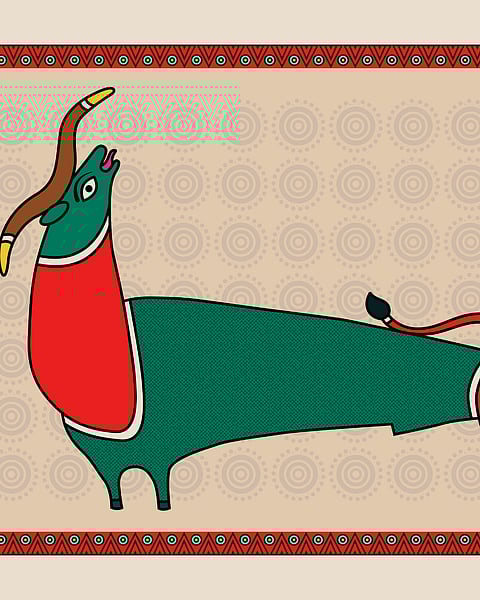
Digital artwork in the style of Gond painting Shutterstock
As the practice of tattooing declined due to caste stigma, modern beauty norms, and health concerns, many Godna artists, especially from the Dusadh community of Bihar, began transferring traditional motifs onto paper and cloth. This shift, popularised in the late 20th century, allowed designs once etched on skin to survive as visual heritage. Using natural pigments and Mithila-style techniques, artists preserved symbolic patterns like fish, parrots, and sunbursts. While not a direct continuation of the ritual practice, Godna painting is now a crucial form of cultural preservation and economic livelihood for marginalised artisans
Common themes of godna painting are fertility (fish, parrots), protection (sun, scorpion, snake), beauty and clan identity (peacocks, animal forms), agricultural life (wheat stalks) and domestic scenes. Motifs remain close to their tattoo origins, retaining ritual and symbolic value even off skin. Artists use handmade paper or cloth, lamp-black or soot, plant extracts, Gobar, turmeric and other natural pigments; brushes are bamboo or twig tools evolved from tattoo instruments. The painting retains the linear, dotted and rhythmic syntax of the hand-poked mark.
Advertisement
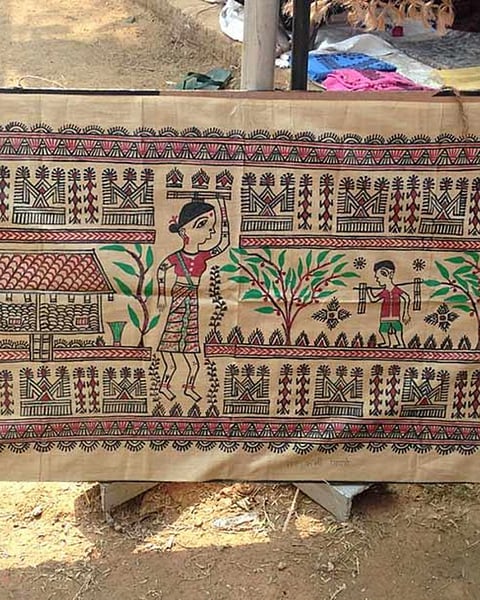
Godna handicraft Indiamart
In modern urban India, a few tattoo artists are working to preserve Godna with new technique while in rural villages traditional practitioners see it as both heritage and livelihood. They face shrinking demand, caste stigma, unsafe conditions, and the erosion of oral knowledge. Many now adapt by transferring motifs to paper or cloth, but with little income or recognition. Since Godna is not formally classified as a craft, government support is rare. Artists call for heritage status, skill training, fair markets, and health assistance.
Published At: