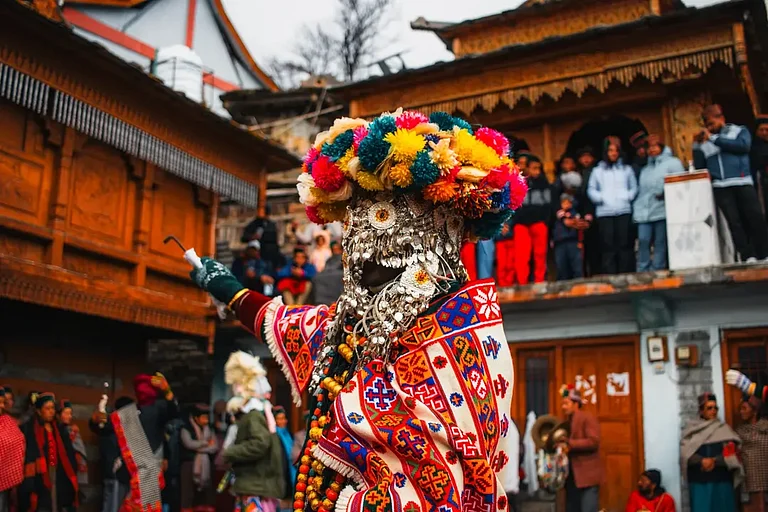
Under a Chhau mask, a dancer can barely see. The eye-holes are narrow, positioned for the character’s face rather than the performer’s, and during a battle sequence—leaping, spinning, dropping into splits mid-air—he is essentially moving on memory and the sound of a dhol (drum), trusting years of drilled choreography over his own eyes. It is one of the odder facts about a dance form that is, at bottom, built on odd, durable choices: performed almost entirely by farmers and labourers rather than professional artists, taught with no script or notation, and staged not in theatres but on open ground at night, under the open sky, during the spring festival of Chaitra Parva.
Bengal’s First Chhau Museum Is Built On A Dance Guru’s Own Backyard
A veteran Chhau guru gave up 1.5 bigha of his family’s land to build it. Two decades of fieldwork by a Kolkata NGO shaped what went inside. West Bengal’s first Chhau museum opened in Purulia on September 1

Advertisement
That tradition, Chhau, danced for generations across Purulia, Seraikela, and Mayurbhanj, now has its first dedicated museum in West Bengal. The Chhau Skill Development Centre and Community Museum opened to visitors in Bamnia, a village in Jhalda-II block of Purulia district, on September 1 this year. How it got built is arguably more interesting than the fact of it: a Chhau guru donated the land it stands on, a Kolkata-based social enterprise spent two decades in the community shaping what went inside, and Coal India’s CSR arm paid for construction.
The Guru Who Gave Away His Land
Binadhar Kumar didn’t have to do this. He’s spent his life as a Chhau performer and teacher in Bamnia, learning the form at 14 from his father and guru, Ramnath Kumar, and later helping develop the Jhalda school of the dance. When the idea of a permanent Chhau centre came up, Kumar and his family handed over 1.5 bigha of their own land to build it, echoing his father, who had donated land for the village school a generation earlier.
Advertisement
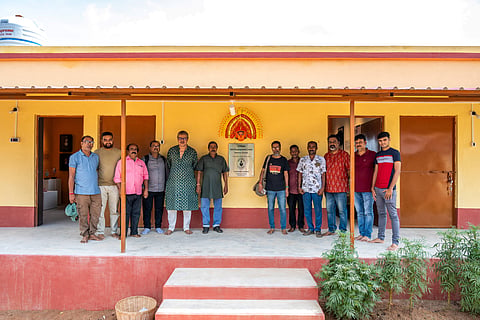
More than 500 Chhau artists and around 20 gurus from Bamnia and nearby villages are part of the community the new centre hopes to support banglanatak dot com
The organisation behind the museum is banglanatak dot com, a Kolkata-based social enterprise that has used culture as a tool for development since 2000 and has been embedded in Purulia's Chhau community since 2004. “We have been working with Chhau since 2004, and based on our two decades of experience, we have developed the community museum here,” founder-director Amitava Bhattacharya told Outlook Traveller.
What’s Actually Inside: Four Genres, One Craft On Display
Walk through the museum, and the point being made is that Chhau isn’t one thing. It separates the tradition into its four regional genres—Purulia, Seraikela, Mayurbhanj, and Kharsawan—each with its own masks, costumes, and instruments.
Purulia Chhau, native to Bamnia, grew out of martial exercises and older folk dances like Paika, Natua, and Nachni; its masks are large and character-specific—a lion mask comes with a lion costume—and the choreography keeps the acrobatics and mock combat of its origins.
Advertisement

West Bengal’s first dedicated Chhau museum has opened in Bamnia, Purulia, documenting the dance’s regional traditions and material culture banglanatak dot com
Seraikela Chhau, from Jharkhand, took a different path under royal patronage, becoming shorter, more lyrical dance-dramas.
Mayurbhanj Chhau, from Odisha, drops masks entirely and relies on facial expression instead. UNESCO added Chhau to its Intangible Cultural Heritage list in 2010, largely because it’s one of the few traditions still taught almost entirely by oral transmission, inside families rather than institutions.
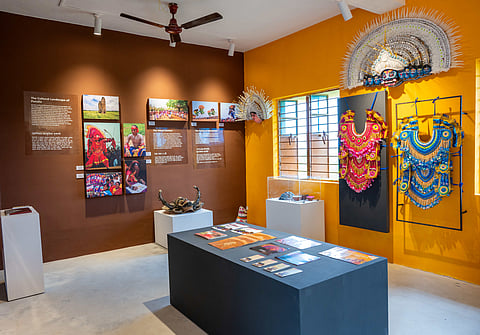
The museum features Purulia, Seraikela, Mayurbhanj and Kharsawan Chhau, showing how the four traditions differ in masks, costumes, instruments and performance banglanatak dot com
The museum also documents how the masks get made—clay, paper pulp, cloth, days of layering and painting—pointing visitors five kilometres down the road to Charida, the “mask village” that has supplied Purulia Chhau’s faces for roughly a century and a half. Around 150 to 300 families still make masks by hand, a craft that won a GI tag in 2018.
Five Hundred Artists, No Fixed Numbers Yet
The centre’s other half is a working training space, and the scale is already there to justify it: Bamnia and its surrounding villages count more than 500 Chhau artists and roughly 20 gurus. Those gurus, not outside instructors, will run the training—technique, repertoire, performance craft—aimed particularly at pulling younger artists in before the older generation ages out, Bhattacharya said.
Advertisement
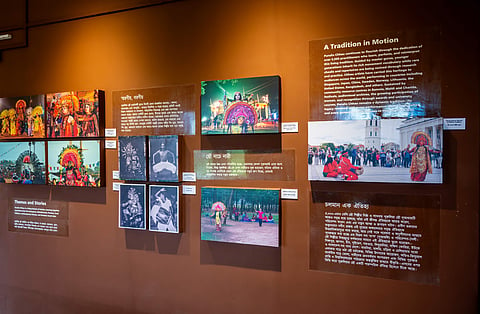
Visitors can also learn how Purulia Chhau masks are made, from clay and paper pulp to the layering, painting and finishing that gives each character its face banglanatak dot com
What doesn’t exist yet is a business plan with numbers attached—no annual training targets, no visitor projections, no job estimates. banglanatak dot com will cover the centre’s running costs itself for two years, using that time to figure out what works before making promises to the community.
Location helps regardless. Thirty seven km from Purulia town, five km from Kotshila, which has a Vande Bharat Express stop, with the Muruguma Dam and Ajodhya Hills nearby. The longer plan links Bamnia, Charida, Muruguma, and Ajodhya into a single circuit, with Bamnia as the first stop, where visitors encounter the dance before moving on to the craft and the landscape. There’s talk too of a digital archive to capture technique and oral histories before the older gurus are gone, and of a running calendar of festivals rather than a building people visit once.
None of it changes what happens on the ground in March, when Chaitra Parva comes around, and the masks come off the museum wall and back onto the dancers’ faces, under the open sky, exactly where Chhau has always belonged.
Advertisement
FAQs
1. Where is the new Chhau museum located?
The Chhau Skill Development Centre and Community Museum is located in Bamnia village in Jhalda-II block of Purulia district, West Bengal.
2. What can visitors see at the Chhau museum in Purulia?
The museum documents the four regional Chhau traditions, their masks, costumes and instruments, along with the process of making Purulia Chhau masks.
3. What are the four types of Chhau featured at the museum?
The museum features Purulia, Seraikela, Mayurbhanj and Kharsawan Chhau.
4. How is the new Chhau centre helping local artists?
The centre provides a dedicated training space where local gurus can teach technique, repertoire and performance skills, with a focus on bringing younger artists into the tradition.
5. Is Chhau recognised by UNESCO?
Yes. Chhau was inscribed on UNESCO’s Representative List of the Intangible Cultural Heritage of Humanity in 2010.
Advertisement
Published At: