In "War and Peace," Leo Tolstoy has French soldiers entering Moscow and encountering kvass, which they refer to as “pig’s lemonade”. More than a century later, the description still captures the strangeness of kvass to anyone encountering it for the first time: a lightly fermented drink made, traditionally, from rye bread or rye flour and malt. It is cloudy, mildly sweet and sour, slightly carbonated and usually contains very little alcohol. But calling it a Russian beer, as it is sometimes described, misses the point. Kvass belongs to a much wider Eastern European drinking tradition, with versions found across Belarus, Ukraine, Russia, Lithuania, Latvia, Estonia, Poland and Finland, among other places. Its history is also a story of making a daily drink from limited grain, turning bread into something that could be fermented, and eventually transforming a household staple into a mass-produced soft drink.
Why Does Eastern Europe Have A Drink Made From Bread? The Story Of Kvass
Made from rye bread or flour and malt, kvass has been brewed across Eastern Europe for centuries. Here’s how this lightly fermented drink evolved from a household staple into a mass-produced beverage

Kombucha Of Eastern Europe?
The easiest way to understand kvass is to begin with what it is not. It is not beer, even though both are grain-based fermented drinks. Traditional kvass is made by steeping rye bread, or a mixture of rye flour and malt, in hot water before fermentation. Yeast and lactic-acid bacteria can be involved, producing a drink in which lactic fermentation is more important than alcohol production. The word kvass itself is connected to an old root meaning “to become sour”, which points towards the drink's defining characteristic.
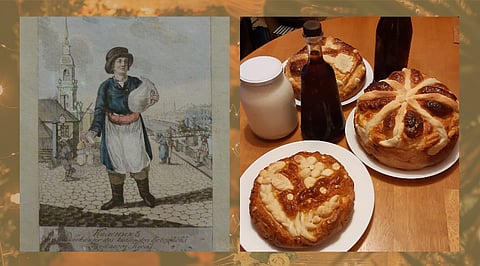
The traditional process is relatively simple. Dried rye bread is soaked in hot water and left for around 12 hours, allowing the liquid to take on its flavour. The bread is then removed, and sugar and yeast are added before another period of fermentation. Another method uses rye flour, rye malt, sugar and baker's yeast. Industrial production follows a more controlled process, using wort concentrate, water and sugar before adding yeast and lactic-acid bacteria cultures. Fermentation generally lasts between 12 and 24 hours.
The result is a beverage that occupies an unusual position between food and drink. Kvass is usually only around 0.5 to 1 per cent alcohol by weight, although some versions can reach higher levels. In Eastern Europe, it has traditionally been treated as an everyday drink rather than an alcoholic beverage, which helps explain why it could be consumed routinely and why it was historically made in large quantities for households, workplaces, armies and hospitals.
Bread is not even the only possible base. Lithuanian gira, one of the names used for kvass, can be made from fermentable ingredients including caraway tea, beetroot juice and berries, although black bread and rye or barley malt remain common. Ukrainian traditions include pear and apple kvass as well as beetroot kvass, the latter also used in cooking. So while “bread drink” is a useful introduction to kvass, it is not the whole story.
The Drink That Turned Bread Into Something Else
The origins of kvass are not settled. It is associated particularly strongly with the Slavic world, but there is no definitive evidence identifying the people who first invented it. What is known is that the drink was established in northeastern Europe by at least the 10th century, and the earliest written reference appears in the Primary Chronicle, a medieval chronicle associated with Kyiv.
The chronicle describes the celebrations surrounding the baptism of Vladimir the Great in 988, when food, mead and kvass were distributed to the people of Kyiv. The location and date matter because kvass is sometimes presented simply as a Russian drink, while the surviving written reference comes from a chronicle written in 12th-century Kyiv describing an earlier event. At that time, Moscow did not yet occupy the historical position it would later acquire.
The reason kvass became so deeply embedded in the region may have had less to do with ceremony than with practicality. Grain production in parts of northeastern Europe was considered insufficient to make beer a daily drink. Beer required a relatively large quantity of grain, whereas kvass could be produced from much less. Rye was particularly important because it was one of the region's major grains and brought considerable flavour even when used in smaller quantities.
This made kvass an efficient way of turning grain and leftover bread into an everyday beverage. A Russian expression, perebivat'sya s khleba na kvas, literally referring to moving from bread to kvass, came to mean living from hand to mouth or scraping by. The expression reflects the drink's association with frugality and the use of stale rye bread.
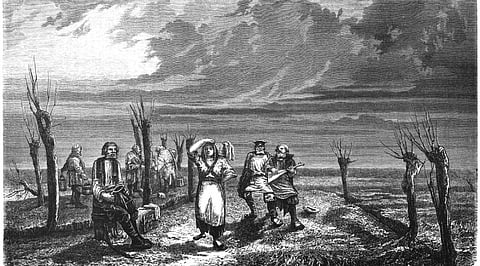
By the 19th century, making kvass remained an ordinary household activity. In Poland, recipes for local versions were often closely guarded by families, religious orders and monasteries. In rural areas, it could be made regularly on farms. The drink was also associated with physical labour: an old Polish folk song describes reapers carrying a piece of bread and a goatskin of kvass into the fields during hot weather.
“A healthy drink has long been renowned:
bread kvass,
a chunk of bread below the armpit,
a goatskin of kvass
and the peasant is ready for the fields.
Into a hot drought.”
From Farm Kitchens To Yellow Street Barrels
Kvass eventually moved beyond the household, and the change was closely connected to industrialisation. During the second half of the 19th century, military activity, industrial growth and projects such as the construction of the Trans-Siberian Railway created demand for drinks that could be supplied to large numbers of people. Commercial production expanded, and more than 150 varieties were recorded, including versions flavoured with apple, pear, mint, lemon, chicory, raspberry and cherry.
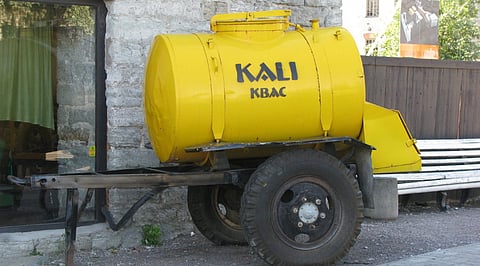
The shift from household production to commercial sales changed how people encountered the drink. Instead of making kvass at home, consumers could buy it from vendors selling it from barrels on the streets. In the Soviet period, the image of kvass became particularly associated with yellow tank wagons dispensing the drink during summer. Factories produced it on a large scale, turning an old fermented beverage into something closer to a mass-market soft drink.
That transformation also altered the taste. Industrial kvass could be heavily sweetened and, according to brewer and researcher Lars Marius Garshol, resemble a rye-flavoured cola. Bottled versions remain widely available across Eastern Europe, while traditional preparations continue to survive in cafés, restaurants, brewpubs and homes.
The story differed from country to country. In Latvia, kvass faced competition from Coca-Cola after the dissolution of the Soviet Union, but bottled local kvass later regained ground, helped partly by its lower price. In Poland, the drink declined with the spread of mass-produced soft drinks and carbonated water before experiencing renewed interest in the early 21st century alongside interest in traditional and natural products. Lithuania continues to serve gira both bottled and on draft, while Estonia knows the drink as kali and Finland has its own related kalja tradition.
FAQs
1. What is kvass?
Kvass is a lightly fermented beverage traditionally made from rye bread or rye flour and malt. It is mildly sweet and sour, slightly carbonated and usually very low in alcohol.
2. Is kvass an alcoholic drink?
Traditional kvass generally contains very little alcohol, usually around 0.5 to 1 per cent by weight, although some versions can have higher alcohol levels.
3. Why is kvass made from bread?
Kvass developed as a practical way of turning rye bread, grain and other ingredients into a fermented everyday drink. Leftover or stale bread could be soaked, fermented and used rather than discarded.
4. Where does kvass come from?
Kvass is associated with Eastern Europe and has long traditions across countries including Russia, Ukraine, Belarus, Lithuania, Latvia, Estonia and Poland. One of the earliest written references appears in the Primary Chronicle in connection with celebrations in Kyiv in 988.
5. Is kvass the same as beer?
No. Although both are fermented grain-based drinks, traditional kvass has much less alcohol and involves significant lactic-acid fermentation. It is generally treated as a soft or everyday beverage rather than beer.