Kingfishers flew across the Tungabhadra and perched on a telegraph line nearly as high as the tip of the northern gopuram of the Virupaksha Temple. The sound of Sanskrithymns washed across the outlandish landscape that surrounded the sacred centre of Hampi, as I sat by the river bank waiting for the sun to rise. A chattering crowd slowly gathered near the ghat on the other side of the river. I gazed atthe line of the crowd until my eyes were arrested by the sight ofa moving boulder in the river. Peering at it intently, I suddenly realisedthat the rather curiously-shaped rock was actually an elephant, the sacred Lakshmi.
Karnataka The Elephants of Hampi
The Vijayanagara empire's totemic elephants are the cornerstone of Hampi's art

Advertisement

Lakshmi is the star-attraction of the Virupaksha Temple. I'd met her a few days earlier under not-so-happy circumstances inside the temple precincts, as she stood inside a pavilion clearly too small for her blessing a never-ending line of delighted devotees with her tired trunk. I watched her now as she made her way to the middle of the river with the mahout on her back. Hazy images of statues, carvings and temples whirledthrough my mind, eliciting memories of the past few days that I had spent in Hampi.

As I stood on the southeastern slope of the Hemkuta hill, scanning the giant statue of Sasivekalu Ganesha, my eyes settled on the snake carved around the distinctly over-indulged belly of the elephant god. The belly signified the Vijayanagara empires wealth and prosperity whereas the snake around it was probably meant to be a subtle reminder of the knowledge and wisdom that co-existed with it. The pavilion around the statue had beenbuilt much later, in 1505 CE, by a trader from Chandragiri, in modern Andhra Pradesh, in memory of Narasimha II of the Saluva dynasty.
Advertisement

Further up, to the north of the hill, I encountered a remarkable hall filled with pillarsthat stood out amongst the other structures. The long, svelte granite pillars of the hall were crawling with intricate carvings of Vishnus dashavatara. Inside this hall was another colossal monolithic sculpture of a rotund Kadalekalu Ganesha. The belly of this statue waschiselled to resemble a Bengal gramhence the name, kadalekalu. As I made my way to the royal enclosure, I came across another elaborate structure with eleven beautifully carved domes. Thisused to house the Elephant Stablesafine specimen of Indo-Islamic architecture and also a beautiful reminder of the harmony that existed in the cosmopolitan environs of the empire. Specially built for the royal elephants, under each of these domes wasa chamber large enough to accommodate two elephants comfortably. Each chamber was connected to the adjoining one with an arched doorway big enough for a mahout to enter and exit. The ceiling of every chamber wasmeticulously carved with designs so beautiful that were I a royal elephant in those days Id sure have developed an eye for art.
Advertisement
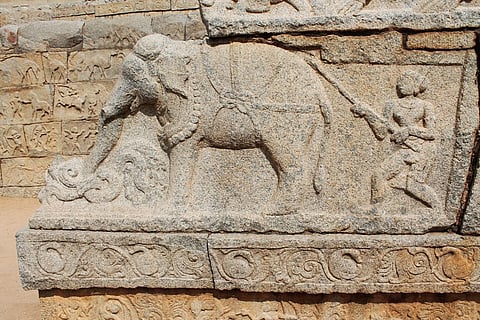
Abd-al-Razzaq, the Persian traveller who visited Vijayanagara in the 1440s, had recordedelaborate descriptions of these elephants. Theywere supposed to have been the largest of the thousands owned by the royal family. He even wrote ofa magnificent white elephant which was led out before the monarch every morning as the sight of it was meant to be a happy omen. He described, in detail, how the royal elephants were fed khichri laden with butter twice a day and the punishments that theking meted out to mahouts for the smallest of mistakes. Razzaq also gave a detailed account of how elephants were captured and tamed to be drafted inthe royal army.The Mahanavami Dibba, unlike other structures in Hampi, does not seem to bemuch of an architectural marvel from afarjust another platform, slightly taller than the restin the royal enclosure. But on closer inspection it proves you wrong. Covered from top to bottom with figures in carved in relief, the level of intricacy ofthe carvings that cover the platform is astounding. Musicians, dancing girls, hunters, traders, birds and the many elephants are so beautifully rendered that you can tell the exact expression on the face of even the smallest carving. This platform, a stunning specimen of the level of sophistication present in the craftsmanship of those days, was the centre of the Mahanavami festival, a major celebration throughout the empire. It was from here that the king and his court watched the proceedings of the three-day festival unfold and it is quite evident from the carvings on the base of the platform that elephants, again, were an indispensable part of the festivities.
Advertisement

Razzaq, in his memoirs, writes of aremarkablespectacleduring the extravagant festival. In pursuance of the kings orders, all the generals and other personages from all over the empire would gather at the palace, sometimes travelling for aslong as three months, just to get here in time for the festival. With them they brought thousands of elephants, who were assembled in front of the castle, their curvaceous backs resembling the waves of a troubled sea. Covered in beautiful armour and decked up to their trunks in jewels of all colours, these majestic beasts carried on their backs make-shift castles, equally magnificently adorned. In them were placed jugglers, dancers and performers of all kinds.
The elephant, I realised, somehow stood out as a significant totemic symbol of this erstwhile empire whose beating heart lay right here, on the southern bank of the Tungabhadra. It was, in fact, the backbone of Vijayanagaras flourishing culture, befittingly acknowledged in stone. As the rising sun reflected on the river, turning it tangerine, the sudden explosion of colours in the skypink, orange and goldenpulled me out of my reverie. The kingfishers flewoff their line and disappeared behind the temple. I watched Lakshmi as she flung the stick-wielding mahout off her back, and plopped down in the river, soaking herself in the waters of the Tungabhadra,a melancholic metaphor of the glorious days that once were.
Advertisement
Published At: