For centuries, people have walked up Yamunachala hill in Maharashtra’s Dharashiv district to visit Tulja Bhavani Temple in search of strength and reassurance. Regarded as one of India’s most revered Shakti Peethas, the temple is dedicated to Goddess Bhavani, a reincarnation of Goddess Parvati. Established in the 12th century by Mahamandaleshwara Māradadeva of the Kadamb dynasty, it has, over time, become a place people turn to in times of illness, uncertainty, and some of life’s most difficult moments.
Tulja Bhavani Temple In Tuljapur: Exploring One of Maharashtra’s Most Powerful Shakti Peethas
Discover Tulja Bhavani Temple in Tuljapur, one of Maharashtra’s most revered Shakti Peethas, where centuries of legend, ritual and Maratha history converge.

Advertisement
The Origin Of Shakti Peethas
Shakti Peethas are among the most sacred pilgrimage sites in Hinduism. The word 'Shakti' means power, while 'Peetha' refers to a sacred seat. Together, these terms describe shrines where divine feminine energy is believed to reside. As Hindu mythology tells it, the Shakti Peethas trace their origin to the sacrifice of Goddess Sati, who gave up her life after her father insulted her husband, Lord Shiva. Stricken by grief, Shiva carried her remains across the universe. His cosmic dance, known as the Tandava, threatened to disrupt the balance of existence. To restore harmony, Lord Vishnu intervened, wielding his Sudarshan Chakra, a divine spinning discus symbolising cosmic justice and righteousness. Using it, he dismembered Sati's body; the pieces fell to earth at various locations. These sanctified places became the Shakti Peethas.
The Three And A Half Shakti Peethas Of Maharashtra
Traditionally, there are 51 recognised Shakti Peethas, though some scriptures note 52, 64, or 108. These sacred sites are spread across India and neighbouring regions, including Nepal, Bangladesh, Pakistan, and Sri Lanka.
Advertisement
Among these, the Three-and-a-Half Shakti Peethas of Maharashtra are especially revered. The three full Peethas are Mahalakshmi Temple in Kolhapur, Tulja Bhavani Temple in Tuljapur, and Renuka Devi Temple in Mahur, while the fourth, considered a ‘half’ Peetha, is the Saptashrungi Temple in Vani near Nashik.
Tulja Bhavani Temple: A Brief History
According to legend, the origins of Tulja Bhavani Temple date back to the story of Anubhuti, a devoted woman who performed penance on Yamunachala hill. When the demon Kukur tried to disturb her, she called upon Goddess Bhavani for protection. The goddess appeared, destroyed the demon, and restored peace. Because of her swift arrival, she was named Tvarita, meaning ‘the fast one,’ which later became Tulja. This event established the hill’s sacred status and marked the beginning of Tuljapur as a centre of Shakti worship.
Over the centuries, this sacred space grew into a major temple under the Kadamba dynasty in the 12th century. It survived turbulent times, including invasions by the Delhi Sultanate. One of the temple’s most unusual features is the nature of the goddess herself. Unlike most temple idols that remain fixed, Tulja Bhavani is considered a chala deity. Her black stone, eight-armed idol, is moved from its throne several times a year. This tradition reflects the belief that the goddess actively watches over and protects her devotees.
Advertisement
The temple’s historical meaning deepened through its bond with Chhatrapati Shivaji Maharaj. He believed Tulja Bhavani was not just a goddess but the spiritual guardian of his mission. According to legend, she appeared to him and gifted him the Bhavani Talwar, a sacred sword symbolising divine approval of his struggle for Swarajya, or self-rule. Over time, Tuljapur became closely tied to the Maratha spirit of courage and resistance. Even today, rituals such as the Palang Seva, where the goddess is ceremonially put to rest, and the sacred waters of Kallol Tirth keep these traditions alive. These rituals link the world of warrior history with everyday devotion.
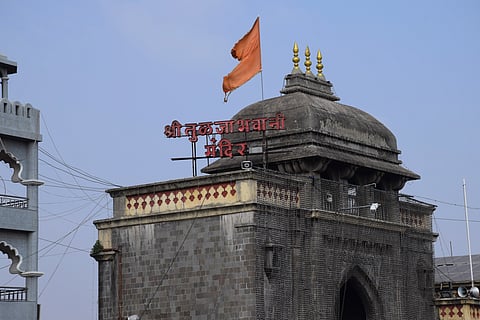
Ancient black stone façade of Tulja Bhavani Temple, Tuljapur Shutterstock
Things To Do And See At The Tulja Bhavani Temple
The Temple Architecture And Complex
Tulja Bhavani Temple is built in the Hemadpanti style, a 12th- to 13th-century Indian architectural style famous in Maharashtra. The grand Sardar Nimbalkar Gate marks the entrance, opening into a complex that feels both fortified and sacred. Intricate stone carvings reflect the craftsmanship of ancient artisans, and the elevated location adds to the temple’s commanding presence.
Advertisement
The Sanctum And Idol Of The Goddess
At the heart of the temple lies the sanctum sanctorum, housing the three-foot-tall idol of Goddess Bhavani. Carved from black stone and believed to be swayambhu, or self-manifested, the goddess is depicted with eight arms holding weapons, and one hand raised in abhayamudra, offering protection and fearlessness. The idol’s expression is calm yet powerful, leaving a lasting impression on devotees.
Daily Rituals And Sacred Traditions
The day begins with Kakad Aarti in the early hours. Rituals such as Abhishek, Naivedya, and Oti Bharan continue throughout the day. A unique tradition is the Gondhal, a devotional folk ritual performed by families and newlyweds seeking blessings.
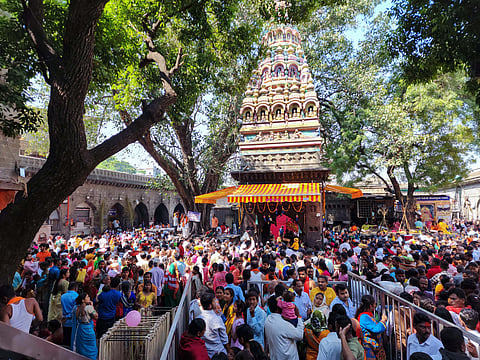
Devotees inside Tulja Bhavani Temple during the festive season in Tuljapur Shutterstock
Navratri And Festival Energy
Navratri is the most important festival at Tuljapur. For nine nights, the temple becomes the spiritual epicentre of the region, drawing thousands of devotees. The air fills with chants, music, and devotion. Other festivals such as Kojagiri Purnima, Gudi Padwa, and Makar Sankranti are also celebrated with equal devotion.
Advertisement
Nearby Attractions
Pandharpur
A visit to Tuljapur is often paired with Pandharpur Temple, one of Maharashtra’s most important pilgrimage towns. Dedicated to Lord Vithoba, Pandharpur is renowned for its Wari procession and devotional culture.
Solapur Fort
History enthusiasts can explore Solapur Fort, a testament to the region’s strategic importance and history. Its massive walls and expansive grounds offer insight into centuries of rule and resistance.
Naldurg Fort
For a quieter, scenic experience, Naldurg Fort combines history with natural beauty. Surrounded by water and open landscapes, it offers a reflective break from the intensity of pilgrimage crowds.
How To Get To Tuljapur Bhavani Temple
By Air
Pune International Airport (PNQ) is the closest major airport, about 293-300 km away. Solapur Airport (SSE) is closer at 50-52 km, but offers limited regional flights.
By Train
The closest railway stations are Osmanabad (Dharashiv) and Solapur. Both are well-connected to cities across Maharashtra and neighbouring states. Solapur has better connectivity to major cities like Mumbai, Pune, and Hyderabad, making it a more common choice for long-distance travellers. From these stations, you can take buses and taxis to reach your destination.
Advertisement
By Road
Tuljapur is well-connected by road to Solapur (about 45 km) and Dharashiv (about 25 km). Maharashtra State Road Transport Corporation buses run regularly, and private taxis are a convenient option.
Local Transport
Auto-rickshaws and local taxis are commonly used within Tuljapur. App-based cab services are limited.
Best Time To Visit
Tulja Bhavani Temple is open year-round, but the most pleasant time to visit is between October and February, when the weather is cooler and ideal for temple visits. Navratri, celebrated in September and October, offers the most striking spiritual experience, though it attracts large crowds. Summers can be extremely hot, making early morning or evening visits preferable.
FAQs
1. Why is Tulja Bhavani Temple considered a major Shakti Peetha?
Tulja Bhavani Temple is believed to be one of the places where the divine energy of Goddess Shakti resides, making it one of Maharashtra’s three-and-a-half Shakti Peethas.
2. Who is Goddess Tulja Bhavani associated with historically?
Advertisement
The temple is closely linked to Chhatrapati Shivaji Maharaj, who regarded Goddess Bhavani as his spiritual guardian and symbol of Swarajya.
3. What makes the idol at Tulja Bhavani Temple unique?
Unlike most temple idols, Goddess Tulja Bhavani is a chala deity, meaning the idol is ritually moved several times a year as part of temple traditions.
4. When is the best time to visit Tulja Bhavani Temple?
The most pleasant time is between October and February, while Navratri offers the most vibrant spiritual atmosphere despite heavy crowds.
5. How can travellers reach Tuljapur?
Tuljapur is accessible by road from Solapur and Dharashiv, with the nearest major railhead at Solapur and the closest airport at Pune.
Published At: