Italy possesses a wealth of historic architecture. But determining appropriate uses for these structures after their original functions have ceased presents a significant challenge. Throughout the country, monasteries no longer accommodate monastic communities, convents remain vacant, and the maintenance costs of historic buildings continue to rise. Some are converted into museums, which preserve their narratives but often render them static. Others are neglected and fall into disrepair.
Restored Umbrian Monastery Turns Into One of Italy’s Most Unique Boutique Hotels
A 12th-century monastery in Umbria has found a new purpose as Vocabolo Moscatelli, a boutique hotel that balances heritage conservation, contemporary design, and sustainable hospitality while offering travellers an immersive stay steeped in history

Advertisement
However, sites such as Vocabolo Moscatelli demonstrate an alternative approach, where history is not merely preserved as a static exhibit but is actively integrated into a new functional context.
Situated in the hills of Umbria near the medieval town of Umbertide, the boutique hotel occupies a former 12th-century monastery. While it now accommodates travellers rather than monks, the building retains a strong connection to its historical origins. The thick stone walls, aged timber beams, and terracotta brickwork continue to shape the guest experience. These historic spaces now serve as settings for leisurely breakfasts, afternoons in the garden, and evenings with Umbrian wine, rather than for religious observance.
This transformation contributes significantly to the site's appeal.
From Monastery To Boutique Hotel
The monastery stood for nearly 800 years before falling into disuse. Once occupied by monks from nearby Gubbio, it retained much of its original character despite years of neglect, including a small chapel, stone masonry, and traditional timber construction.
Advertisement
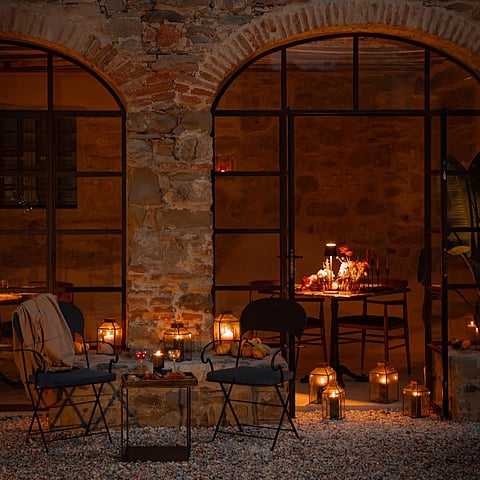
Thoughtful design highlights the architectural features Instagram: @vocabolo_moscatelli
In 2019, hospitality professionals Frederik Kubierschky and Catharina Lütjens, who first met while working at the Park Hyatt Zurich, purchased the abandoned complex. Their vision wasn't to create another countryside luxury resort, nor was it to restore the monastery as a historical exhibit. Instead, they wanted an intimate hotel where guests could experience the building as a living place rather than a preserved monument.
After an 18-month restoration project, Vocabolo Moscatelli reopened with just 12 rooms, each featuring a personalised design. Some retain vaulted ceilings and exposed stone walls; others open onto private balconies or feature outdoor soaking baths overlooking the Umbrian countryside. The adults-only policy, with guests aged 14 and above permitted, reinforces the sense of calm, preserving the monastery's contemplative atmosphere.
The hotel is distinguished by its demonstration that historical structures can remain relevant through continued everyday use.
Rather than covering ancient walls with polished luxury, architect Jacopo Venerosi Pesciolini of Archiloop kept the building as the focal point. Original masonry, timber beams, and historic floors have been carefully preserved, while contemporary Italian furniture, sculptural lighting, and understated interiors create a dialogue across centuries. Nothing feels overly restored or artificially aged. Instead, the design accepts that the building has lived many lives and is now beginning another.
Advertisement
This design philosophy is evident in the smallest details. Handcrafted iron beds from the Umbrian workshop Lispi, ceramics by Cotto Etrusco, and works by contemporary Italian artists reinforce a sense of place without resorting to decorative clichés. The restaurant adopts a similar approach, offering seasonal Umbrian cuisine prepared with local ingredients, while regional wines, produce, and ingredients from the gardens further connect the dining experience to the surrounding landscape.
The sustainability story is equally understated. Adaptive reuse is one of the most environmentally responsible forms of hospitality. By restoring an existing structure rather than constructing a new one, the project conserves materials, reduces waste, and preserves traditional craftsmanship that might otherwise disappear. Here, sustainability is embedded in the building's very existence rather than added as an afterthought.
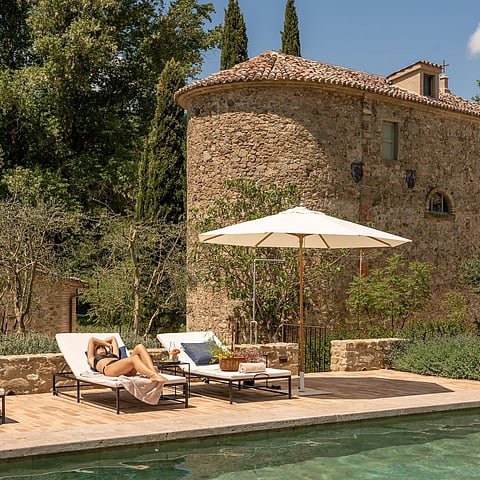
Reinvention without losing the original charm makes it unique Instagram: @vocabolo_moscatelli
The Fine Line Between Restoration and Reinvention
Restoring a heritage building is rarely a simple task. An excessive emphasis on historical preservation can result in a building that functions as a museum, admired yet detached from contemporary life. Conversely, overly aggressive modernisation may obscure the building's original identity beneath new design elements.
Advertisement
Vocabolo Moscatelli achieves success by avoiding both extremes of preservation and modernisation.
The hotel does not attempt to recreate an idealised medieval monastery, nor does it conceal its historical character with modern luxury. Instead, it recognises the ongoing evolution of buildings. The exposed stone walls visibly reflect their age, contemporary furnishings are integrated harmoniously, and modern amenities are incorporated without dominating the architectural features.
This underlying philosophy asserts that authenticity arises from allowing historic buildings to evolve while maintaining respect for their existing features.
It is a philosophy increasingly visible across Italy. In Trentino, Monastero Arx Vivendi transformed part of a 17th-century monastery into a contemporary hotel while deliberately distinguishing new architectural additions from the original structure. In Piedmont's Langhe region, Borgo Monchiero Heritage adapted an 18th-century monastery into a boutique stay by preserving its original proportions and materials. Though each project interprets adaptive reuse differently, they share a common belief that heritage survives best when it remains in active use.
Advertisement
What Vocabolo Moscatelli Says About The Future Of Heritage
For travellers, Vocabolo Moscatelli provides more than exceptional accommodation; it presents an alternative perspective on heritage.
Historic buildings are frequently appreciated only from a distance, with visitors admiring façades, reading informational plaques, and then departing. Residing in a restored monastery alters this dynamic. Guests sleep beneath beams that have supported the structure for centuries, traverse corridors shaped by previous generations, and spend time in spaces originally intended for contemplation. In this context, history becomes an immersive experience rather than a passive observation.
Having received One MICHELIN Key, Vocabolo Moscatelli is recognised as one of Umbria's most distinctive boutique hotels. Its significance, however, extends beyond hospitality. The project demonstrates that conservation does not necessitate preserving a building in its original state; in some cases, the most effective means of safeguarding history is to allow for adaptation.
FAQs
1. What is Vocabolo Moscatelli?
Vocabolo Moscatelli is a boutique hotel in Umbria, Italy, housed within a restored 12th-century monastery. The property combines historic architecture with contemporary Italian design while preserving much of its original character.
Advertisement
2. Where is Vocabolo Moscatelli located?
The hotel is situated in the Umbrian countryside near the medieval town of Umbertide, making it an ideal base for exploring central Italy.
3. Why is Vocabolo Moscatelli significant?
The hotel is an example of adaptive reuse, where a historic monastery has been thoughtfully restored into a modern hospitality space without compromising its architectural heritage.
4. Has Vocabolo Moscatelli received any awards?
Yes. Vocabolo Moscatelli has been awarded One MICHELIN Key, recognising it as one of Italy's outstanding boutique hotels for its exceptional hospitality and distinctive character.
5. What makes Vocabolo Moscatelli different from other heritage hotels?
Rather than recreating a museum-like atmosphere, Vocabolo Moscatelli allows guests to experience a living historic building through sensitive restoration, contemporary interiors, local craftsmanship, and a strong commitment to sustainability.
Published At: