Beyond Noosa’s beaches, surf breaks, and restaurants lies a unique landscape, a network of freshwater lakes, wetlands, forests, and waterways that stretches from the upper Noosa River towards the coast. Known as the Noosa Everglades, the system extends for about 60–65 kilometres and forms part of the 85,000-hectare Noosa River catchment. Its waters move through forested headwaters, freshwater lakes, and estuarine wetlands before eventually reaching Laguna Bay and the Coral Sea.
Noosa Everglades: Explore Australia’s River Of Mirrors
The Noosa Everglades is more than the famous “River of Mirrors”: it is a connected catchment of lakes, wetlands, forests, and waterways that reveals another side of Queensland’s Noosa region

Advertisement
The Noosa Everglades is often described as one of only two Everglades systems in the world, with the other one being Florida’s Everglades. There is no formal definition or officially mapped boundary for an “Everglades”; at the core of it is a connected, low-gradient landscape in which water links freshwater wetlands, lakes, floodplains, estuaries and the sea. By that definition, the Noosa River catchment functions as a single hydrological system rather than a collection of separate scenic spots.
A Landscape Defined By Water
The defining feature of the Noosa Everglades is its interconnectedness. Water moves gradually from the forested upper catchment into Lake Cootharaba, through Lake Cooroibah and the lower estuary, towards Lake Weyba and Laguna Bay. The freshwater becomes brackish and eventually meets saline coastal waters. This creates a continuum of habitats, from upland forests and melaleuca wetlands to freshwater lakes, mangroves, and coastal wetlands.
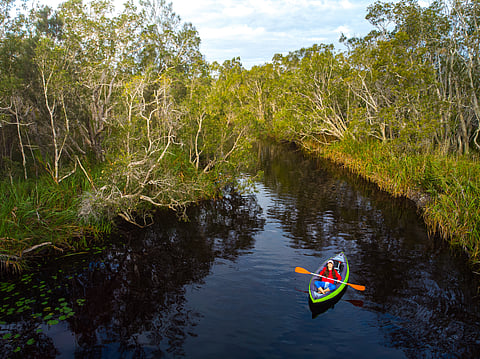
Head out kayaking and explore on your own Shutterstock
That is also what brings in the comparison with Florida’s Everglades. Both systems are characterised by low-gradient terrain and the slow movement of water across a broad landscape. In Noosa, the individual lakes and waterways are therefore part of a larger ecological network. The health and character of one section are connected to what happens elsewhere in the catchment.
Advertisement
Why The “River of Mirrors” Matters
The upper reaches are probably the most recognisable part of the Noosa Everglades. Here, the water is often remarkably still, reflecting the surrounding tea-tree forests and vegetation. This is the section that popularised the “River of Mirrors” description and, historically, the informal use of the term “Everglades”. Boat tours from Tewantin to the upper Noosa River introduced visitors to this landscape before the broader catchment came to be described as an Everglades system.
Over time, however, the idea expanded. From the 2010s, tourism bodies increasingly used the description “one of only two Everglade systems in the world”. By 2018–2020, the emphasis had shifted towards understanding the Everglades as a connected system encompassing the upper catchment, river and major lakes rather than just the mirrored upper river.
A Wilderness That Is Accessible
Despite its relative remoteness, the Noosa Everglades is easy to reach. The main access points for kayak and boat tours include Boreen Point and Elanda Point, while the area can also be reached from Noosa as a day trip. From Noosa Heads, the gateway is roughly 20–40 minutes away, depending on the access point.
Advertisement
The simplest way to understand the landscape is from the water. Guided boat tours offer a slower introduction to the wetlands, while canoes and kayaks allow visitors to move into narrower sections of the river. Experienced paddlers can also hire kayaks and explore independently. Early mornings are particularly suited to paddling, when the water is still and wildlife activity is higher.
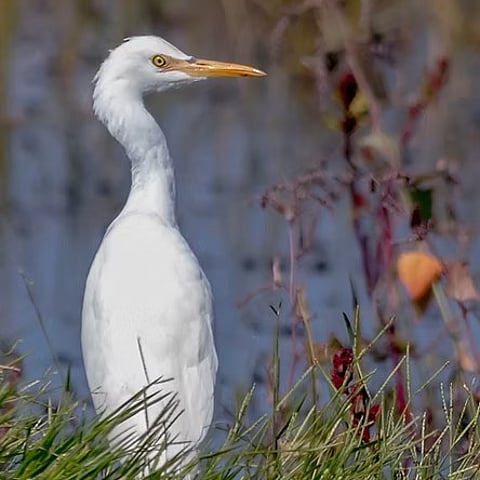
Cattle Egret standing beside a wetland pond The Noosa Everglades
The area is also significant for birdlife. More than 40 per cent of Australia’s bird species are found in the region, including pelicans, cormorants, sea eagles, ospreys, jabirus, and glossy black cockatoos. Around 65 per cent of the catchment lies within national parks, while the wider landscape extends across the Noosa and Great Sandy UNESCO Biosphere Reserves.
Staying Close To The Water
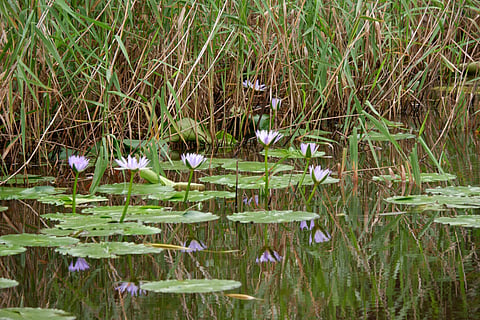
Water lilies Shutterstock
The Everglades can be explored in a few hours, but staying nearby enhances the experience. Habitat Noosa, on Lake Cootharaba, offers camping and glamping options, and serves as a departure point for tours. Boreen Point has lakeside campsites, while Harry’s Hut provides a more basic bush-camping experience deeper within the Everglades although this requires permits. Alternatively, travellers can stay in Noosa and make the Everglades a day trip.
Advertisement
A visit to the Noosa Everglades is ultimately less about ticking off individual sights than understanding how they make up a vast ecosystem. Whether seen from a kayak, a boat or a campsite beside the river, the Everglades complement Noosa’s better-known coastal attractions.
FAQs
1. What are the Noosa Everglades?
The Noosa Everglades are a network of freshwater lakes, wetlands, forests and waterways forming part of the 85,000-hectare Noosa River catchment in Queensland, Australia.
2. Why are the Noosa Everglades called the “River of Mirrors”?
The upper Noosa River is known for its exceptionally still water, which reflects the surrounding tea-tree forests and vegetation, creating a mirror-like appearance.
3. How do you explore the Noosa Everglades?
The Everglades can be explored by guided boat tours, kayaks and canoes. Visitors can also camp near the waterways or visit as a day trip from Noosa.
4. Where are the Noosa Everglades located?
The Noosa Everglades are in Queensland, Australia, within the wider Noosa River catchment. Boreen Point and Elanda Point are among the main access points.
Advertisement
5. Can you stay in the Noosa Everglades?
Yes. Accommodation options include camping and glamping at places such as Habitat Noosa, lakeside camping around Boreen Point and bush camping at Harry’s Hut with the required permits.

Published At:
Tags