If “The Odyssey” has made you fantasise about ancient Greece, its seafarers and the ships that carried them across the Mediterranean Sea; there is something extraordinary waiting beneath those waters. More than 2,000 metres below the surface of the Black Sea, roughly 50 miles off the Bulgarian coast, lies a Greek merchant ship that has been there for about 2,400 years. You cannot dive down to see it. In fact, nobody has. But remotely operated vehicles have captured how the ship is still recognisable in its original form, with its mast, rudders and rowing benches surviving on the seabed.
A Greek Ship From The Age Of Plato Still Rests Beneath The Black Sea
More than 2,000 metres below the Black Sea, an ancient Greek merchant vessel has survived for millennia thanks to the oxygen-free waters surrounding it

Advertisement
Below roughly 150 metres, the Black Sea has almost no oxygen. This creates a strange underwater dead zone where many of the organisms responsible for breaking down wood simply cannot survive. So while an ancient wooden ship would normally disappear over time, this one has remained well preserved in the darkness. It is, in effect, a time capsule created not by human hands but by the chemistry of the sea.
A Sea With A Dead Zone
The Black Sea is the largest body of permanently anoxic (completely lacking oxygen) water on the planet. Its unusual chemistry begins with the way its waters are layered. Freshwater from rivers including the Danube and Dnieper floats above denser, saltier water that enters from the Mediterranean. Because these layers barely mix, oxygen from the surface does not make its way down into the depths.
The transition happens at roughly 150 to 170 metres. Around this level, researchers have found a belt of sulphur bacteria, while the deeper water is dominated by hydrogen sulphide, the compound associated with the smell of rotten eggs. Below the boundary, the environment becomes hostile to many of the organisms that normally live around and feed on shipwrecks. That includes wood-boring molluscs and many of the bacteria that would ordinarily help digest a wooden hull.
Advertisement
The Ship That Time Forgot
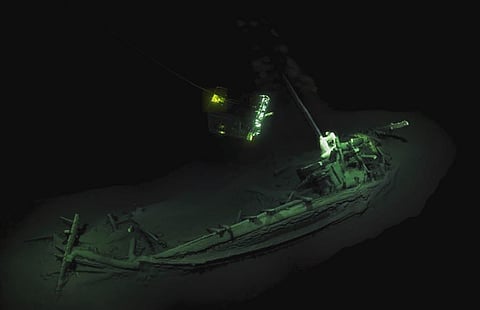
The image of the Greek vessel obtained by remote imaging Instagram: @pictures_in_history
The vessel was discovered during the final season of the three-year Black Sea Maritime Archaeology Project. In 2017, researchers using remotely operated vehicles found it lying on its side more than two kilometres beneath the surface, around 50 miles off the Bulgarian coast. The discovery was announced publicly on October 23, 2018.
A small sample of wood taken from the vessel was radiocarbon dated to around 400 BCE, placing the ship in the Classical Greek period, around the time of Plato and Aristotle. The wooden vessel is about 23 metres long, or roughly 75 feet. Its mast is still standing. Its twin steering rudders remain in place. The benches where rowers once sat can still be recognised in the remotely operated vehicle footage.
The ship lies on its side, settled into the seabed. Looking at the footage, it seems strangely less like a wreck and more like a ship that was simply left there. In fact, in a crossover of archaeology and mythology, the ship resembles vessels shown in ancient Greek pottery, including the famous Siren Vase in the British Museum. That vase depicts Odysseus tied to the mast of a ship to resist the Sirens' songs. The wreck has a similar general design, giving researchers an actual surviving vessel with which to compare those ancient representations.
Advertisement
It Is Not The Only Ship Down There
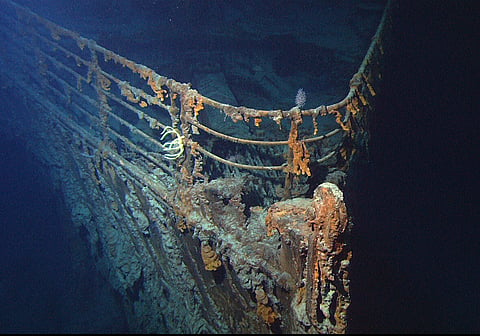
The anoxic zone prevents decay of the wood (representational) Unsplash
The 400 BCE Greek merchant vessel may be the oldest intact shipwreck documented in the Black Sea's anoxic zone, but it is far from the only wreck waiting beneath the surface. The Black Sea Maritime Archaeology Project mapped around 60 wrecks off the Bulgarian coast. They range across centuries, from Roman trading vessels carrying amphorae to a 17th-century Cossack raiding fleet. Some of the details recorded include rigging still coiled and cargo still lying where it was placed.
These wrecks are more than archaeological curiosities. A shipwreck can preserve traces of how people travelled, what they traded and how they built their vessels. Ancient maritime archaeologists can study surviving objects to understand the societies that produced and used them. Organic material is particularly valuable because it normally has a short archaeological life. Wood, fabric and bone decompose easily, especially in oxygenated marine environments. When they survive, researchers can potentially use techniques such as radiocarbon dating to establish their age.
Advertisement
FAQs
1.Where is the 2,400-year-old Greek shipwreck?
The ancient Greek merchant ship lies more than 2,000 metres beneath the Black Sea, roughly 50 miles off the Bulgarian coast.
2. How old is the Greek shipwreck in the Black Sea?
Radiocarbon dating of a wood sample places the vessel at around 400 BCE, making it roughly 2,400 years old.
3. Why is the ancient ship so well preserved?
The wreck lies in the Black Sea's deep, oxygen-free waters, where many organisms that normally break down and consume wood cannot survive.
4. Can people dive to the ancient Greek shipwreck?
No. The wreck lies more than two kilometres below the surface, far beyond the depth accessible to conventional divers. Researchers studied it using remotely operated vehicles.
5. What is unusual about the Black Sea's deep water?
Below roughly 150–170 metres, the water becomes largely anoxic, meaning it contains very little or no oxygen. This unusual environment helps preserve organic archaeological material.
Advertisement
Published At: