I saw my first wild tigers way back in 1974 in Madhya Pradesh’s recently declared Kanha Tiger Reserve. Travelling alone, two OM camera bodies and a full set of Zuiko lenses in tow, I landed up in Kanha from Bombay and was met at the Jabalpur railway station by the late Bhagwan Rekwar of Shakti Travels, who drove me straight to the Kanha Forest Bungalow. There, he left me in the care of 27-year-old Manglu Baiga, saying, “You are going to spend a week with one of the best wildlife people in the world.”
Tigers, The Wild, And A Lifetime In India’s Forests
A lifelong journey through India’s predator landscapes, from tiger forests and leopard country to the villages that continue to live with, tolerate and protect the wild

Advertisement
How right he was. Sipping tea on the steps of the Kanha Forest Rest House before dawn with Manglu, I heard him whisper, “Bagh aaya raat ko” (the tiger came last night). Instructing me to ditch the tea, he walked me to the waiting elephant, where I clambered on, while he walked ahead, searching for tiger spoor in the dim light of dawn. Once in a while, I could swear he seemed to be sniffing for tiger scent.
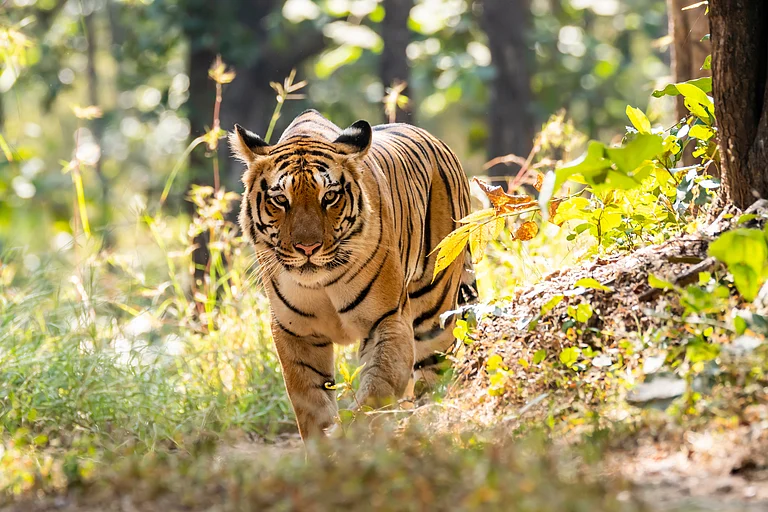
After 30 minutes of slow searching, Manglu, now sitting with me atop the elephant, pointed to a beautiful tigress reclining in a bamboo grove, her subadult cubs playfully rough-housing in a nearby dry streambed. And I was hooked. Within minutes, as we turned to leave the tigers to their own devices, Manglu whispered for the mahout to stop. Thirty metres away, a magnificent male tiger, father of the cubs, threw us a snarl, warning us to keep our distance. Barely breathing, I shot off a few frames. “All I want to do with my life is to protect you and your jungle home,” I said to the tiger family under my breath. And that, virtually, is all I have done ever since.
Advertisement
I saw no other tourists in Kanha. No entry tickets. No formalities. Just a quick signature in the Guest Register, plus a nominal payment for the room, and a pittance to the caretaker for a week of delicious, woodfire-cooked vegetarian meals. Not surprisingly, with conversation flowing freely, Manglu and I became lifelong friends.
This was way before the age of cell phones, and my wife Madhu was understandably unhappy when I announced that I would be vanishing into a “forest where tigers lived outside cages,” leaving her with our three-year-old daughter Miel in tow, and our second daughter, Tara, on the way. And yet, today, almost all our family holidays are taken in wild places.
Into The Wild
Back then, domestic wildlife tourism was virtually non-existent. Those who visited Kanha, Bandhavgarh, Ranthambhore, Bandipur and Manas were largely shikaris, biologists, wildlife photographers and foreigners. Today, domestic tourists far outstrip overseas visitors.
Advertisement
Sanctuary Asia magazine played a role in this shift, thanks to the late Fateh Singh Rathore, Field Director of Ranthambhore, who persuaded me to launch the magazine and later to produce 30 Hindi wildlife documentaries for Doordarshan in the mid-1980s, reaching 30 million future wildlife enthusiasts across India.
The real gift of India’s wild places is not just an animal appearing on a forest track. It is the oneness with nature that eludes most in urbania
Sensitively implemented tourism is undoubtedly a conservation tool. But I have no illusions. “In season,” the best of our wildlife destinations are hopelessly overcrowded. The experiences I had in the early years of my wildlife evolution are not what visitors get today.
Even when India’s forests were extensive, and human populations were lower, tigers, leopards, elephants and more clashed with humans. But it is far worse now. The price farmers and locals pay for their proximity to wildlife destinations barely makes the news, even when they lose prize bulls or an entire year’s harvest to tigers, elephants or wild pigs in a night.
Advertisement
The Forest Edge
This is a key conservation issue today, as is the extirpation of forests for monetary gain. The old idea that wildlife survives only inside protected areas, while people live outside them, has given way to a far messier reality. Tigers, leopards, elephants, rhinos and snow leopards are forced to move through landscapes dotted with villages, farms, roads, pilgrim destinations, tea gardens, orchards, army posts and, yes, some very noisy tourist lodges. In Maharashtra, leopards live in sugarcane fields and forest edges around places such as Junnar and Nashik. In Assam, rhino, elephant, and tiger landscapes abut villages, highways and floodplains. In Ladakh and Himachal, snow leopards and herders are often at odds with each other.
Little wonder that, as they fight for their very existence, villagers take to using homemade bombs, snares and weapons of all descriptions to supply poaching gangs with animals that regularly raid their food sources. On a daily basis, Sanctuary Asia magazine receives endless communications from people who send us mixed bags of good, bad and ugly human-animal interrelationship stories. Yet, some years ago, a leopard fell into a well in Nashik, Maharashtra. The spotted cat miraculously survived for 30 hours until a successful rescue operation was launched by forest officials, who were helped by the very farmers who often lost livestock to leopards.
Advertisement
Large carnivores prefer to avoid humans because of a natural fear of the ape that walks. But while healthy forests can provide carnivores with food, shelter and isolation, such forests are unfortunately targeted by coal mines in Chandrapur, iron ore mines in Goa, and highways, roads and dams almost everywhere. It hardly helps that the political system has increasingly begun to categorise lands that do not yield measurable, quick economic returns as “wastelands.” And when these lands are converted to non-forest use, the animals living inside have little option but to stumble into conflict when they are forced out in search of water, food and shelter.
Such conflicts won’t ever vanish, but India has begun to build responses to them. Compensation and ex gratia systems, however imperfect, attempt to address death, injury, crop and livestock losses. Local trackers and community volunteers are often the first to respond when a leopard or tiger strays near a settlement. In some landscapes, tourism-linked livelihoods have altered attitudes. Snow leopards that once represented only livestock loss now generate income through homestays, local guiding and provisioning during winter wildlife tourism. Responsible lodges exist, and drivers, trackers, naturalists, staff and provisions do come from villages. But nature tourism has much ground to cover before it can claim to be “responsible” as an industry.
Advertisement
That said, India is vastly more tolerant than the Industrial North. In Saurashtra, leopards and lions are welcome in fields at night because the predators keep crop-eating herbivores at bay. In Rajasthan’s Bera hills, leopards boost village incomes. We in India should celebrate the tolerance and reverence our people have for nature, even when deer and monkeys raid their fields. But celebration is not enough. Tourism must help alleviate such problems, working with advocacy organisations such as the Responsible Tourism Society of India, Travel Operators for Tigers and lodge owners willing to share their revenues with villages, not as charity, but as partners who can help enhance tourism experiences in “Carnivore Country.”
The “I want only to see a tiger” lot misses the larger story. The real gift of India’s wild places is not just a charismatic animal appearing on a forest track. It is the oneness with nature that eludes most in urbania. Outside our wilds, however, it is still the negotiations that unfold every day at forest edges, in fields, orchards, villages and high pastures, where people and large animals are learning, uneasily but remarkably, to occupy the same country.
Advertisement
Looking for more such exciting and meaningful stories? Grab our issue on Amazon.
Published At: