It was our tenth kilometre of the day, and the second round of gashti—a term local forest guards use for patrolling the jungle. The morning round had already been an exhausting six kilometres. Now with the afternoon sun weighing heavily over a rain-soaked Pench National Park in Madhya Pradesh, the forest had turned into a sweltering, humid cauldron. Each step forward was a struggle—slippery leaves underfoot, tangled shrubs above ground, and the air thick with the smell of damp earth and decay. My arms were scratched from the dense foliage, and at times, the forest guards had to hack through overgrowth with axes to clear a path.
On The Frontline: A Glimpse Into The Lives Of India's Forest Guards
Inside the lives of India’s forest guards, whose daily duties blur the line between survival, service, and sacrifice

Advertisement
Suddenly, a voice rang out through the underbrush: “Saab, yaha par keel hai.”
Our small group—two forest guards, four support staffs, and me, a city-bred outsider—perked up. The word “keel” (kill) hinted at a fresh discovery, one that could potentially reveal the recent presence of a big cat. Pench, after all, is prime tiger country—its rugged sal and teak forests inspired Rudyard Kipling's "The Jungle Book" (1894), and the spirit of Shere Khan still lingers in these woods.
We followed the voice, weaving through thick vegetation for about 30 seconds before we arrived at what was once a magnificent male sambar deer. Its antlers and legs were all that remained. The rest of its body had been devoured—most likely by a tiger, not more than three or four days ago. For a moment, I was frozen. The forest guards, however, sprang into action with efficiency. One took out his phone to log the incident. Another relayed the update over a walkie-talkie. Meanwhile, I stood awkwardly, trying not to gag at the overpowering stench and the swarm of flies that clung to the air like static.
Advertisement
Sensing my discomfort, one of the guards turned to me with a wry smile: “This is one of the easier days. At least the tiger finished most of the meat. Had it left the intestines behind, you wouldn’t have been able to tolerate it.”
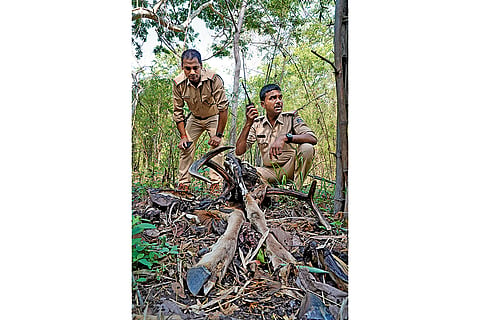
Forest guards discover a sambar kill | Photo: Suresh K. Pandey
I managed a weak smile in response. Clearly, I was out of my depth. These men, on the other hand, walked this path daily—not just physically, but psychologically. Life, death, decay—nothing was hidden in the forest. “It must have dragged the sambar from here,” another guard pointed to a slope where the shrubs had been partially uprooted. We moved a few metres ahead, and a sharp, acrid smell hit us again.
“That’s tiger urine,” the guards said casually. “He might still be nearby.”
That was our cue to retreat. The sun was dipping below the canopy, and the forest was beginning to awaken in its nocturnal glory—rustling leaves, distant calls, invisible eyes. We walked another three kilometres before arriving at the forest rest house—an old British-era structure from 1903, now serving as a modest place to stay.
Advertisement
As I waved goodbye to the guards, they said, “Subah chhe baje milte hai. Gashti ke liye taiyar rahiyega.” (Let’s meet at six am. Be ready for patrolling.)
I nodded, waved back, and stepped into my room—just as the electricity went out. The caretaker knocked gently on my door. “Sir, khana kha lijiye. Bahar mat nikliyega—andhera hai, light bhi nahi hai. Koi jaanwar aa gaya to pata bhi nahi chalega.” (Sir, have your dinner. Don't go outside—it's dark, and there's no light. If an animal comes, you won't even realise it.)
These men walked this path daily—not just physically, but psychologically. Life, death, decay—nothing was hidden in the forest.
“You bet I won’t,” I muttered to myself.
After a quick meal, I lay down in the heat, the fan motionless above. But through the open windows, a breeze filtered in—carrying the smells and sounds of the forest. Sleep eventually came, interrupted by half-dreams of the sambar's final moments, its neck in the jaws of a tiger, each breath shorter than the last.
Advertisement
I was in Sakata village, in the Ari Range (Buffer Zone) of the Pench National Park, to understand the often overlooked lives of India’s forest guards—those who stand on the frontlines of conservation, yet remain invisible in most public discourse. Their daily risks are echoed in grim global data. According to the International Ranger Federation (IRF), which represents park rangers and wardens worldwide, India loses more forest rangers annually than any other country. Between 2012 and 2017, the country accounted for nearly 31 per cent of global ranger fatalities—162 out of 526. The trend has continued. From June 2022 to May 2023 alone, over 40 Indian rangers were killed while on duty.
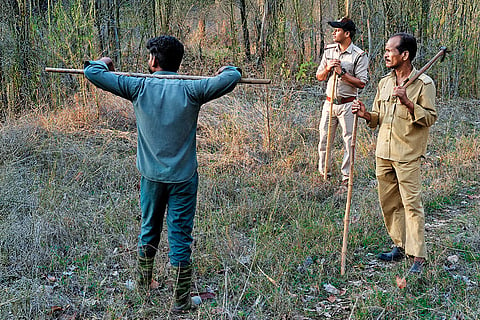
Choudhery (middle) has been a forest guard for nine years | Photo: Suresh K. Pandey
“An analysis of line-of-duty deaths from 2006 to 2021 shows that, on average, two rangers die each week globally, with Asia reporting the highest casualties. However, India’s higher numbers are more due to better reporting systems and a larger workforce, rather than the country being more dangerous,” said Rohit Singh, Vice President of the IRF. Singh also pointed out that 34 per cent of rangers in Asia, Africa, and Latin America lack essential skills to perform their duties—this figure is even higher in India, at 45 per cent.
Advertisement
“While India has one of the most robust ranger training systems globally, the real challenge lies in reaching temporary and support staff. This gap needs stronger collaboration between conservation organisations and government departments,” he added.
These statistics reflect harsh realities on the ground. During my time in Pench, what stood out was how forest guards and support staffs operate round-the-clock, patrolling dense forests on foot, frequently without backup or protective gear. Despite being tasked with protecting forests and wildlife, they work in dangerous conditions with minimal support and little recognition.
The next day began on a far more dramatic note than I’d anticipated. After waking up and getting ready, I walked over to forest guard Pankaj Choudhery’s quarters, only to find the door locked and the place deserted. I waited outside for a while, puzzled, until the rest house manager informed me that Choudhery had been called away by his seniors at 3 am for an emergency tiger rescue.
Advertisement
I immediately recalled the news I’d heard upon arriving in Pench: a tiger had mauled a villager to death, and tensions were running high. The villagers were furious, demanding retribution and vowing to kill the tiger. That’s what had prompted the urgent call—and why Choudhery and several of his colleagues had been dispatched to rescue and relocate the animal.
“We began the rescue at five in the morning,” Choudhery, 30, told me later that evening. “The tiger had entered a canal, which made it difficult to tranquilise him. That’s why the operation lasted till almost four pm. Police had to be deployed just to manage the crowd so that the situation didn’t become volatile.”
“After killing the man, the tiger didn’t return to the forest,” he continued. “Instead, it started roaming near the village. Human-animal conflict is a challenge here and it has become more frequent in the past three or four years. The populations of both humans and tigers have increased—and they’re both competing for space. Incidents like this are the result.”
Advertisement

Lalit Salame, a Suraksha Shramik, changes out of his uniform after work | Photo: Suresh K. Pandey
However, this is only a part of the challenge. Tension escalates during the tendu leaves (used to wrap bidi) collection season, when locals, despite repeated warnings, continue to enter the forest. These intrusions often result in dangerous confrontations with wildlife—a situation that Choudhery and his team, who are responsible for managing roughly 10 sq km of forest, must constantly navigate. "The biggest challenge is getting people to understand the importance of protecting wildlife and the forest," he said. "Locals here view the forest as their property, which complicates efforts to manage human-wildlife conflicts."
Choudhery’s day usually starts early with a six to seven kilometre patrol through the forest, followed by an afternoon of logging sightings and filing routine updates. An evening patrol rounds out his daily routine, but beyond this structure, no two days are the same. Whether it's coordinating road repairs, overseeing the digging of water trenches, responding to late-night emergencies, or monitoring forest fires, the job demands constant adaptability. “We have to be ready for anything,” he said. “It’s not always about routine—it’s about responding to whatever the forest throws at us.”
Advertisement
One of those challenges includes dealing with human threats to wildlife. While large-scale poaching is rare in Pench, smaller hunting attempts persist. Traps and live wires remain a threat, especially during the monsoon. “People sometimes target chital (spotted deer) and wild boar for food,” he said. “Each time we stop a hunt, it’s a small win that makes a big difference.”
Despite the many challenges, Choudhery earns around Rs 34,000 a month after nine years on the job—hardly enough for such demanding and risky work. Still, he continues without hesitation.
“Earlier, the forest was no more than a picnic spot for me,” he said. “But once I took on this role, it became a responsibility. My thinking changed—and so did my attitude toward the animals and the land.”
Thud..thud..thud…the rhythmic strike of axe against wood echoed through the forest, cutting through the stillness of the humid afternoon. I stood nearby, sweat-soaked and weary, waiting for the path ahead to be cleared. A massive tree had fallen across the muddy trail, halting our evening gashti entirely. Four men worked tirelessly, heaving their axes with all the strength they could muster, chipping away at the obstacle before them.
Advertisement
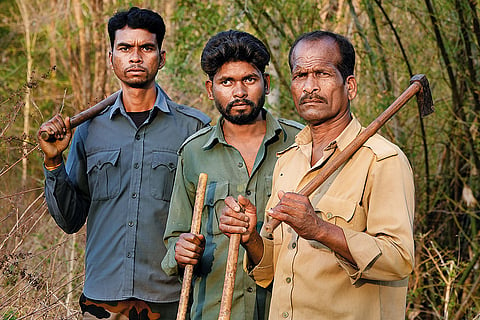
Dhurve (middle), a Suraksha Shramik | Photo: Suresh K. Pandey
These were not forest guards or uniformed officials, but Suraksha Shramiks—local villagers hired to support the forest department. They occupy the lowest rung in the hierarchy, yet shoulder some of the most physically demanding and thankless work on the ground.
While the lives of forest guards rarely come into public view, those of Suraksha Shramiks are even more invisible. And yet, their role is critical. With a deep understanding of the landscape, animal movement, and the rhythms of the forest, they form the backbone of field operations.
This reliance on support staff like Suraksha Shramiks has grown over time, particularly as India’s network of Protected Areas (PAs) has expanded—from just five national parks in the 1970s to over 100 today. With a persistent shortage of trained, permanent frontline workers, many parks now depend on these skilled or semi-skilled workers.
Reliance on support staff like suraksha shramiks has grown over time as India’s network of Protected Areas has expanded
Advertisement
Fulbhan Dhurve is one of them. Working alongside forest guard Choudhery, Dhurve quickly stood out—lively, mischievous, yet deeply committed to his work. It was he who discovered the sambar carcass in the forest just the day before. With a squint, old scars on his face, and a weathered toughness, he seemed cut from the very fabric of the forest.
“I’ve been doing this job for the past 10 years,” said 29-year-old Dhurve, as he slashed through thick shrubs with his axe to clear a path for us, moments after clearing the fallen tree. “We do everything—from patrolling with the guards to clearing roads to digging trenches and cutting grass. We do most of the physical labour.”
A decade ago, Dhurve was hired for a short-term summer position tackling forest fires, or agni suraksha. “If you perform well, they keep you on,” he explained. “For four years, I worked those four-month stints, earning Rs 5,000 per month. That was Rs 20,000 a season.”
Eventually, he was hired as a Suraksha Shramik and now earns about Rs 10,500 a month after EPF deductions. “How much gets deducted, I don’t know,” he laughed. “I guess I’ll find out when I’m old.”
As we wrapped up our gashti for the day, we sat on a log near the rest house, the sun now a molten orange, casting its glow through the trees. Dhurve spoke about his family—his mother, wife, and infant daughter—who lived some 25 km away. He visited when he could, though the job rarely allowed for it.
“It’s not enough,” he said, referring to his salary. “Whatever I earn goes into food and necessities.” He paused, then added, “I couldn’t study much, but I want my daughter to. That’s all I really want now.”
So why does he keep doing this thankless job when there might be better-paying work out there, I asked. He gave a half-smile, the kind that says everything and nothing all at once. “Majboori hai, sir. What else can I do—you tell me?”
I had no response. Some questions don’t have answers. All I could manage was a quiet “hmm” as the forest began to slip into dusk.
Published At:
Tags