In a quiet, sunlit art room at a Tibetan institute in Sarnath, Mr Choegyal sits cross-legged on the floor, his back perfectly straight. His eyes remain fixed on a sheet of white silk stretched tightly over a wooden frame. Holding a brush as fine as a single eyelash, he carefully places a tiny drop of crushed turquoise pigment onto the canvas. Around him, colourful Thangkas (sacred scroll paintings) hang silently on the walls, their intricate gold detailing shimmering softly in the afternoon light.
Inside The Ancient Art Of Thangka Painting In Sarnath
Discover the history, symbolism, and spiritual significance of Thangka painting, the sacred Tibetan Buddhist art preserved in Sarnath and beyond

Advertisement
The word Thangka literally translates from Tibetan as a scroll painting that can be rolled and carried. For centuries, these portable masterpieces have served as spiritual narratives depicting the life, teachings, and philosophical traditions of the Buddha. They represent a rich artistic lineage that stretches across centuries, from the ancient murals of the Ajanta caves to the rich artistic traditions of Himalayan monasteries and the remarkable murals painted by Japanese artist Kosetsu Nosu within Mulagandha Kuti Vihar in Sarnath.
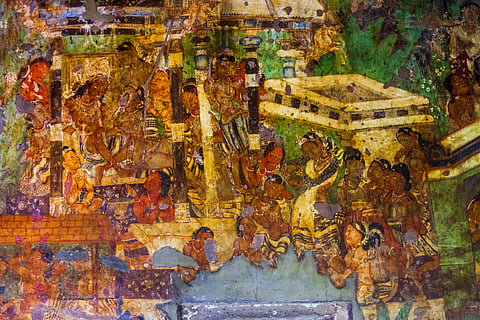
An ancient buddhist painting at the Ajanta Caves Shutterstock
More than mere decoration, a Thangka serves as a bridge to the divine. Monks, pilgrims, tourists, and practitioners contemplate these highly detailed images as part of meditation and spiritual reflection, using them to explore deeper meanings within the Dharma. Every figure, posture, and symbol carries layers of meaning that guide the mind toward contemplation and inner awareness.
History, Exile, And A New Home
The evolution of Thangka painting carries strong artistic and philosophical influences from ancient India's great Buddhist centres, such as Nalanda and Vikramashila universities. Travelling monks journeying through the mountain passes between India and Tibet carried these lightweight scrolls alongside sacred scriptures. They became ideal teaching companions for a nomadic tradition, enabling spiritual teachers to explain complex ideas to communities where written texts were not always available.
Advertisement
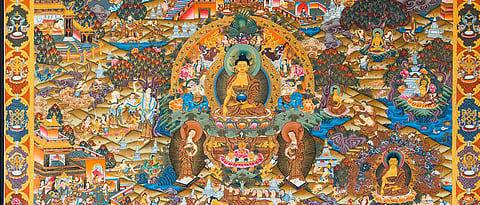
A thangka showing the life of Buddha Deposit Photos
Following the Tibetan exile of 1959, thousands were forced to leave their homeland and seek refuge elsewhere. Still absorbed in his work, Mr Choegyal shares a quiet reflection: "When Tibetans came to India, they could not bring everything with them, but they carried their traditions and memories. India became a place where this art could survive and continue to flourish. Today, we continue teaching younger generations so that our heritage remains alive."
India offered sanctuary not only for displaced people but also for the preservation of artistic and spiritual traditions. Institutions in places like Sarnath continue to safeguard this heritage for future generations.
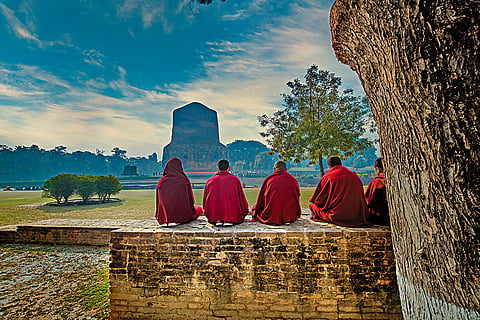
Buddhist monks in prayer near the Sarnath Stupa in Varanasi, Uttar Pradesh Shutterstock
Beyond Art: The Spiritual Discipline Of Thangka Creation
Creating a Thangka is an act of spiritual discipline rather than an expression of individual artistic freedom. Artists follow precise and ancient systems of proportion and symbolism that have remained unchanged for centuries.
The process begins with the careful preparation of silk or cotton cloth, followed by the creation of an exact geometric framework that determines the iconographic proportions of sacred figures. Once the initial sketch is complete, artists apply natural pigments traditionally made from crushed minerals such as lapis lazuli, turquoise, and cinnabar. Fine details are then enhanced with liquid gold.
Advertisement
Every colour and gesture forms part of a silent symbolic language. The meditation posture (Dhyana Mudra) signifies inner balance and concentration, while figures such as Avalokiteshvara remind practitioners of compassion toward all sentient beings. Once completed, the scroll is placed within a rich brocade border and consecrated through prayers by lamas, transforming it from a work of art into an object of devotion.

An artist working on a Thangka painting Deposit Photos
Beyond Monuments: The Living Spirit Of Buddhism
Today, the art of Thangka painting continues to be preserved across Himalayan regions, including Nepal, Bhutan, and several parts of India. Yet Sarnath remains one of its most meaningful sanctuaries, the holy place where Lord Buddha first turned the Wheel of Dharma through the Dhammacakkappavattana Sutta. Within institutions such as the Central Institute of Higher Tibetan Studies, young students continue learning these ancient techniques, ensuring that the chain of artistic and spiritual knowledge remains unbroken.
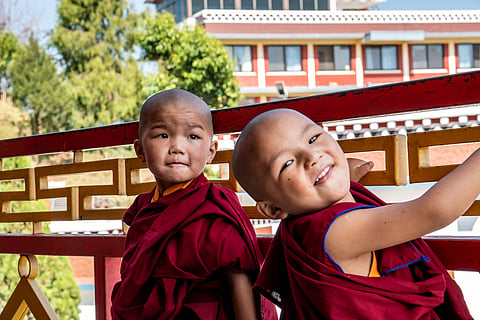
Child monks at the Namo Buddha Monastery, Nepal Shutterstock
As the evening light slowly fades across Sarnath, the delicate gold lines on a newly painted Thangka continue to glow. Beyond the ancient stupas and monuments of the Buddhist Circuit, these sacred scrolls remind visitors that Buddhism does not survive only in stone structures and archaeological remains. It continues to live quietly, in monastery halls, in the patient hands of artists, and in traditions carried faithfully across generations.
Advertisement
Sangye Thrinley works as a Buddhist expert for the Uttar Pradesh tourism department.
FAQs
1. What is a Thangka painting?
A Thangka is a traditional Tibetan Buddhist scroll painting that depicts deities, Buddhist teachings, mandalas, and spiritual narratives used for meditation and religious practice.
2. Why are Thangka paintings important in Buddhism?
Thangkas serve as visual aids for meditation, teaching, and spiritual contemplation, helping practitioners understand Buddhist philosophy and symbolism.
3. Where did Thangka painting originate?
Thangka painting developed in Tibet but draws significant influence from ancient Indian Buddhist centres such as Nalanda and Vikramashila, along with Himalayan artistic traditions.
4. What materials are used to create a Thangka?
Traditional Thangkas are painted on cotton or silk using natural pigments derived from minerals such as lapis lazuli, turquoise, and cinnabar, often enhanced with gold detailing.
5. Where can travellers see authentic Thangka paintings in India?
Sarnath, Dharamshala, Ladakh, Sikkim, and several Himalayan Buddhist monasteries are among the best places to experience authentic Thangka art and learn about its spiritual significance.
Advertisement
Published At: