Anyone who has attended a Tamil Brahmin wedding will remember the colour and commotion: jasmine woven into hair, silk catching the light, relatives calling instructions across the mandapam, priests chanting above the music, and children darting between rows of chairs. It can all seem gloriously chaotic. Yet beneath the noise, each ritual turns an idea about marriage into something visible, playful and easy to remember.
From The Latest Issue: Of Fire And Flowers
From an umbrella-bearing groom and a flower-decked swing to seven shared steps and a final look at the stars, a Tamil Brahmin wedding turns marriage into theatre, memory and celebration

Advertisement
This is only one among India’s countless wedding traditions, and customs vary across regions and communities. What remains fascinating is how the ceremonies draw everyone into the performance. Families laugh, tease, sing and bless the couple, so that the wedding becomes not just a solemn rite but a shared theatre.
The transition begins even before the couple meets at the mandapam. During the vratam, the bride and groom separately mark the end of one stage of life and prepare to enter another. Sacred threads may be tied around their wrists, while a day before the main wedding ceremony, married women sow nine kinds of grain in small earthen pots during ankurarpanam. By the wedding day, the seeds begin to sprout. Amid the silk and festive excess, those modest pots offer a quiet reminder that a household, like a seed, needs patience, nourishment and care.
The ceremony soon becomes more theatrical with the Kashi yatra, my favourite ritual. The groom appears dressed like an ascetic, carrying a walking stick and an umbrella. He announces that he is leaving for Kashi to pursue learning and a life of renunciation. Of course, he rarely gets very far. The bride’s father steps in, persuades him to choose the life of a householder, and offers his daughter’s hand in marriage. Relatives cheer and make sure the runaway groom does not escape too easily.
Advertisement
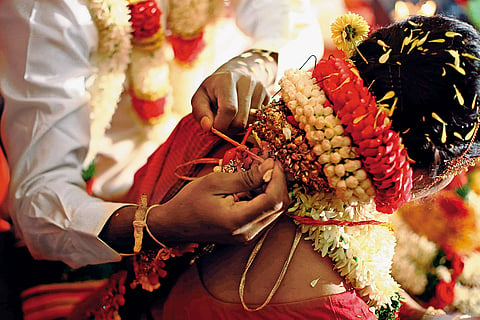
The groom ties the thali (mangalsutra) around the bride's neck during a Tamil wedding Shutterstock
The humour makes the ritual memorable, but the idea beneath it is simple. The groom pauses at the threshold and chooses responsibility, family and companionship over a solitary life. The umbrella becomes more than a prop. It marks the mock-heroic final journey of the bachelor before he returns to the mandapam.
From this public drama, the mood softens with the oonjal. The bride and groom sit side by side on a decorated wooden swing while women sing traditional songs and relatives gather around. In some families, coloured rice balls or ceremonial offerings are circled around the couple to ward off the evil eye. The swing moves and the couple is expected to remain composed together.
To me, it is one of the most elegant metaphors in the wedding. Fortune changes, moods shift, and families experience both celebration and difficulty. The couple cannot control every movement beneath them, but they can learn to remain steady with each other. It is also one of the few moments when the pace slows. The older women sing, the couple sits close, and the two families begin to look less like separate camps and more like one gathering.
Advertisement
What stays with me is the act itself. Marriage is imagined not as a single declaration, but as a movement towards a common future, one deliberate step at a time
The mood lifts again with the exchange of garlands. What should be a simple act often turns into a playful contest, with relatives lifting the bride and groom so that neither can place the garland too easily. Each family tries to outwit the other, laughter breaks through the formalities, and the mandapam briefly feels like a schoolyard. Eventually, both garlands are exchanged, and the game ends in mutual acceptance.
That lightness matters. Weddings can become overwhelmed by expectation and ceremony. The garland exchange restores a youthful element to the occasion and reminds everyone that companionship must include friendship and humour.
The rituals then become quieter and more focused. In kanyadaanam, the bride’s father places her hand in the groom’s, often pouring water over their joined hands. The moment is sometimes understood simply as “giving away” the bride, but its emotional force lies in the visible transfer of trust and responsibility. The sacred fire is lit nearby, with agni invoked as witness as the couple moves from family ritual into shared vows. Offerings of ghee are made into the flames, binding the ceremony to ideas of protection, continuity and the creation of a new household.
Advertisement
The most important shared movement comes with the saptapadi, when the couple takes seven steps together around the fire. The verses are intricate, but their concerns are recognisably human: food, health, strength, prosperity, happiness, family welfare, harmony through changing seasons and lasting companionship.
What stays with me is the act itself. Marriage is imagined not as a single declaration, but as a movement towards a common future, one deliberate step at a time. The seventh step seals the bond as one of friendship, a companionship in which neither walks behind the other.
After the intensity of the mandapam, the ceremony may end by turning the couple’s attention outwards. During arundhati and dhruva darshanam, they are led outside and asked to look towards the night sky. Dhruva, the Pole Star, represents steadiness, while Arundhati and Vashistha are remembered as symbols of companionship. After hours spent looking at priests, relatives, flames and each other, the bride and groom finally look up. Their private commitment is placed against a much larger sky.
Advertisement
Perhaps that is why these customs endure. They speak through objects and actions anyone can understand: a thread, a seed, an umbrella, a swing, a garland, joined hands, seven steps and a star. Together, they turn marriage into a journey the entire family can witness.
A Tamil Brahmin wedding may be noisy, crowded and full of interruptions. Beneath the exuberance is a sequence of gestures that repeats the same lesson: choose each other consciously, nurture what you begin, remain steady when life swings, keep humour alive, accept responsibility, and continue walking side by side.
Looking for more such exciting and meaningful stories? Grab our latest issue on Amazon.
Published At:
Tags