The Lotus Mahal in Hampi, India, stands as an architectural masterpiece revered by historians. Its name derives from its resemblance to a lotus flower, and it is located within the Zenana Enclosure, an essential area in Hampi's historical context. Contrary to the name's implications of a pleasure pavilion, it is believed that the pavilion served as a meeting place for the emperor and his closest advisors, often referred to as a "council chamber" on early maps of the site dating back to 1799.
All About Lotus Mahal In Hampi, Karnataka
The Lotus Mahal, also referred to as Kamal Mahal or Chitrangi Mahal, is a historic palace that dates back to the Vijayanagara Empire. An important remnant at the Hampi Heritage Site in Karnataka, it is known for its stunning architecture

Advertisement
Architecture
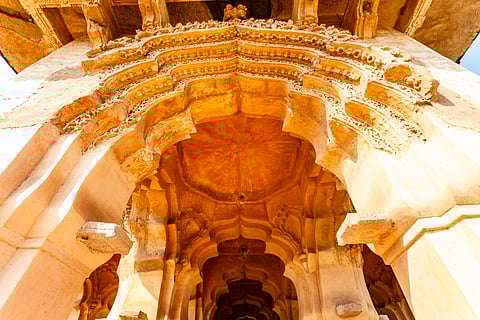
The architectural design of the Lotus Mahal sets it apart from other prominent structures in Hampi. Its structure illustrates the Vijayanagara courtly style, skillfully blending temple-like elements such as curved eaves and pyramidal towers with sultanate influences seen in lobed arches and plaster designs.
Positioned in the northeast corner of the Royal Centre, the Lotus Mahal stands within a high-walled compound, surrounded by other structures, including a vaulted building of uncertain purpose, the remnants of two palaces, and various water features. The compound walls feature octagonal and square watchtowers with balconies. Interestingly, a small doorway on the eastern side of the enclosure leads to the elephant stables, implying that the Lotus Mahal enclosure likely served as a residence for men rather than a zenana or women's quarter--contrary to the common misconception.
Restoration
The city of Vijayanagara, of which Lotus Mahal was a part, suffered a destructive attack in 1565 by armies from the Deccan sultanates and was never rebuilt. Today, known as the "Group of Monuments at Hampi," this site remains a remarkable testament to the empire's architectural prowess. To preserve its heritage, the Archaeological Survey of India has undertaken extensive restoration work on the site, including that of the Lotus Mahal. However, despite these efforts, many of the original decorative elements have been irretrievably lost. Recent restoration work has led to alterations in the appearance of the pavilion's outer surface.
Advertisement
Getting There
To get to Hampi, one needs to travel around 350 kilometres from Bengaluru. The nearest airport is about 40 kilometres from Hampi, offering daily flights from Bengaluru and Hyderabad. Once in Hampi, the Lotus Mahal can be easily reached by hiring a taxi or renting a bike. For those arriving by train, the Hosapete railway station is the closest, approximately 15 kilometres away from Hampi. Additionally, several buses operate between Bengaluru and Hampi, providing an accessible means of transport.
Stay
The Karnataka State Tourism Development Corporation (KSTDC) manages both the premium Hotel Mayura Bhuvaneshwari in Hampi and the budget-friendly Hotel Mayura Vijayanagara near Tunga Bhadra Dam (TB Dam) in Hosapete. For those seeking more luxurious accommodations, Evolve Back Hampi and Hyatt Place are among the most popular options available in Hampi.
Cover Photo Credits Shutterstock
ALSO READ The Secret World of Hampi
Advertisement
Published At: