The first thing that surprises me about Petra is its scale — walls of rose stone rising all around me, their surfaces scarred by wind and time. The path funnels me forward, sunlight slipping in and out, the air cooling as the canyon tightens. Walking the narrow passage, I think of Agatha Christie arriving here in the 1930s, notebook in hand, letting the place do the work of suspense for her. There are no plaques or tours that mark her trail in Petra, but scenes from the book jump out at me, like the glare off pink sandstone, the hush before dusk, the uneasy feeling that the past is watching you walk by.
In The Footsteps Of Agatha Christie Through Petra: A Literary Journey Through The Rose City
The Queen of Crime set one of her most compelling novels in this ancient lost city

Advertisement
A Literary Trail Into the Rose City
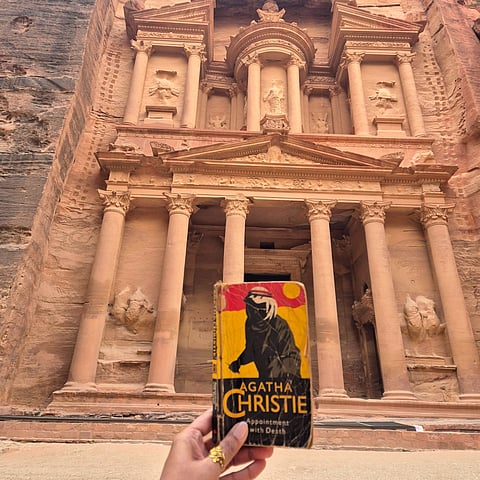
Agatha Christie's “Appointment with Death” Author
Published in 1938, “Appointment with Death” features the famously moustachioed Belgian detective Hercule Poirot as he and the Boynton family travel from Jerusalem to Petra, the eventual scene of a murder. I first read the book in school, and later, devoured every bit of information about Petra from the library encyclopaedia (this was the early 1990s, before you could just Google things). Since then, I have re-read the book several times and hoped to visit the scene of crime (so to speak) for myself. But Jordan eluded me — until this year. Naturally, I dusted off my much-thumbed copy the weekend before embarking upon my trip.
I reach Petra in time for lunch at my hotel, where the kitchen has prepared Jordan’s national dish, mansaf (lamb cooked in fermented yoghurt sauce and served with rice). I polish it off and head to the visitor centre. While my guide Abdallah purchases tickets (JOD 50, approx. INR 6,500), I peruse the shops for souvenirs. One of them is named Indiana Jones Gift Shop, and I remember that the climax of the third movie in the franchise was shot in Petra. For me, however, the site has always been associated with Christie’s book.
Advertisement
Walking Through Nabataean History
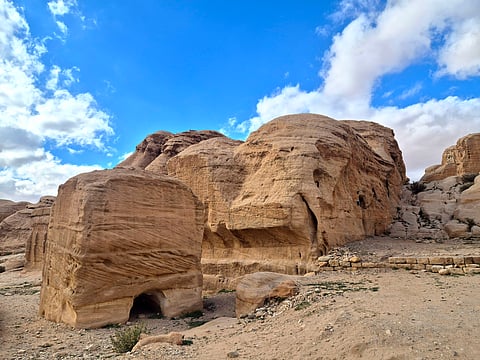
Djinn Blocks during daytime Author
“The horses were led out of the village along a slippery path with loose stones. The ground fell away and they zig-zagged down.” The area around Petra has been inhabited since 7000 BC. In the 4th century BCE, it was settled by the Nabataeans, a nomadic Arab people who established a prosperous trading civilisation. Petra was inscribed as a UNESCO World Heritage Site only in 1985, prior to which the area was still inhabited. The village that Christie refers to is long gone, but the steads remain. You can hire a horse (or a golf cart!) if you aren’t up for the roughly 2km walk; however, it isn’t a strenuous trail, and you can make your own pace. I stop at the so-called Djinn Blocks, massive monolithic cube-shaped monuments dating to the 1st century CE. Their exact purpose is unknown, but local Bedouin legends believed they were inhabited by djinn (supernatural spirits), hence the name.
Advertisement
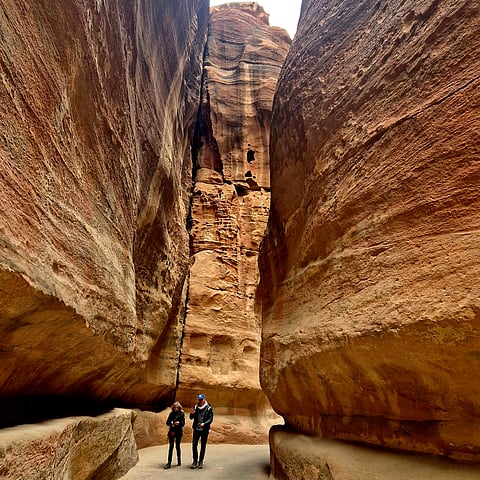
Inside the Siq Author
I soon arrive at the entrance of the Siq, a narrow natural gorge that winds for about 1.2km and at some points is no more than 3m (10 ft) wide. Christie’s words echo: “... down into the bowels of the earth, through a labyrinth of red cliffs. They towered now on either side. Sarah felt stifled, menaced by the ever-narrowing gorge.” In the book, the scene takes place past sunset when the towering rocks no doubt looked sinister. But at 4pm on a slightly overcast evening, I’m only mesmerised by the sandstone walls rippling with shades of rose and gold. Along the way, Abdallah points at various niches carved into the rock, a couple of which show figurines, presumably of the Nabataean god Dhu-Shara. Elsewhere, there’s a weathered carving of a merchant leading a camel as well as remains of 2000-year-old terracotta pipes laid by the Nabataeans to bring water into Petra.
Advertisement
The Treasure At The End
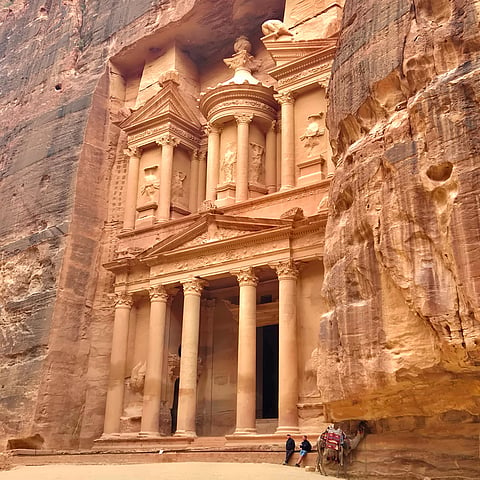
A shot of The Treasury Author
Finally, I reach the end of the Siq, and get my first glimpse of Petra's most elaborate ruin, Al-Khazneh (the Treasury). Carved out of the sandstone rock face, it was built in the 1st century CE as a tomb for the Nabataean King Aretas III. Some of its architectural details have eroded over time, but I can still discern mythological figures on its façade. The name ‘Al-Khazneh’ came about much later, as the local Bedouins believed it contained treasures. Standing before it, I realise the real treasure isn’t hidden inside. It is in the long journey of imagination that brought me to Petra — from the pages of a book to beholding the rose-coloured wonder with my own eyes.
The Essentials
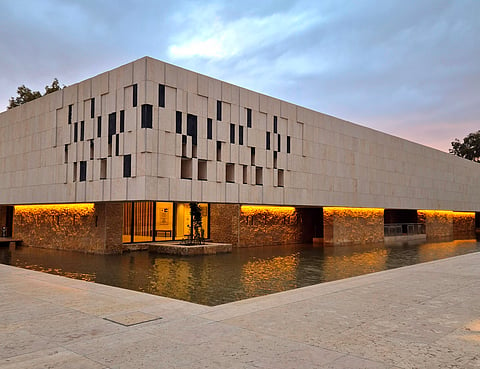
Petra Museum as seen during dusk Author
Royal Jordanian (rj.com) has direct connectivity with the capital city of Amman. From here, Petra is 235km (about 3 hours) by road. Just 3km from Petra Visitor Centre, The Old Village Resort (oldvillageresort.com) is the ideal base in the Rose City. Built over the ruins of a late Bronze Age settlement, this former Ottoman-era village has been beautifully restored and converted into a 200-key resort. Once you’re done exploring Petra, visit The Petra Museum (free entry) outside the visitor centre for insights into the Nabataeans.
Advertisement
(Prachi Joshi is a Mumbai-based freelance writer who covers travel, food and luxury, and has been featured in several renowned media outlets.)

Published At: