In the collective imagination of India, Kerala is a land defined by emerald backwaters, the thunderous rhythm of temple drums, and an almost pathological obsession with South American football. Yet, for those of us born in the royal town of Tripunithura, the beautiful game has always been played with a piece of seasoned willow and a cork ball. Here, in the winding lanes of the former capital of the Cochin Kingdom, the ghost of Pelé has always stood a little behind the shadow of the batsman.
From The Latest Issue: A Ground Called Home
In a small royal town near Kochi, cricket shaped childhoods, blurred social lines, and became a shared inheritance

Advertisement
I grew up in the shadow of the Sree Poornathrayeesa Temple, where the air carried the scent of camphor mixed with the salty breeze from the Arabian Sea. For the first decade of my life, my world was dictated by the seasons of the Palace Oval, locally known as the Ottoli ground. I was the unexpected caboose of my family, born in 1974 when my father, L. Neelakantan, was already 50. By the time I was five or six, my elder brothers, Lokanathan, affectionately called Ramani Swami, and Rajendran, were already strapping young men in their mid-20s.
To my child’s eyes, they were giants. I have vivid memories of tagging along, my small hand swallowed by theirs, as they walked to the Ottoli ground for practice or to watch the tournament. They were avid players, part of the local priesthood devoted to the religion of cricket that seized our town every autumn during the Pooja holidays. Watching them in their crisp, sun-bleached whites, I did not just see my brothers. I saw the embodiment of a town’s peculiar heritage. Whether they represented a local club or simply honed their craft, they belonged to a lineage that made Tripunithura a cricket-mad island in a football-crazy sea.
Advertisement
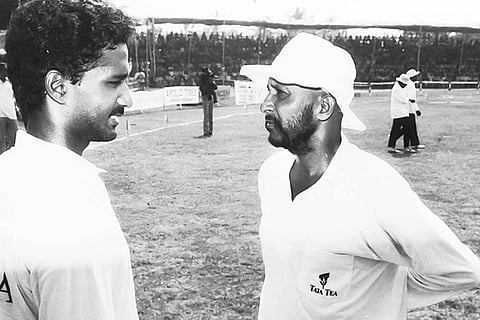
Indian cricketer Syed Kirmani (right) COURTESY OF TRIPUNITHURA CRICKET CLUB
While the cricketing world formally marks 1971 in Melbourne as the birth of the One Day International, the people of Tripunithura know we were decades ahead of the curve. In 1951, K.V. Kelappan Thampuran of the Cochin Royal Family, himself an accomplished first-class cricketer, grew weary of the inconclusive nature of multi-day matches. At the Prince’s Club, now the Tripunithura Cricket Club, he proposed a radical knockout format that would guarantee a result in a single day. Thus was born the All India Pooja Knockout Cricket Tournament, timed to coincide with Navratri, turning the 10 days of Pooja into a carnival of sport. Last year, the tournament marked its 75th anniversary, a staggering milestone it reached without a single break, surviving wars, pandemics, and the arrival of television.
My father, known around town as “Caltex Swami” because he owned the two local petrol pumps, was born in 1924. Along with his elder brother and other local businessmen, members of the royal family, and a handful of elite families, he formed a bridge to the tournament’s infancy. In those early years, when the wicket was often more mud than turf, men like him were the lifeblood of the game. He was one among many early sponsors who helped the tournament evolve from a royal pastime into a community-funded passion.
Advertisement
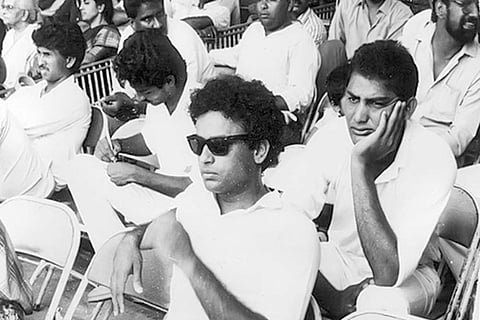
Star cricketer (first from right) Mohammad Azharuddin at the Pooja Knockout COURTESY OF TRIPUNITHURA CRICKET CLUB
The archives of the Tripunithura Cricket Club are a treasure trove of this history. I often spend hours poring over sepia-toned photographs of legends who once graced our ground. Sometimes I find myself scanning the crowded galleries, then little more than bamboo structures roofed with coconut leaves. I hope to spot the youthful faces of my father or uncles perched on the low granite boundary walls. Time has made them elusive, ghosts hidden within a forgotten age.
Though its origins were royal, the Pooja tournament was the ultimate leveller. Princes played alongside clerks, and the experts perched on the stone wall were as likely to be coconut pluckers as palace officials. It became a game for everyone, who gathered to see if local heroes could stand up to national stars. It was an era, when cricketers, even those who went on to win World Cups, had not yet transformed into distant celebrities. They were our people, who walked among us and remained gloriously mortal.
Advertisement
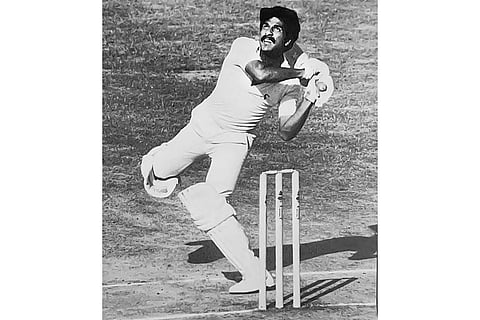
Krishnamachari "Kris" Srikkanth | Courtesy: Facebook/Vintage Cricket
My most visceral childhood memory is watching Krishnamachari "Kris" Srikkanth (more popularly known as “Cheeka”) just before India’s triumph in the 1983 World Cup. Cheeka played with a ferocity that seemed to vibrate through the ground. I remember the roar of the crowd as he launched sixes clear of the stadium, some landing in the compound of the nearby Government Hospital, others splashing into the Andhakara Thodu. Once a royal waterway, it had by then declined into a pit-ridden canal. Hitting a ball into that murky water was a badge of honour for the batsman and a logistical nightmare for us ball boys. After an over, players would often wander to the granite wall and sit with spectators, sharing peanuts from paper cones while listening patiently as a tea-shop owner offered advice on swing or the googly.
These men were loved more than idolised. They were celebrated artists, no different from Kathakali maestros or classical drummers. They were invited into homes, humble huts and royal mansions alike, fed on banana leaves, and taken around to see the town. In today’s era of billion-rupee leagues, such memories feel almost like fables.
Advertisement
Today, the Palace Oval has evolved. The canal has seen better days, and the stadium now boasts a professional turf and modern pitch. Yet its rustic charm remains. For the traveller visiting Kochi, Tripunithura offers a glimpse into a different Kerala, one where cricket is not merely a sport but a family heirloom. The Pooja Knockout is a 75-year-old love letter to the game, written in white flannel on a field of royal green. As the next season approaches, the echoes of my brothers’ practice sessions and my father’s stories still linger in the breeze. This is no mere travelogue. It is a slice of my life, and if you find yourself here during the next Pooja season, it might become a slice of yours too.
Know Before You Go
When: During Navratri (September–October), concluding on Vijayadashami
Where: Palace Oval (Ottoli Ground), Tripunithura, approximately 10 km from Ernakulam
Getting there: Easily accessible by Kochi Metro (Tripunithura station) and local buses
Advertisement
Best seats: The low granite boundary walls, where local spectators gather
Nearby: Hill Palace Museum and tea stalls near Sree Poornathrayeesa Temple serving pazham pori and ginger tea
Anand Neelakantan is a bestselling author with over 15 books.
Looking for more such exciting and meaningful stories? Grab our latest issue on Amazon.
Published At: