For most travellers, Puri is synonymous with the Jagannath Temple and the spectacular Rath Yatra. Yet, beyond these celebrated landmarks lies another remarkable tradition that has quietly endured for over eight centuries. Every year, from Rama Navami to Baisakha Trutiya, the temple town transforms into a vast open-air theatre for Sahi Jata (also known as Sahi Jatra), where mythology, martial arts and community spirit converge. There are no elaborate stages or ticketed performances here. Instead, neighbourhood lanes become performance spaces, residents become mythological characters, and the entire city becomes part of a living cultural narrative that has been passed down through generations.
Did You Know About Puri's Eight-Century-Old Celebration Of Myth And Martial Arts?
Step into Puri's Sahi Jata, an 800-year-old cultural tradition blending martial arts, mythology, devotion and spectacular street performances

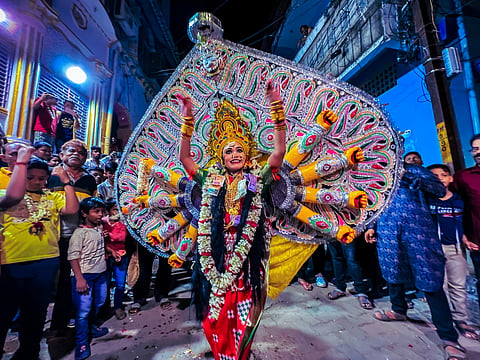
A child performer dressed as "Durga Medha" - Goddess Durga, dressed on "Tatti"- Shola Pith Debmalya Das
Advertisement
An Eight-Century Legacy
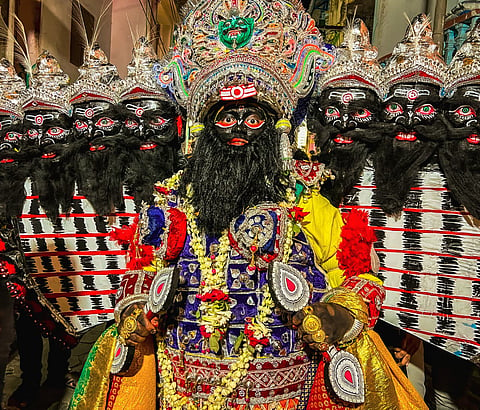
Men dress as evil Ravan, who during these 15 days of Sahi Jata, roams on the streets throughout the day and on the last day, he visits the Jagannath Temple to seek his blessings Debmalya Das
The roots of Sahi Jata trace back to the Eastern Ganga dynasty, when the tradition emerged as much from necessity as devotion. Puri's traditional neighbourhoods, known as Sahis, established Akhadas where young men trained in sword fighting, wrestling, stick combat and acrobatics to help safeguard the sacred Jagannath Temple.
Advertisement
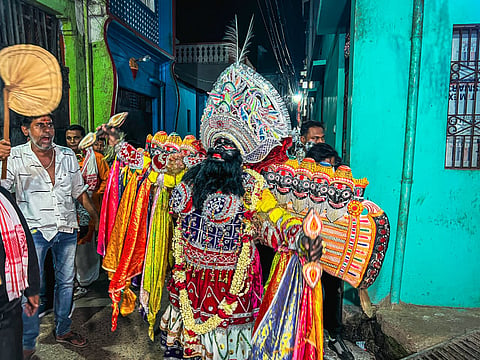
The performer portraying Ravana captivates spectators as he makes his way through the streets of Balisahi Debmalya Das
Over time, these martial exercises evolved into a unique cultural festival that blended physical prowess with storytelling. Today, eight Sahis organise the celebrations in succession, each taking responsibility for bringing episodes from the Ramayana to life. The month-long festival has become one of Odisha's most distinctive expressions of living heritage, where ancient traditions continue to thrive through collective participation.
A City Performs
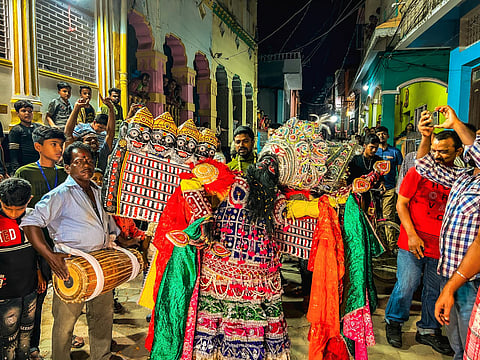
Where mythology comes alive on the streets Debmalya Das
Unlike conventional theatre, Sahi Jata has no curtains, stages or backstage areas. Every street becomes a performance arena, drawing residents and visitors into an immersive retelling of epic tales.
Men, women and children voluntarily step into the roles of gods, goddesses, demons and legendary heroes. Among the festival's most striking sights are the Durga Medha processions, where young girls don intricately handcrafted headpieces and costumes made from Sola Pitha (Indian cork). These ornate creations are masterpieces of traditional craftsmanship, often taking weeks to complete.
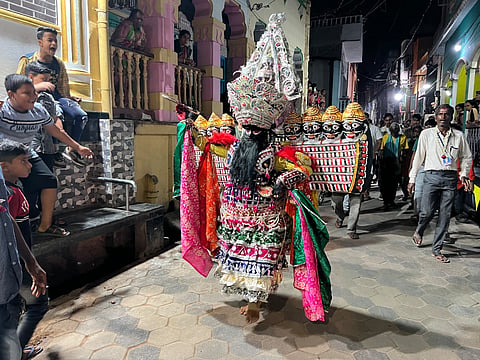
Ravana performing on the streets of Balishahi, entertaining the community people Debmalya Das
Some costumes demand extraordinary endurance. The performer portraying Ravana carries an elaborate ensemble weighing close to 100 kilograms, requiring immense balance, stamina and months of physical preparation. Many participants begin training nearly six months in advance, underscoring the dedication that sustains this centuries-old tradition.
Advertisement
Devotion Before Drama
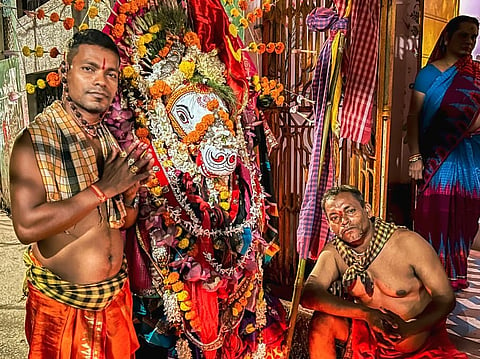
The Ghoda Nacha horse is a sacred symbol of Goddess Mangala Devi. Throughout Sahi Jata, families place it outside their homes, where mothers offer daily prayers and worship Debmalya Das
Although Sahi Jata is celebrated for its theatrical grandeur, its heart remains deeply spiritual.
Before stepping into character, every performer visits the Jagannath Temple in full costume to seek the blessings of Lord Jagannath. The ritual is a reminder that these performances are not merely artistic expressions but acts of devotion.
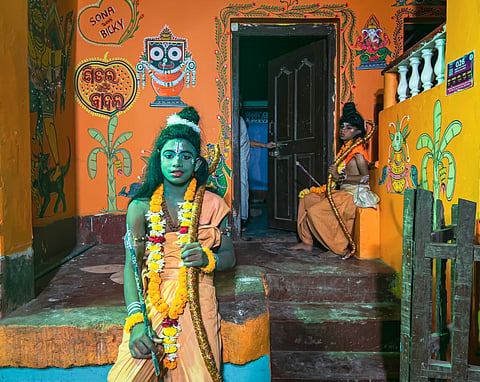
Children in the roles of Ram and Lakshman prepare to perform in the winding lanes of Puri's historic Sahis Debmalya Das
Throughout the festival, processions weave through Puri's historic streets, accompanied by traditional music, chants and enthusiastic crowds. One of the most captivating spectacles is the Durga Medha procession, where performers dance late into the night from Balisahi to Harchandi, carrying their elaborate Sola Pitha creations in a vibrant display of faith, craftsmanship and community pride.
The Final Battle
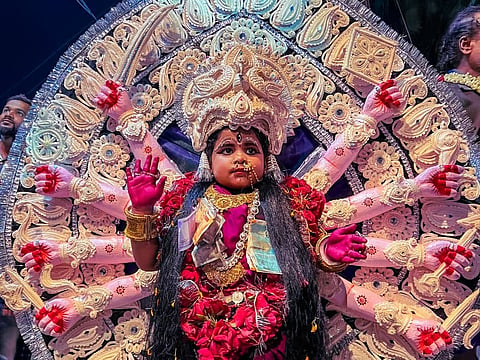
A child portraying Goddess Durga, adorned in an elaborate Durga Medha made of handcrafted Shola Pith Debmalya Das
The festival reaches its dramatic climax on the concluding day, when the timeless battle between Lord Rama and Ravana is reenacted before thousands of spectators.
For nearly two weeks, the performer portraying Ravana roams the streets of Puri, making theatrical appearances that build anticipation across the city. On the final day, Ravana first offers prayers at the Jagannath Temple before proceeding to Jagannath Ballav. Lord Rama, dressed within the temple precincts, arrives soon after.
Advertisement
What follows is an electrifying performance of the epic confrontation, ending with Ravana's defeat—a symbolic triumph of righteousness over evil that has resonated through generations.
It is one of Odisha's most spectacular cultural performances, where theatre, ritual and public participation merge into a single unforgettable experience.
A Living Heritage
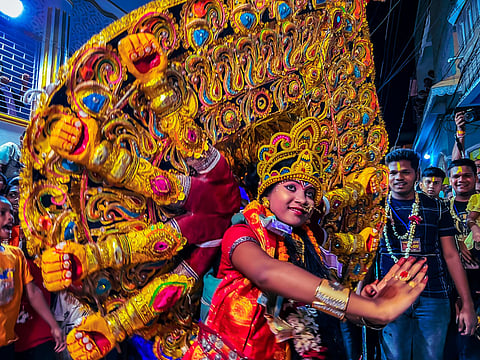
Young performers embody Goddess Durga during the Dashabujha Durga Medho Debmalya Das
Walking through Puri during Sahi Jata feels like stepping into a world where mythology is not confined to ancient texts but lives and breathes in the city's streets. Through my camera, I witnessed not only elaborate costumes and dramatic performances but also the quiet devotion of the people who keep this tradition alive year after year. Every handcrafted Medha, every rehearsed movement and every procession reflected an extraordinary commitment to preserving a shared cultural memory.
Sahi Jata is far more than a festival. It is the living soul of Puri—a celebration where theatre, martial heritage, artistry and faith continue to flourish after more than 800 years. For travellers seeking to experience Odisha beyond its famous landmarks, this remarkable tradition offers an intimate glimpse into a heritage that remains as vibrant today as it was centuries ago.
Advertisement
FAQs
Q1. What is Sahi Jata?
Sahi Jata is an 800-year-old open-air theatre and cultural festival in Puri, Odisha, where neighbourhoods enact episodes from the Ramayana through performances, processions and martial arts.
Q2. When is Sahi Jata celebrated?
The festival is held annually from Rama Navami to Baisakha Trutiya, spanning nearly a month.
Q3. Why is Sahi Jata unique?
Unlike conventional theatre, Sahi Jata transforms the streets of Puri into performance spaces, with local communities portraying mythological characters in elaborate costumes.
Q4. What is the highlight of the festival?
The grand finale features the dramatic reenactment of the battle between Lord Rama and Ravana at Jagannath Ballav, symbolising the triumph of good over evil.
Q5. What are the Durga Medha processions?
The Durga Medha processions feature performers—many of them young girls—wearing intricately crafted Sola Pitha (Indian cork) costumes and dancing through Puri's streets as an expression of faith and artistry.
Debmalya Das is a travel and documentary photographer whose work has been featured in renowned international publications. Alongside his creative pursuits, he serves in the Panchayat Administration of the West Bengal Government, travelling to remote corners of India to document stories, cultures, and the human spirit through his lens.
Advertisement

Published At: