"The Mississippi River towns are comely, clean,
From The Latest Issue: The Long Way South
Following the Mississippi from Minnesota into Illinois, a road trip reveals how rivers, roads and historic towns shaped the American Midwest

Advertisement
well built, and pleasing to the eye, and cheering
to the spirit. The Mississippi Valley is as reposeful
as a dreamland, nothing worldly about it . . .
nothing to hang a fret or a worry upon.”
—Mark Twain, Life On The Mississippi (1883)
The Mississippi did not look especially imposing from where I stood in Minneapolis. From the Endless Bridge outside the Guthrie Theater, it moved steadily between old brick warehouses and the towers of the city, passing beneath the Stone Arch Bridge. As I squinted against the strong winds, cyclists crossed my line of sight, people walked dogs along the riverfront, and below us, the remains of flour mills sat beside landscaped paths. It was an ordinary weekday scene, except that almost everything around me existed because of the river.
We were beginning a road trip through parts of the American Midwest, travelling from Minnesota into Illinois. Yet it was the Mississippi that first gave the journey a shape. It had built settlements, powered industries and determined which towns prospered. Even when the road eventually took us away from it, its influence remained.
Advertisement
Minneapolis was once one of the world’s largest flour-milling centres. Grain arrived from farms across the Midwest and was processed in mills powered by St. Anthony Falls, the only natural waterfall on the Mississippi. Flour left the city by rail and river, carrying the name of Minneapolis far beyond Minnesota.
Fragments of that industrial period remain at Mill Ruins Park. Walls stop abruptly where buildings once continued. Old stone and brick structures stand beside modern apartments, offices and cultural spaces. The city has not attempted to restore the riverfront to a single period. It has simply found new uses for what survived.
By early evening, we had made our way to St. Anthony Main. It was almost seven, but the sun was still high. Restaurant patios were filling up, cyclists coasted along the waterfront, and families queued for ice cream. At Aster Café, housed inside the city’s oldest surviving masonry building, we found a table overlooking the river. There was nothing dramatic about watching the Mississippi from there. It did not rush past or demand attention. All it did was drift by, as it had before the mills, the bridges and the glass towers appeared around it.
Advertisement
The following morning, we drove south.
Beyond Minneapolis, the roads opened out. The river appeared intermittently through trees and between limestone bluffs, close enough at times to seem like a travelling companion and then gone for long stretches. Someone would spot the water and point. Another person would reach for a phone. Then the view would close again, and the conversation inside the car would resume.
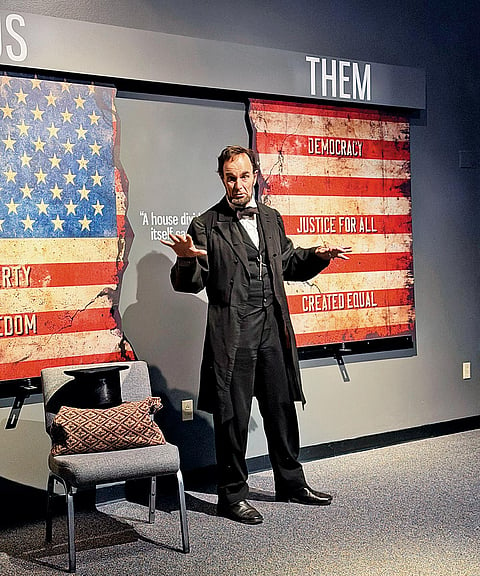
Lincoln impersonator Fritz Klein | Photo: Tenzin Chodon
Galena’s Charm
We reached Galena in the evening, just as the rain began to settle in. It continued through the night. By morning, Main Street was wet and glistening, and people moved between cafés and shops under umbrellas.
After breakfast at Charlie’s Place, we picked up coffee from a local roastery and wandered along the street, ducking inside antique stores and boutiques whenever the rain became heavier. “It's a small town, and most people know each other here,” Fallon from Visit Galena, the town's tourism body, told us.
Advertisement
It didn't take long to see what she meant. Every few minutes, someone stopped along the pavement to greet a neighbour, exchange a few words and then carry on with their day. Nobody seemed to be in any particular hurry.
As we continued walking, Fallon explained how closely Galena's fortunes had once been tied to the river. During the 19th century, lead mined from the surrounding hills was shipped by steamboat along the Mississippi, turning the town into one of the busiest inland ports between St. Louis and St. Paul. Today, over 85 per cent of downtown is listed on the National Register of Historic Places, preserving much of what those prosperous years built. Among its best-known landmarks is the home of Ulysses S. Grant, who lived in Galena before becoming the Union general who led the North to victory in the American Civil War and, later, the 18th President of the United States.
Advertisement
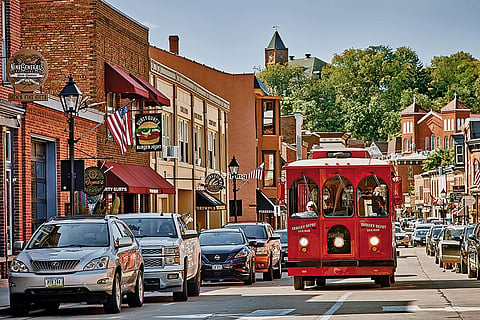
Galena's iconic Main Street | Courtesy: Galena Country Tourism
Lincoln And The Mother Road
“Four score and seven years ago…”
The room fell silent. I had arrived a few minutes late at the Abraham Lincoln Presidential Library and Museum in Springfield and, initially, saw only a tall figure standing before a small crowd. He wore a black frock coat over a white shirt and waistcoat. His stovepipe hat rested on a chair beside him.
For a moment, my sleep-deprived brain was willing to believe what I was seeing.
The man before us was Fritz Klein, one of America’s best-known Abraham Lincoln impersonators. He delivered the Gettysburg Address slowly, with pauses that made it easy to forget, if only for a moment, that this wasn't the 16th President of the United States.
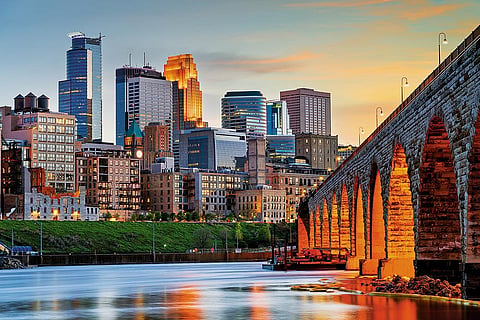
The historic Stone Arch Bridge in Minneapolis | Photo: Shutterstock
That sense of proximity continued through the museum. Original artefacts sat alongside reconstructed rooms, immersive films and theatrical performances. Rather than presenting Lincoln as a distant historical figure, the museum showcased him as a politician navigating disagreement, ambition, war and personal loss.
Advertisement
Springfield mattered to the experience. It was where Lincoln practised law, campaigned and raised a family, rooting his story firmly in the landscape that shaped his public life.
Not far away, the Illinois State Fairgrounds offered a lighter kind of historical memory through the Route 66 Experience. Vintage billboards, recreated petrol pumps, classic cars and the towering Muffler Men recalled the highway that once linked 92 Illinois communities. Like countless travellers before us, we paused beside the iconic Route 66 shield for the obligatory photograph. Nostalgic though the exhibit was, it celebrated a road that connected towns, sustained roadside businesses and turned the American road trip into a national tradition.
As we left the fairgrounds, I scrolled through photographs from the journey–the Mississippi beneath the bridge in Minneapolis, Galena under rain, Fritz Klein’s stovepipe hat and the Route 66 shield that we had just passed.
Outside the window, another Illinois town approached and passed. Grain silos stood beyond the fields, church steeples rose above the trees and the occasional diner appeared beside the highway before disappearing behind us. I put my phone away.
Advertisement
There were still miles left to drive, and more towns waiting somewhere beyond the next bend. For the first time throughout the journey, I found myself looking less for the next stop on the itinerary than for what the road might reveal before we got there.
The Information
Where To Stay
Canopy by Hilton Minneapolis Mill District; Wyndham Garden Galena Hotel & Spa; Fairfield by Marriott Inn & Suites Springfield Southwest
Where To Eat
Aster Café, Minneapolis; Café Zorya, Winona; Charlie's Place, Galena; Lagomarcino's and LemonGrass Café in Moline
Other Must-Visit Attractions
Paisley Park, Chanhassen; Minneapolis Sculpture Garden; First Avenue and the Prince Mural, Minneapolis; National Eagle Center, Wabasha
Looking for more such exciting and meaningful stories? Grab our latest issue on Amazon.
Published At: