The Zojila Tunnel reached a key milestone on June 9, 2026, when engineers completed a breakthrough after controlled blasting, bringing the project significantly closer to completion.
Zojila Tunnel Breakthrough Brings Kashmir And Ladakh Closer Than Ever
The Zojila Tunnel marks a major step in connecting Kashmir and Ladakh, cutting through the Himalayas at high altitude. Once complete, it will ease travel across the Zojila Pass, reduce journey time, and end months-long winter isolation in the region

Advertisement
Once finished, it will stand as the world’s longest single-tube, bi-directional tunnel at a record altitude, designed to ensure year-round connectivity between the Kashmir Valley and Ladakh. Officials noted that a final 2.5-meter section was successfully breached, marking an important step forward in the execution of this high-altitude infrastructure project.
A Milestone
The Zojila Tunnel achieved a major breakthrough blast from an equidistant point of 6.5 km, linking its East and West portals. The milestone was completed six months ahead of schedule, according to the National Highways & Infrastructure Development Corporation Limited (NHIDCL).
The 13.153 km tunnel connects Baltal in Ganderbal district with Minimarg in Drass, supported by an 18-km approach road. Officials said it is likely to be opened to the public in February 2028, with civil works continuing for several months before electrical work begins.
Once operational, the two-lane, single-tube tunnel is expected to ensure year-round connectivity across the Zojila Pass, which is often closed in winter due to heavy snowfall.
Advertisement
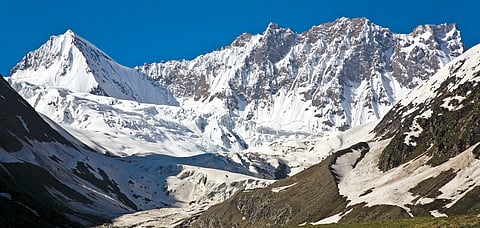
The two-lane, single-tube tunnel is expected to ensure year-round connectivity across the Zojila Pass Shutterstock
Through Zojila’s Heights
The Zojila Tunnel is a 14.15 km engineering project being constructed at an altitude of 11,578 feet, designed to ensure all-weather, year-round connectivity between Kashmir and Ladakh. By bypassing the difficult Zojila Pass, it will cut travel time across the stretch from several hours to around 15 minutes, while ending the region’s long winter isolation that typically lasts up to six months.
Project At A Glance
The Zojila Tunnel project runs for a total of 31 km, incorporating the main tunnel along with approach roads, bridges and other associated works. It is situated on the Srinagar–Leh National Highway (NH-1), linking Baltal in Ganderbal district to Minimarg in Ladakh’s Drass sector. Estimated at a cost of around INR 6,800 crore, the project saw its underground link completed after the breakthrough blast on June 9, 2026. The tunnel is slated to open for public use in February 2028.
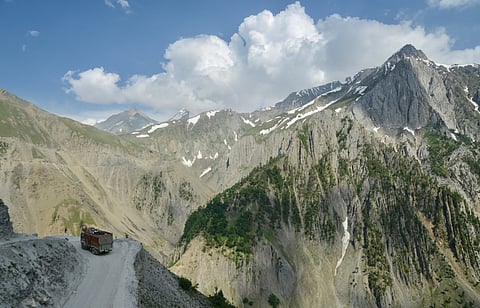
Zoji La is considered to be one of the most difficult terrains to travel through Shutterstock
Environmental Challenges
Advertisement
Fragile geology and seismic risk: The Zojila region lies in a highly active seismic zone with complex rock structures such as schists, clay bands, and fault lines. Tunnelling through such terrain carries risks of landslides, rockfalls and ground movement. Engineers are using the New Austrian Tunnelling Method (NATM) to adjust to changing ground conditions and reduce instability.
Debris and muck disposal: Excavation produces vast quantities of rock waste. If not handled carefully, this material can slide down steep slopes, damage vegetation, silt up high-altitude streams and obstruct natural drainage channels.
Hydrogeological impact: Tunnelling at depth can intersect underground water systems, altering natural flow patterns. This may lead to the drying up of local springs used by nearby communities, while also creating water seepage challenges within the tunnel.
Wildlife and habitat disruption: The Baltal–Minimarg stretch passes through an ecologically sensitive area. Blasting, noise from machinery and increased human activity can disturb local wildlife and interfere with natural movement corridors.
Advertisement
Emissions and climate impact: While the tunnel is expected to reduce long-term emissions by easing traffic over the pass, the construction phase relies heavily on diesel-powered machinery and ventilation systems, which can affect local air quality in the short term.
(With inputs from various sources)
FAQs
What is the Zojila Tunnel?
The Zojila Tunnel is a high-altitude road tunnel under construction to provide all-weather connectivity between Kashmir and Ladakh via the Srinagar–Leh National Highway.
Where is the Zojila Tunnel located?
It connects Baltal in Ganderbal district of Jammu & Kashmir with Minimarg in Ladakh’s Drass sector.
How long is the tunnel?
The main tunnel is 13.153 km long, forming part of a larger 31 km project including approach roads and bridges.
When will it be completed?
The tunnel is expected to open for public use in February 2028.
Why is the Zojila Tunnel important?
It will reduce travel time between Kashmir and Ladakh, ensure year-round access, and remove the seasonal closure caused by heavy snowfall at Zojila Pass.
Advertisement
Published At: