A woman watching the sunset alone on a beach in Goa. A group of friends planning a quick weekend escape from Mumbai. A solo traveller navigating the streets of Kyoto with a carefully mapped itinerary. These are no longer occasional travel moments; they are becoming the new normal. Across India, women are travelling more often, independently, and making their own decisions about where to go next.
Solo, Confident And On The Move: New Data Reveals How Indian Women Are Redefining Travel
New data from Scapia reveals a surge in solo travel among Indian women, with beaches emerging as the most popular destinations

Advertisement
New data released by travel-fintech platform Scapia ahead of International Women’s Day reveals a clear shift in women’s travel behaviour. Women are not only travelling more frequently, but also increasingly planning their trips end-to-end. They’re choosing destinations, booking transport, and selecting stays and experiences.
One of the most striking indicators of this change is the surge in solo travel. On Scapia’s platform, solo travel among women has grown nearly nine times year-on-year, signalling greater confidence and independence. Across flights, trains, buses and hotel bookings, both domestic and international, women are increasingly taking control of how they move and where they go.
The findings also reveal interesting shifts in destination choices, travel budgets and generational preferences. From beach escapes and spiritual journeys to premium stays and emerging international destinations, women are reshaping the travel map in ways that reflect both aspiration and practicality.
Beach Escapes Are Leading Women’s Travel Plans
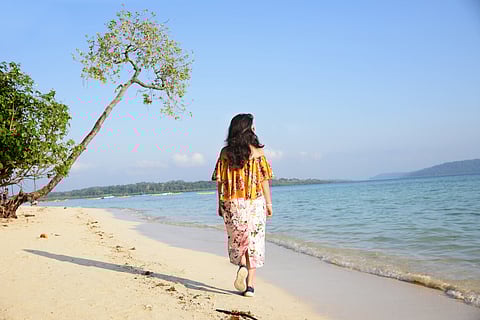
A woman walking along the beach at Havelock Island Shutterstock
According to Scapia’s insights, over 80 percent of domestic leisure bookings by women are for beach destinations rather than hill stations. Beaches offer relaxation, scenic beauty and flexible itineraries, making them appealing for both solo travellers and small groups.
Advertisement
Among the most popular domestic destinations are Goa, Port Blair in the Andaman and Nicobar Islands, and Kerala’s coastal towns such as Kovalam, Poovar and Varkala. The historic seaside town of Diu has also emerged as a favourite.
The same pattern is visible internationally. Southeast Asian islands, in particular, are witnessing a rise in bookings by Indian women travelling solo. Destinations such as Krabi, Phuket, Langkawi, Phu Quoc, Bali and Gili Trawangan stand out for their combination of natural beauty, accessibility and vibrant tourism infrastructure.
Solo Travel Is Growing Faster Than Ever
Solo travel has become one of the most defining characteristics of the new wave of women travellers.
The nearly 9X increase in solo bookings on Scapia’s platform reflects a broader shift in mindset. Travelling alone is increasingly seen as a way to reclaim time, explore personal interests and experience destinations on one’s own terms.
This growth spans multiple forms of travel. Women are not only booking flights but also increasingly using trains and buses for regional movement.
Advertisement
This trend is closely tied to technology. With travel platforms simplifying bookings and digital tools making trip planning easier, women can independently design entire itineraries.
Spiritual Journeys Continue To Hold Meaning

Evening Ganga Aarti in Varanasi Shutterstock
While beach holidays dominate leisure travel, spiritual tourism continues to resonate strongly with women travellers across age groups.
However, preferences differ between generations.
Gen Z travellers are gravitating toward spiritual destinations that combine culture, scenic landscapes and visually compelling experiences. Cities such as Varanasi and Rishikesh are popular among younger travellers drawn to their atmospheric ghats, temples and riverfront settings.
Millennial women, meanwhile, are more likely to visit long-established pilgrimage centres. Destinations such as Shirdi, Haridwar, Amritsar and Velankanni continue to see strong interest within this age group.
The difference suggests that while spirituality remains an important motivator for travel, younger travellers often combine it with exploration, photography and cultural experiences.
Gen Z Chooses Value, Millennials Lean Towards Luxury
The data also highlights a generational divide in spending patterns.
Gen Z women are largely choosing mid-range stays, which account for nearly half of their bookings and have grown almost eight times year-on-year. The trend reflects a value-conscious approach that allows for more frequent travel.
Advertisement
These travellers are also exploring culturally rich destinations such as Jaisalmer, Udaipur, Hampi, Agra and Varanasi. Many are venturing into Tier-3 towns and offbeat locations, and planning quick weekend escapes to places like Lonavala.
Millennial women, by contrast, are driving growth in premium travel. Nearly one in three millennial travellers opts for luxury stays, the highest proportion among all age groups. Domestic beach destinations such as Goa and Pondicherry remain particularly popular within this cohort.
Southeast Asia Dominates International Trips
According to Scapia’s data, Southeast Asia and the Indian Subcontinent together account for 62.6 percent of outbound trips by women, meaning nearly one in two international journeys falls within these regions.
Countries such as Thailand, Vietnam and Sri Lanka remain strong favourites, helped by visa-free or visa-on-arrival access. In fact, over 60 percent of the top international destinations booked by women require no advance visa, highlighting how ease of travel influences decision-making.
Among the fastest-growing destinations is Vietnam, where travellers are exploring multiple cities, including Hanoi, Da Nang, Ho Chi Minh City, Phu Quoc, Ha Long and Sa Pa.
Advertisement
Outside Southeast Asia, Japan stands out as a major draw, with travellers exploring cities such as Tokyo, Kyoto, Osaka, Hakone and Fujikawaguchiko.
At the same time, emerging regions are gaining traction. Countries including Georgia, Kazakhstan, Uzbekistan and Tajikistan are attracting women travellers seeking destinations beyond the usual tourist circuits. Cities such as Tbilisi, Batumi, Borjomi, Almaty and Tashkent are entering the travel radar.
Europe remains aspirational but selective, with trips typically centred around major cities such as London, Paris, Amsterdam and Vienna.
Mobility Across Transport Modes Is Rising
Another insight from the report is the rise in mobility.
Women are travelling more frequently across different modes of transport, reflecting a broader culture of movement and exploration. Train bookings by women have increased 16.5 times year-on-year, bus bookings 11 times and flight bookings 8.2 times.
The data also indicates stronger regional movement, particularly across southern India, where well-connected rail and road networks make short trips and spontaneous travel easier.
Taken together, the trends paint a picture of a rapidly evolving travel culture. Indian women are no longer passive participants in travel planning; they are increasingly the architects of their journeys, choosing destinations that reflect their aspirations, interests and independence.
Advertisement
FAQs
1. Are Indian women travelling more independently?
Yes. New data from Scapia shows that solo travel among Indian women has increased nearly nine times year-on-year.
2. Which destinations are popular among Indian women travellers?
Domestic beach destinations such as Goa and coastal towns in Kerala remain popular, along with international destinations like Bali and Phuket.
3. Why are beach destinations popular among women travellers?
Beach destinations offer scenic landscapes, flexible itineraries and relaxing environments, making them appealing for both solo trips and small group travel.
4. Which international regions are most popular among Indian women travellers?
Southeast Asia and the Indian Subcontinent account for a large share of outbound travel, including countries such as Thailand, Vietnam and Sri Lanka.
5. What travel trends are visible among Gen Z women?
Gen Z women travellers often choose mid-range stays and culturally rich destinations such as Varanasi and Hampi.

Published At: