When Rajasthan presented its INR 6.10 lakh crore Budget for 2026–27 on February 11, it wasn’t just a financial statement—it was a long-range blueprint. Deputy Chief Minister and Finance Minister Diya Kumari positioned the budget as a stepping stone toward Viksit Rajasthan @2047, built on 10 developmental pillars ranging from infrastructure and agriculture to digital governance and green growth.
Rajasthan Government Announces Major Tourism And Heritage Projects In Budget
A INR 6.10 lakh crore budget signals big moves for desert circuits, heritage towns and green tourism in Rajasthan

Advertisement
With the state’s Gross State Domestic Product projected to rise to over INR 21.52 lakh crore and the fiscal deficit targeted at 3.69 per cent of GSDP, the government has signalled expansion with fiscal discipline. Capital expenditure has been sharply prioritised, road networks are set for large-scale upgrades, drinking water infrastructure has received multi-thousand-crore allocations, renewable energy parks are planned in Bikaner and Jaisalmer, and youth employment, startups and women-led enterprises feature prominently.
But within this expansive canvas, tourism emerges not as a side note, but as a strategic growth driver under the sixth pillar: Tourism, Art and Cultural Heritage.
Desert Luxury Vision
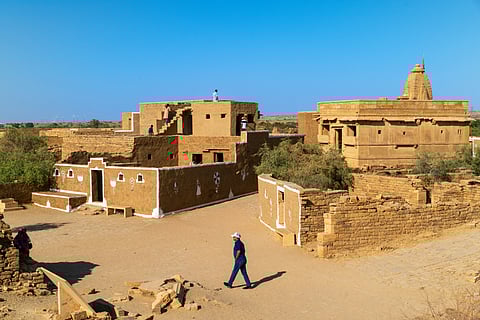
Kuldhara is set to receive a tourist facilitation centre under Rajasthan’s 2026–27 tourism push Unsplash
The most eye-catching announcement is the development of an ultra-luxury Special Tourism Zone (STZ) in Khuri, near Jaisalmer. About 45 km from the Golden City, Khuri has long been the quieter alternative to the busier Sam Sand Dunes, known for its pristine stretches, camel safaris and intimate desert evenings. By positioning it as a high-end tourism hub, the state is signalling a shift toward experience-led desert travel that balances exclusivity with authenticity.
Advertisement
Just 17 km away, Kuldhara, the 300-year-old abandoned village, will get a dedicated tourist facilitation centre. Long associated with legend and mystery, the site already draws steady footfall. Strengthening infrastructure here points to better interpretation, improved visitor management and more structured heritage conservation.
Both initiatives form part of the proposed Thar Cultural Circuit linking Jaisalmer, Jodhpur, Bikaner, Barmer and Jalore—effectively presenting western Rajasthan as a cohesive desert trail rather than standalone stops.
Heritage And Memory
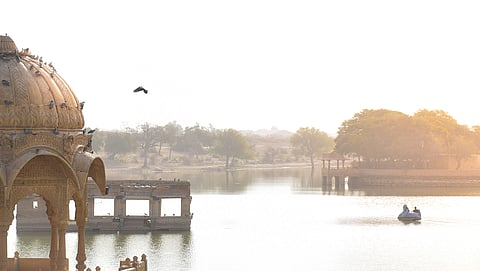
A whimsical revival of frescoed havelis anchors Rajasthan’s renewed heritage conservation drive Unsplash
Beyond the sands, the Shekhawati region receives significant attention. A INR 200 crore Shekhawati Haweli Conservation Scheme will focus on façade improvement, heritage street furniture and cleaning facilities across more than 660 havelis in Jhunjhunu, Churu and Sikar over the next two years. Often described as Rajasthan’s open-air art gallery for its frescoed mansions, Shekhawati has struggled with preservation challenges.
This allocation suggests a renewed commitment to safeguarding its architectural legacy while strengthening cultural tourism. Jhunjhunu will also see the establishment of a war museum, adding a new dimension to the region’s narrative. Known for its intricate havelis and the prominent Rani Sati Temple, the district could soon attract visitors interested in military history alongside heritage architecture. In Bharatpur, INR 100 crore has been earmarked for the construction of the Advanced Braj Convention Centre. While convention infrastructure may seem business-focused, it has clear implications for tourism, positioning Bharatpur as a potential hub for conferences and large-scale events near Keoladeo National Park.
Advertisement
Push For Green Tourism

Eco-tourism gets a boost with the INR 1,500 crore PRITHWI initiative focused on wildlife and habitat protection Unsplash
The increase in tourism is part of a bigger plan to help the environment. The start of PRITHWI—a Project for Resilient and Integrated Terrestrial Habitats and Wildlife Valorisation Initiative—with about INR 1,500 crore shows the state wants to work on habitat growth, reduce conflicts, and encourage eco-tourism. Wildlife ambulances, treatment centres, and new eco-parks are part of a larger effort to be more sustainable. This includes planting 10 crore trees and bettering pollution monitoring.
Changes to roads, water supplies, and energy sources—supported by a lot of spending—should also help tourism. Better roads, traffic systems, and solar parks in Bikaner and Jaisalmer make it easier to get around and be more sustainable. Both are important for a state that depends so much on visitors.
Even though the budget covers everything from farming to digital government, its tourism plan shows a two-part strategy: to make luxury experiences better while protecting cultural and environmental treasures. For travellers, this could translate into better facilities at storied ruins, restored frescoed towns, immersive desert circuits and greener wildlife escapes.
Advertisement
Rajasthan has always known how to stage a spectacle. With the 2026–27 budget, it appears determined to ensure that the show not only goes on, but evolves—thoughtfully, ambitiously and with one eye firmly on 2047.
FAQs
1. What are the key tourism announcements in Rajasthan Budget 2026–27?
The budget proposes an ultra-luxury Special Tourism Zone in Khuri, a tourist facilitation centre in Kuldhara, the Thar Cultural Circuit, Shekhawati haveli conservation, and a war museum in Jhunjhunu.
2. Where will the Special Tourism Zone be developed?
The STZ will be developed in Khuri, a desert village about 45 km from Jaisalmer, known for its quieter sand dunes and cultural experiences.
3. What is the Thar Cultural Circuit?
It is a proposed tourism circuit connecting Jaisalmer, Jodhpur, Bikaner, Barmer and Jalore to create a cohesive desert heritage trail.
4. How much has been allocated for heritage conservation?
₹200 crore has been allocated over two years for the Shekhawati Haweli Conservation Scheme across Jhunjhunu, Churu and Sikar.
Advertisement
5. What is PRITHWI and how does it relate to tourism?
PRITHWI is a ₹1,500 crore initiative focused on wildlife conservation, habitat development and eco-tourism to promote sustainable travel in Rajasthan.
Published At: