Lucknow has added a striking new chapter to its urban and cultural story. On December 25, 2025, the birth anniversary of former prime minister Atal Bihari Vajpayee, Prime Minister Narendra Modi inaugurated the Rashtriya Prerna Sthal, a vast memorial complex built on land that until recently functioned as a major garbage dumping ground on the banks of the Gomti River. The project stands as a powerful example of environmental reclamation combined with political memory and civic ambition.
How A Landfill In Lucknow Rose To A Riverside Memorial
Once a landfill on the Gomti’s banks, Lucknow’s Rashtriya Prerna Sthal has been reborn as a 65-acre riverside memorial with towering statues, immersive museums, and green spaces, showing how urban waste can be transformed into national heritage

Advertisement
From Dumping Ground To Riverside Landmark
The Rashtriya Prerna Sthal is located in the Basant Kunj Yojana area near Hardoi Road, along the Gomti riverfront in Lucknow. For years, this stretch of land was known not for scenic views but for towering piles of municipal waste. Official estimates suggest that around 6.5 lakh metric tonnes of garbage had accumulated at the site, turning it into a source of pollution and a persistent civic challenge.
The transformation began in 2022 under the supervision of the Lucknow Development Authority. Over a period of nearly three years, the landfill was scientifically cleared, the soil stabilised, and the area reshaped to support long term development. As part of the ecological restoration, around 50,000 trees were planted using the Miyawaki technique, a dense afforestation method that accelerates the growth of native vegetation. What was once a foul-smelling dump gradually emerged as a green and usable public space. The project was developed at an estimated cost of INR 230 crores under the Basant Kunj scheme, with authorities indicating that public access to the memorial will be ticketed once it formally opens to visitors.
Advertisement
Inside Rashtriya Prerna Sthal: Statues, Museum, And Public Spaces
At the centre of the complex stand three imposing bronze statues, each rising to a height of about 65 feet. These statues honour Atal Bihari Vajpayee, Dr Syama Prasad Mookerjee and Pandit Deendayal Upadhyaya, leaders whose ideas and political legacies have shaped modern Indian thought. The scale and placement of the statues are designed to give visitors a sense of awe and reflection.
Another major feature is the lotus-shaped museum, spread across approximately 98,000 square feet and equipped with modern exhibition technology. The museum houses multiple galleries that chronicle Vajpayee’s life and tenure as prime minister, including key moments such as the Pokhran nuclear tests. It also presents the philosophies of Antyodaya and Integral Humanism, along with broader narratives from India’s democratic and political journey.
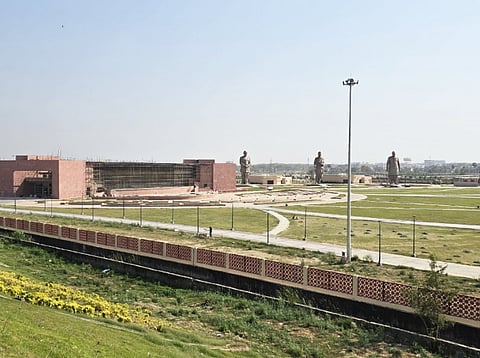
Inside Lucknow’s Rashtriya Prerna Sthal Official Website/Lucknow Development Authority, State Government of Uttar Pradesh, India
Beyond the museum, the complex includes a 3,000 seat amphitheatre, open air theatres, multipurpose halls, a meditation hall and a library. There is also a massive rally ground with the capacity to host over two lakh people, multiple helipads, landscaped gardens, ceremonial gateways, walking pathways and cafes. Together, these elements position the site not only as a memorial but as a multifunctional civic and cultural destination.
Advertisement
Why the Project Matters And How It Fits A Global Trend
Rashtriya Prerna Sthal carries significance beyond its statues and structures. Urban planners and government officials view it as an example of how degraded land can be reclaimed and repurposed to serve both environmental and social goals. By converting a landfill into a green and cultural zone, Lucknow has addressed a longstanding pollution problem while creating a new public asset along the Gomti.
Speaking at the inauguration, Prime Minister Modi described the memorial as a source of inspiration that reflects ideals of unity, self respect and public service. The choice of December 25 also allowed the event to coincide with the birth anniversaries of other national figures, reinforcing the site’s symbolic importance.
Globally, Lucknow’s initiative mirrors similar efforts where former landfills have been turned into public landmarks. In the United States, the Freshkills site in New York, once the world’s largest landfill, is being transformed into an expansive urban park, while Mount Trashmore in Virginia Beach has long functioned as a popular recreational area built over compacted waste. In India, Mumbai’s Maharashtra Nature Park stands as an early example of landfill reclamation turned ecological success. Other cities, including Ahmedabad and Delhi, are exploring comparable projects to convert old dumpsites into parks and public spaces.
Advertisement
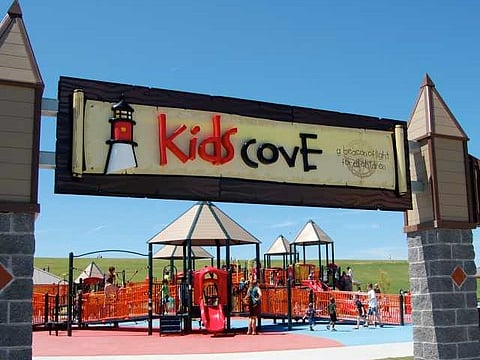
Mount Trashmore, Virginia Beach Official Website/Visit Virginia Beach
As Rashtriya Prerna Sthal prepares to welcome visitors in 2026, it represents both a physical and symbolic transformation. It demonstrates how cities can rewrite their landscapes and narratives, turning sites of neglect into places of memory, learning and inspiration for future generations.
(With inputs from PTI.)
FAQs
1. What is Rashtriya Prerna Sthal in Lucknow?
Rashtriya Prerna Sthal is a 65-acre riverside memorial built on a reclaimed landfill along the Gomti River, featuring statues, museums and public spaces.
2. Where is Rashtriya Prerna Sthal located?
The memorial is located in the Basant Kunj Yojana area near Hardoi Road, along the Gomti riverfront in Lucknow.
3. Who inaugurated Rashtriya Prerna Sthal and when?
The memorial was inaugurated by Prime Minister Narendra Modi on December 25, 2025, marking the birth anniversary of Atal Bihari Vajpayee.
4. What are the key features inside Rashtriya Prerna Sthal?
The complex includes 65-foot bronze statues, a lotus-shaped museum, amphitheatre, meditation hall, library, landscaped gardens and large public grounds.
Advertisement
5. Why is Rashtriya Prerna Sthal significant for urban planning?
It demonstrates how landfill sites can be reclaimed into green cultural landmarks, addressing pollution while creating meaningful public infrastructure.
Published At: