For travellers, some of the most memorable moments in a city come not from ticking off tourist spots, but from experiencing a place on foot. This might mean walking along the water, pausing for a view, or cycling through neighbourhoods. In Helsinki, that experience has just been elevated, quite literally.
Helsinki Opens One Of The World’s Longest Car-Free Bridges Connecting Islands
The new bridge connects Helsinki’s islands and city centre, offering a scenic, traffic-free travel experience

Advertisement
The Finnish capital has opened Kruunuvuorensilta Bridge. It is one of the world’s longest sea bridges designed without private cars. Stretching 1,191 metres across the water, the bridge is already viewed not just as infrastructure but as a destination. It offers a scenic, car-free route that reshapes how visitors explore the city.
A New Way To Move Through Helsinki

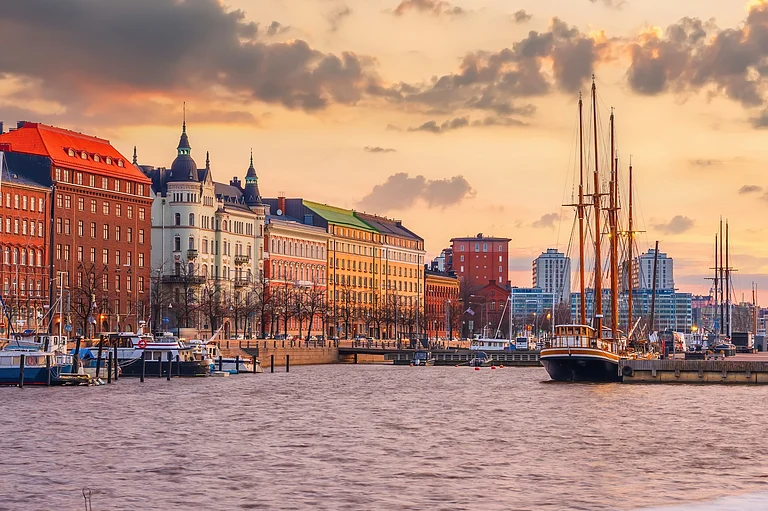
Helsinki cityscape with the iconic cathedral and Market Square. Shutterstock
The new bridge is all about connectivity. For travellers, it’s also about access and experience. Kruunuvuorensilta links the emerging waterfront district of Kruunuvuorenranta to Korkeasaari island and then to central Helsinki. This creates a seamless route across areas that were once less accessible without detours.
What used to be an 11-kilometre journey is now roughly 5.5 kilometres, cutting travel time significantly. For visitors, that translates into easier exploration of Helsinki’s eastern islands without relying on taxis, buses, or ferries. Some immediate impacts include:
Waterfront neighbourhoods are now directly connected to the city centre.
Green spaces and cultural areas can be explored in a single, continuous route.
Travellers can move at their own pace, walking, cycling, or simply pausing along the way.
This shift reflects Helsinki’s broader approach to urban design. Infrastructure is built not just for efficiency but for experience.
Advertisement
Why It Matters For Travellers
What sets Kruunuvuorensilta apart isn’t just its length, but how it invites people to engage with the city. The bridge’s height and gentle curve offer uninterrupted views of the Baltic Sea, Helsinki’s skyline, and the surrounding islands, turning a simple crossing into a sightseeing experience. For travellers, this opens up a different kind of itinerary:
Sunrise and sunset walks over open water
Cycling routes that connect multiple neighbourhoods without traffic interruptions
Photography spots that combine sea, city, and sky in a single frame
During its opening weekend, tens of thousands of locals and visitors reportedly turned up. This showed that the bridge is not just a transport link. It is already becoming a public space.
There’s also a deeper appeal here. In a time when many cities are rethinking how people move through them, Helsinki’s approach feels particularly aligned with slow travel, encouraging visitors to experience the journey itself rather than just the destination.
Advertisement
Designed For A Car-Free Future

Kruunuvuorensilta, Finland's longest bridge Shutterstock
Kruunuvuorensilta is entirely free of private cars, a decision that aligns with Helsinki’s long-term vision of sustainable, people-first mobility. While tram tracks run along the bridge, a new light rail line is expected to become operational by 2027, and pedestrians and cyclists remain at the centre of its design.
The structure, designed by Knight Architects, features a slim cable-stayed form that feels visually light despite its scale. Practical elements have also been carefully considered: wind-protected railings make it comfortable even in harsh coastal weather, while colour-changing LED lighting adds a dynamic visual layer that shifts with the seasons.
Beyond aesthetics and usability, the bridge is built for longevity. Engineered to withstand demanding marine conditions, it has a projected lifespan of nearly 200 years, positioning it as a lasting part of Helsinki’s evolving landscape.
More Than A Bridge, A Travel Experience
For visitors, Kruunuvuorensilta isn’t just about getting from one point to another. It offers multiple experiences in one: a walking trail over the Baltic, a cycling corridor linking neighbourhoods and islands, and a vantage point for Helsinki’s most striking views.
Advertisement
It also reflects a broader shift in how cities think about Instead of separating transport from experience, Helsinki blends the two. Every day movement becomes memorable.
As destinations worldwide try to balance accessibility with sustainability, Kruunuvuorensilta stands out as an example. It shows how well-designed infrastructure can shape not just how a city functions, but how it feels to explore.
For travellers arriving in Helsinki, the bridge offers something simple yet rare. It gives a chance to slow down, move freely, and see the city unfold step by step or pedal by pedal.
(With inputs from various sources)
FAQs
1. What is Kruunuvuorensilta Bridge in Helsinki?
Kruunuvuorensilta is a newly opened sea bridge in Helsinki designed for pedestrians, cyclists, and future tram use, with no access for private cars.
2. How long is the Kruunuvuorensilta Bridge?
The bridge stretches approximately 1,191 metres, making it one of the longest car-free bridges of its kind in the world.
Advertisement
3. What areas does the bridge connect?
It links Kruunuvuorenranta to Korkeasaari island and central Helsinki, improving access to waterfront neighbourhoods and green spaces.
4. Can vehicles use the bridge?
Private cars are not allowed. The bridge is designed for walking, cycling, and public transport, including a future tram line expected by 2027.
5. Why is this bridge significant for travellers?
It offers a scenic, traffic-free route with panoramic views, making it both a transport link and a travel experience.
Published At: