Some of Uttar Pradesh’s most iconic monuments face a serious threat from illegal encroachments. A recent report by the Comptroller and Auditor General (CAG) highlighted the worsening condition of protected monuments across the state, especially in Lucknow, the heart of the erstwhile Awadh region.
Awadh’s Historic Monuments Face A Growing Conservation Crisis: What The CAG Report Reveals
A recent CAG report highlights illegal encroachments, missing land records, and administrative failures threatening some of Awadh’s most iconic monuments

Advertisement
The findings have reinforced long-standing concerns that unauthorised constructions, commercial establishments, and residential settlements are slowly eroding the structural and historical integrity of these irreplaceable sites.
For heritage experts, the issue is not just about damaged walls and shrinking boundaries. It is about preserving the syncretic legacy of Awadh, a period known for its remarkable fusion of Mughal, Persian, and local architectural styles, as well as a culture that celebrated coexistence and artistic excellence.
Lucknow’s Monuments Showing Visible Signs Of Decay

Visitors gather near the grand Rumi Darwaza in the heart of Lucknow Shutterstock
Many of Lucknow’s centrally protected monuments show alarming signs of deterioration. Deep cracks, peeling plaster, and weakened columns are visible at several historic structures. Conservation officials warn that encroachments are worsening the damage.
Illegal constructions often interfere with restoration work and sometimes directly affect the foundations of centuries-old buildings. The problem is especially severe around landmarks such as the Tomb of Saadat Ali Khan, Kazmain Rauza, Rumi Darwaza, and the Residency. All are hemmed in by commercial and residential encroachments.
Advertisement
What The Law Says About Construction Near Protected Monuments
Under the Ancient Monuments and Archaeological Sites and Remains Act, no construction is allowed within 100 metres of a protected monument. The next 200 metres form a regulated zone where construction requires special permission. Violations can lead to fines up to INR 1 lakh and imprisonment for up to two years. Despite these strict rules, enforcement has been weak, allowing encroachments to grow over the years.
Nearly 400 Encroachments Identified Around Heritage Sites
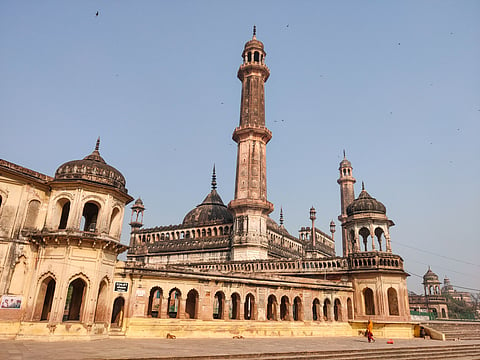
Bara Imambara, an architectural masterpiece built by Nawab Asaf-ud-Daula in 1784 Shutterstock
The issue had first reached the Allahabad High Court in 2013, when Lucknow-based lawyer Syed Mohammed Haider Rizvi filed a petition seeking the removal of illegal encroachments and better protection of historical monuments.
In its 2014 response to the court, the Archaeological Survey of India (ASI) reportedly acknowledged nearly 400 encroachments around 25 of Lucknow’s 60 protected monuments. These include tea stalls, biryani shops, residences, and even government offices built on land designated to remain free of construction.
Advertisement
Sites such as Sikandar Bagh and Naubat Khana, near Asafi Imambara, have also been cited as examples in which public authorities themselves are accused of occupying heritage land.
Audit Reveals Missing Monuments And Administrative Failures
The conservation crisis extends far beyond illegal construction. The CAG’s Report No. 36 of 2025 found that 31 centrally protected monuments in Uttar Pradesh are now officially classified as “untraceable,” meaning they continue to exist in government records but have effectively disappeared on the ground due to unchecked urbanisation and years of neglect.
The audit also uncovered serious documentation gaps that have weakened the ASI’s ability to protect heritage sites. Of Uttar Pradesh’s 487 centrally protected monuments, 456 are being managed without legal land titles or complete ownership records. In addition, nearly 86 per cent of monument notifications do not clearly define site boundaries, making it difficult to challenge unauthorised occupation or construction in court.
Advertisement
The report found that none of the ASI circles in the state, including the Lucknow Circle, had prepared mandatory Site Management Plans or long-term conservation strategies.
Even restoration efforts have raised concerns. The audit flagged several cases of inappropriate structural alterations that compromised the historical authenticity of monuments. It also noted that antiquities are being stored in deteriorating conditions, while only around 20 per cent of the state’s heritage artefacts had been digitised by 2026.
High Court Pushes Administration To Revive Dormant Committee
Following the Allahabad High Court’s intervention in 2013, a district-level high-power committee was constituted to tackle encroachments around protected monuments in Lucknow. However, despite the committee’s mandate, little progress was made over the next decade.
Administrative action gained momentum in late 2023, when Divisional Commissioner Roshan Jacob directed the Archaeological Survey of India (ASI), Hussainabad and Allied Trust (HAT), and civic agencies to conduct a joint survey and prepare a coordinated plan to identify and remove illegal occupants. In the first phase, encroachments involving about 50 families at five centrally protected monuments were cleared.
Advertisement
Judicial scrutiny intensified further in March 2026, when the Lucknow Bench of the Allahabad High Court sought updates on the committee’s achievements and issued notices to the Union Ministries of Culture and Tourism over concerns that thousands of heritage sites across Uttar Pradesh were at risk. One immediate outcome was the approval of INR 6 crore under the Smart City Project for the restoration of three historic gates at Chhota Imambara. The conservation work is being carried out by INTACH Conservation Institute.
The Hussainabad and Allied Trust, which manages several monuments in Lucknow, has disputed some of the figures cited by activists and the ASI. Trust officials argue that some occupants are long-standing tenants rather than illegal encroachers and that certain facilities, such as the police station outside Chhota Imambara, are necessary for maintaining law and order.
Why Awadh’s Heritage Matters To India

The Tomb of Saadat Ali Khan within Lucknow’s historic Kaiserbagh complex Shutterstock
Awadh’s monuments are more than architectural landmarks. They are living records of a unique cultural era that blends Hindu and Islamic artistic traditions and fosters one of India’s richest artistic legacies. From grand gateways and ornate mausoleums to gardens and imambaras, these structures embody the region’s history, identity, and collective memory.
Advertisement
The CAG report has added fresh urgency to a problem that conservationists have highlighted for years. With court scrutiny intensifying and administrative agencies under pressure to act, the coming months could prove critical for the future of Awadh’s historic monuments.
For now, the question remains whether authorities can move beyond surveys and notices to deliver meaningful protection for one of India’s most extraordinary cultural legacies.
(With inputs from various sources)
FAQs
1. What does the CAG report say about Awadh’s monuments?
The report highlights illegal encroachments, incomplete land records, missing boundaries, and a lack of conservation plans that are threatening protected monuments in Lucknow and across Uttar Pradesh.
2. Which monuments in Lucknow are most affected?
Sites such as Rumi Darwaza, the Tomb of Saadat Ali Khan, Kazmain Rauza, the Residency, and Chhota Imambara have all been cited as facing encroachment and structural deterioration.
3. How many monuments in Uttar Pradesh are classified as untraceable?
Advertisement
According to the CAG report, 31 centrally protected monuments in Uttar Pradesh are officially listed as untraceable.
4. What does Indian law say about construction near protected monuments?
No construction is allowed within 100 metres of a protected monument, while construction in the next 200 metres requires special permission under the Ancient Monuments and Archaeological Sites and Remains Act.
5. Why is Awadh’s heritage significant?
Awadh’s monuments reflect a unique blend of Mughal, Persian, and local architectural influences and represent one of India’s richest cultural and artistic legacies.

Published At: