In the limestone shadows of Jebel Buhais, archaeologists have uncovered something that reshapes the story of early humans. Evidence from the Buhais Rockshelter shows that people lived here as far back as 125,000 years ago, long before this region was thought to sustain life.
125,000 Years Ago, Humans Were Already Here: This Sharjah Discovery Rewrites History
Archaeologists uncover a 125,000-year-old human settlement at Buhais Rockshelter in Sharjah, challenging long-held beliefs about early human migration and survival in Arabia’s harsh landscapes

Advertisement
For decades, scientists believed southeastern Arabia saw little to no human activity between 60,000 and 12,000 years ago. The new findings challenge that assumption directly. Researchers now say the rockshelter was not a one-time refuge but a place people returned to again and again over thousands of years.
This finding pushes the region’s human timeline much further back and fits with earlier discoveries nearby that had already hinted people were moving through Arabia far earlier than was once thought. It now looks likely that this landscape was part of a route early humans used as they moved out of Africa and into Asia, and not a dead end.
Life In A Harsh Landscape
What makes this discovery remarkable is not just its age but its setting. The environment around Buhais was never easy. Today, it is arid, and even in prehistoric times, conditions shifted dramatically.
Yet, humans adapted. The fact that people kept coming back to this site makes one thing clear. They were not just drifting through. They knew the terrain, understood what it could give them, and returned when it made sense to do so. That kind of pattern speaks of resilience, not luck.
Advertisement
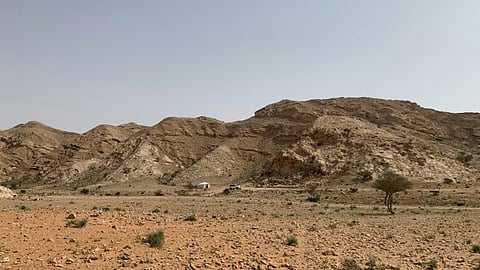
125,000-year-old settlement discovered in Sharjah’s Buhais Rockshelter Instagram/oxfordbrookes
According to researchers, climate change affected how these communities lived. They were nomadic and migrated based on whether or not the climate was suitable for them, leaving as soon as the land became inhospitable, but returning when conditions improved. The rockshelter would have provided a safe place for them to stay during high levels of uncertainty, while providing them with a reliable location to establish themselves once again.
Stone Tools, Not Skeletons Tell The Story
At Buhais, the most important finds are stone tools and occupation layers rather than large structures or intact human remains. Archaeologists have identified several phases of human presence, with the earliest dating back roughly 125,000 years. People returned to the site much later as well, around 59,000, 35,000 and 16,000 years ago, suggesting a long and repeated connection with this place.

Buhais Geological Park, Sharjah Visit Sharjah
The tools themselves include flaked implements used for cutting and scraping, along with sharpened flakes and cores that show tools were actually made at the site. Scattered around them lies debris from the tool-making process. This detail matters. When both finished tools and production waste appear together, it shows that people did not simply pass through. They stayed long enough to shape, use and repair what they needed.
Advertisement
These repeated occupation layers point to a pattern. Groups likely moved through the region in response to shifting water sources and climate cycles, returning to the same rockshelter when conditions allowed.
Fire, Shelter, And Signs Of Daily Life
The trace of everyday actions left by people has also been discovered. Evidence shows the use of fire at this location through ash deposits and burned material. The layers of sediment also contain evidence of disturbance created by human activity and, where tools have been clustered together, suggest there was some organisation in terms of how a space was used.
The fact that there are no surviving huts or constructed spaces doesn’t detract from the evidence that this was an essential stop on the journey. This site functioned as a base camp for people to prepare food, rest and engage in daily activities. One would expect a natural shelter like this site would provide shade from the sun, shelter from the wind and views of the surrounding area.
Advertisement
Climate Adaptation
What stands out most at Buhais is not a single discovery but a pattern of disappearance and return. The different occupation phases line up with periods when Arabia experienced more favourable environmental conditions, often linked to stronger monsoon activity.
When the climate turned harsher and water became scarce, people moved away. When conditions improved, they came back. This cycle repeated over tens of thousands of years.
This stop and start pattern shows that early humans were not simply enduring the landscape. They understood it. They adapted their movements to its rhythms and used places like Buhais as reliable shelters whenever the environment allowed them to return.
Nearby Discoveries That Change The Bigger Picture
The findings at the Buhais Rockshelter connect to a much larger archaeological landscape across Sharjah that continues to reshape what we know about early human movement. Not far from here, Faya-1 has yielded some of the oldest stone tools found outside Africa, dating back roughly 125,000 years or more. These include hand-axes, scrapers and perforators, many of which closely resemble tools from East Africa, suggesting that early humans may have crossed directly into Arabia along a southern route rather than the traditionally assumed northern pathways.
Advertisement
Further strengthening this picture, the Mleiha Archaeological Centre reveals a long arc of human presence, with evidence ranging from early stone tools to burial sites and settlements that reflect a gradual shift from mobile hunter-gatherer groups to more settled ways of life. Surrounding it all, the Jebel Buhais landscape has produced one of the largest prehistoric burial grounds in Arabia, with remains of around 600 individuals along with animal bones, jewellery and burial goods, showing how this region later became not just a place of survival, but of memory, ritual and community.

Mleiha Archaeological Centre Wikimedia Commons
The discovery places Sharjah firmly on the map of early human history. Sites like Buhais Rockshelter and the broader Jebel Buhais area already hold burial grounds and artefacts spanning thousands of years, but this pushes their significance much further back.
It also adds weight to the idea that Arabia was not just a barren passage but an active landscape where early humans lived, adapted and moved onward.
Advertisement
(With inputs from various sources)
FAQs
1. What was discovered at Buhais Rockshelter in Sharjah?
Archaeologists found evidence of human activity dating back 125,000 years, including stone tools and occupation layers.
2. Why is the Sharjah discovery important?
It challenges earlier beliefs that southeastern Arabia was uninhabited during certain prehistoric periods.
3. What kind of artefacts were found at the site?
Researchers uncovered flaked stone tools, cores, and debris showing tool-making and repeated human occupation.
4. Did early humans live permanently at Buhais Rockshelter?
No, they likely moved in and out based on climate conditions, returning when the environment became favourable.
5. How does this discovery change human migration history?
It supports the idea that early humans travelled through Arabia as part of their migration out of Africa into Asia.
Published At: