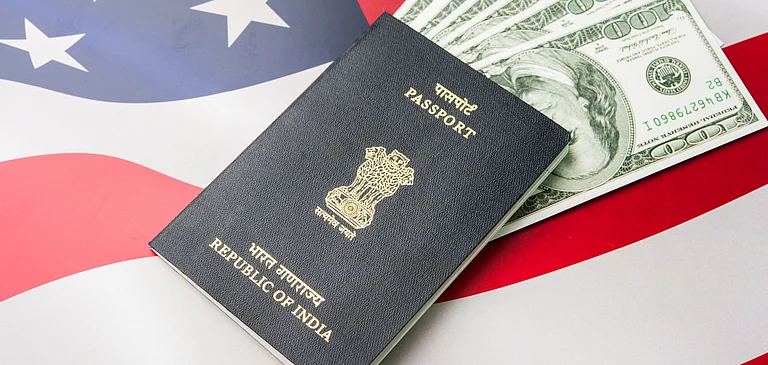


Starting Monday, December 15, the United States began screening and vetting the social media accounts of all H-1B visa applicants and their dependent H-4 visa holders, following an earlier order from the US State Department. The move aims to identify applicants deemed “inadmissible,” reinforcing the principle that a US visa is a “privilege, not a right,” amid the Trump-era administration’s ongoing crackdown on immigra
Public Profiles
The new rules introduce several key changes affecting Indian professionals. All H-1B and H-4 applicants are now required to set their social media profiles to “public” for review, allowing authorities to examine past posts for potential security threats.
This has already led to delays, rescheduled interviews in India, and concerns that past online activity could impact visa approvals. Additional scrutiny and tougher checks have caused processing slowdowns and “prudential revocations” for existing visa holders, creating uncertainty for professionals already in the US and prolonging waiting times for new applicants. Thousands of Indian H-1B and H-4 visa applicants are experiencing significant delays as US consulates reschedule their interviews to March, April, or May.
Financial And Professional Impact

Financial barriers have also increased, with a one-time $100,000 fee for new H-1B visas adding significant costs for employers and acting as a deterrent for skilled Indian workers. Automatic Employment Authorization Document (EAD) extensions for H-4 spouses and F-1 OPT students were ended on 30 October 2025, disrupting work continuity for dependents and students. Furthermore, broader restrictions on applicants from certain “countries of concern” have paused Green Card and other immigration applications, heightening overall uncertainty for foreign professionals.
Industry experts warn that these changes will slow the entry of highly skilled Indian workers, disrupt ongoing projects, and increase operational costs for employers. India’s IT sector, which relies heavily on H-1B talent, faces challenges in workforce planning and project timelines, while professionals must navigate longer processing times, higher fees, and stricter scrutiny.
Indian Professionals Feel The Brunt
The tightened rules mark a major shift in US immigration policy, creating a more costly and uncertain path for Indian tech professionals and signalling a more challenging environment for skilled labour mobility between India and the United States. Adding to the uncertainty, some visa holders have been issued “prudential revocations,” a temporary suspension of their visas when eligibility concerns arise. These measures have created anxiety and disruption for Indian professionals planning to work or continue employment in the United States.
The new H-1B visa measures are expected to create significant challenges for Indian workers. Heightened scrutiny and procedural delays are adding uncertainty and anxiety to an already complex system. The introduction of steep fees and stricter requirements is increasing the financial burden on both employees and firms reliant on H-1B talent.
These hurdles are creating barriers for skilled professionals, including tech workers and doctors, potentially slowing career progression. Experts also suggest that the tightened rules could prompt some Indian professionals to explore job opportunities in other countries, signalling a strategic shift in global talent mobility.
What Is An H-1B Visa?
The H-1B visa is a US non-immigrant work visa that allows foreign professionals to work temporarily in “specialty occupations” requiring specialised theoretical or practical knowledge, typically supported by a bachelor’s degree. Common fields include IT, engineering, healthcare, and other technical professions.
To obtain an H-1B visa, applicants must be sponsored by a US employer. The visa is initially granted for three years and can be extended up to a maximum of six years. Eligibility depends on meeting the required degree standards or possessing equivalent professional experience, and the program is subject to an annual cap on the number of visas issued.
FAQs
What new screening measures have been introduced for H-1B and H-4 visas?
Starting December 15, 2025, all H-1B applicants and their H-4 dependents must undergo social media screening. Applicants are required to make all social media profiles public for review.
How are visa interview schedules affected?
Many applicants in India are seeing their in-person interviews rescheduled to March, April, or May due to the expanded screening process.
What is a “prudential revocation”?
It is a temporary, precautionary cancellation of a visa issued when the US State Department has eligibility concerns about a holder.
Are there new fees for H-1B visas?
Yes, a one-time $100,000 fee for certain new H-1B visas has been introduced, increasing costs for employers and applicants.