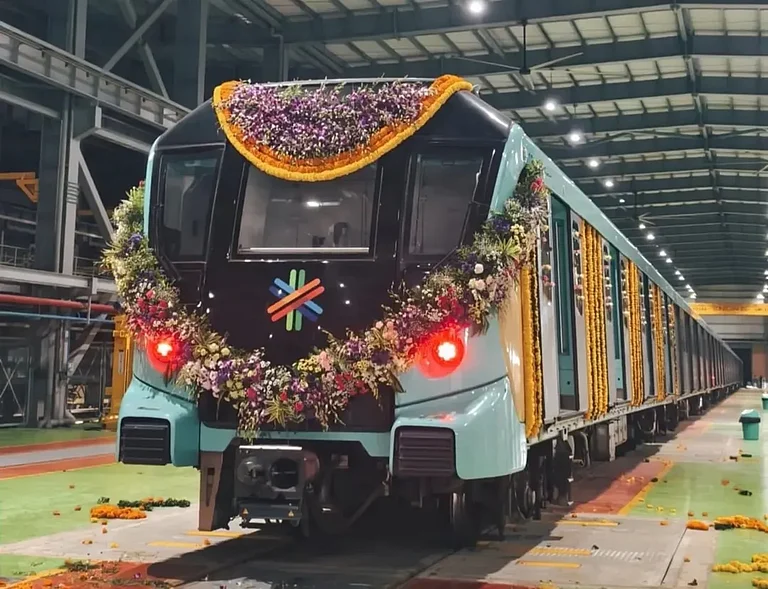
On a quiet Sunday morning, before the city had fully shaken off its weekend drowsiness, Bhopal stepped into a new chapter. At exactly 9 am, the city’s first commercial Metro train rolled out from AIIMS station, carrying not just passengers but a collective sense of curiosity, pride, and possibility. By the time evening arrived, more than 5,700 people had experienced Bhopal’s newest way to move—many of them smiling, phones raised, documenting a moment they felt was long overdue.
From early morning, stations began to fill with families, young professionals, students, and senior citizens, all eager to be part of the first day. Tickets were bought patiently, queues stretched across station entrances, and inside the coaches, the mood was unmistakably celebratory. This wasn’t just about getting from Point A to Point B—it was about seeing the city from a new perspective, quite literally.
The 7.5-kilometre stretch, known as the Priority Corridor, connects AIIMS to Subhash Nagar and marks the first operational phase of the much-anticipated Bhopal Metro project. The service had been formally inaugurated a day earlier by Union Minister Manohar Lal Khattar and Madhya Pradesh Chief Minister Mohan Yadav, but Sunday was when the Metro truly met its people.
A City Shows Up


By evening, official figures confirmed that 5,731 passengers had travelled on the Metro, a number that quietly climbed higher in other estimates, crossing 7,000 by day’s end. Being a Sunday and a public holiday, officials noted that most commuters were riding out of curiosity rather than necessity, treating the journey as a city outing rather than a daily commute.
Trains ran consistently throughout the day, completing 17 trips between AIIMS and Subhash Nagar. Some services were noticeably more crowded than others, with the mid-afternoon run emerging as the busiest, carrying over 300 passengers at one point. Inside stations and coaches, passengers clicked selfies, recorded videos, and took in the novelty of smooth rides, clean platforms, and air-conditioned comfort.
Outside the stations, the excitement spilled onto the streets. Two-wheelers and cars lined up near entry points, especially at Subhash Nagar, as families arrived together, turning the Metro ride into a shared Sunday plan. For many, it was a proud moment—Bhopal joining a growing list of Indian cities redefining urban travel.
Promise And Potential
With the launch of Metro services, Bhopal has become the 26th city in India to have a Metro rail system and the second in Madhya Pradesh after Indore. For a city long dependent on road-based transport, this marks a significant shift in how daily mobility could evolve.
Passengers expressed optimism about what the Metro could mean in the long run—less time spent in traffic, reduced fuel costs, and a cleaner alternative to crowded roads. Office-goers, in particular, see it as a potential game-changer once services expand beyond the initial corridor and frequencies improve.
That said, the first day also revealed areas that will need fine-tuning. Some commuters flagged longer waiting times between trains, with gaps of nearly half an hour causing mild inconvenience during peak moments. These early observations are expected to guide operational adjustments as the system settles into routine service.
Building The Future

The Bhopal Metro project, once fully completed, will span 30.8 kilometres and is estimated to cost INR 10,033 crore. Of this, INR 2,225 crore has been invested in developing the Priority Corridor alone. Officials view this first phase as a foundation—both technically and symbolically—for a larger, more connected network that will eventually reshape daily travel across the city.
For now, the Metro’s debut feels less like a grand spectacle and more like a gentle but decisive step forward. A city trying something new, its residents showing up with enthusiasm, patience, and phones held high. If the first day is any indication, Bhopal’s relationship with its Metro has begun on a hopeful note—one ride, one selfie, and one smooth glide at a time.
(With inputs from PTI.)
FAQs
1. When did Bhopal Metro begin commercial operations?
Bhopal Metro started its commercial services on Sunday, December 21, with the first train departing at 9 am.
2. Which route is currently operational?
The Metro is currently running on a 7.5-kilometre stretch between AIIMS and Subhash Nagar, known as the Priority Corridor.
3. How many passengers used the Metro on the first day?
More than 5,700 passengers travelled on the Metro on its first day, with overall footfall crossing 7,000, according to estimates.
4. Why was there heavy footfall on Day One?
Being a Sunday and public holiday, many residents rode the Metro out of curiosity, sightseeing, and to experience the city’s first Metro service.
5. What is the total length of the Bhopal Metro project?
Once completed, the Bhopal Metro will span 30.8 kilometres, with the Priority Corridor marking its first operational phase.