

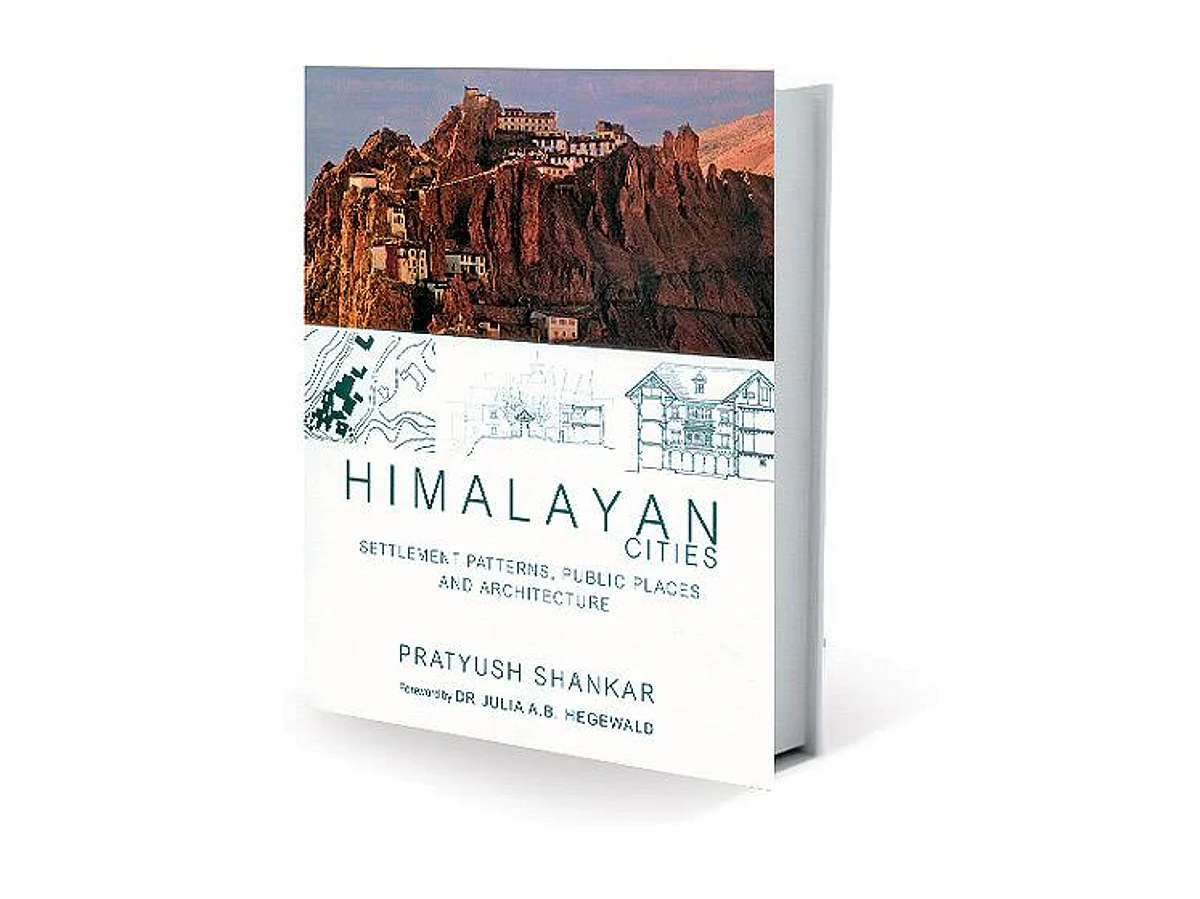
&lsquoHimalaya&rsquo and &lsquoCity&rsquo aren&rsquot words that go so well together. Or  that&rsquos what the conventional wisdom is. However, there&rsquos a large degree of ignorance involved in thinking so. As architect and academic Pratyush Shankar&rsquos important new book Himalayan Cities shows, urban planning has had a huge role to play in the way various Himalayan peoples imagined themselves in the con- text of the awe-inspiring natural environment in which they&rsquove lived their lives.
The result of years of painstaking research and stunning erudition, the book approaches its subject from various per- spectives. One is the role of the natural environment. The Himalaya, as Shankar maintains, plays a very important role in the mythical and cultural imagination of the sub-continent. While this is true throughout the South Asian landmass, in a way it&rsquos even more intense in the regions that either lie smack in the middle of the range or in the areas that abut the Himalayan setting. A combination of this and the fact that the mountains have historically been home to a large array of &lsquodistinct ethno-political communities&rsquo &mdash as Shankar astutely puts it &mdash has resulted in a wide variety of cities, public spaces and architecture.
The most stunning of these is certainly the Kathmandu valley. In this small valley, at least a thousand years of cultural efflorescence and trade gave rise to a unique and highly artistically evolved architecture and urban planning. With their unique syncretic culture, the three city-states of the valley &mdash Kathmandu, Patan and Bhaktapur &mdash have been designing public spaces with a very clear idea of what lies within a city and what lies without. Even within the city, following the conception of a mandala, the centre of the city, usually the designated area holding the royal courts and (Hindu) royal temples are surrounded by a radiating hierarchy of residential quarters grouped around courtyards (mostly Buddhist). This interplay of religious motifs &mdash with their respective symbolism and philosophical perspectives &mdash inform the urban landscape.
That&rsquos just Nepal. Shankar painstakingly investigates the spaces of other notable Himala- yan cities, like the capitals of the kingdoms of Chamba, Mandi and Ladakh, among others. He also devotes a section on the coming of the British and the Colonial imaginary that produced so much original architecture in our hill stations. Assisted by lavishly illustrated floorplans, cross-sections, sketches and photographs of the outstanding structures &mdash temples, castles, monasteries &mdash Shankar goes deep into his subject, and produces an exhaustive and lively work.