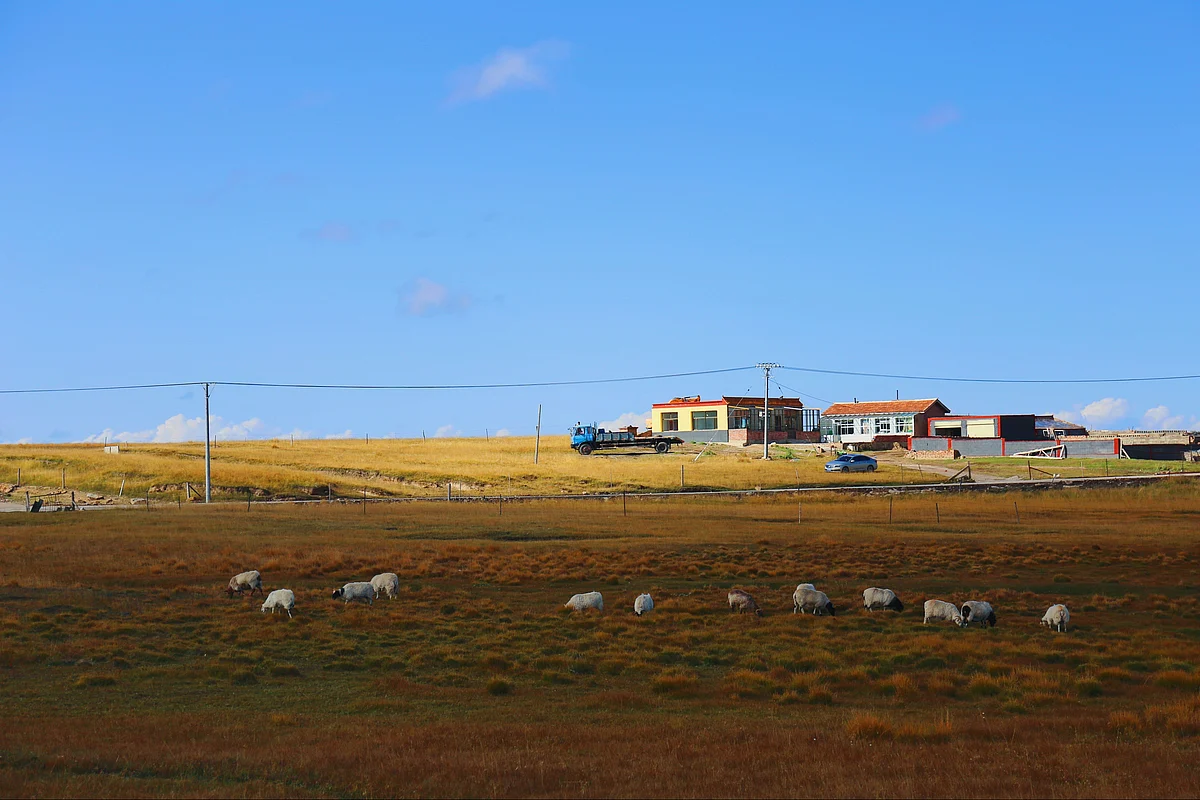
The first thing Akira Ofuka does is bow—deep, almost ceremonial. Then he straightens up, beams at me, and declares, “Aah! Indo! Land of Gandhi!” He says this with such great delight that I can’t help but beam back at him. I am at a yakitori restaurant in Nagato, a small coastal city tucked into the northern edge of Japan’s Yamaguchi Prefecture. And for 73-year-old Ofuka-san who runs it along with his wife, I am apparently his first encounter with an Indian traveller.
The feeling of novelty, I must confess, is mutual. In a world where Indians have enthusiastically claimed every café, street and alleyway, from playing the dhol at Times Square to doing dandiya at the Eiffel Tower, I had stumbled upon a town so blissfully untouched by my fellow countrymen, that I texted a former editor. His response: “Congratulations. And you didn’t even have to go to the South Pole.”
And that is precisely the dilemma I sat with before writing this piece: Do I reveal Nagato—the quiet, stunning, completely under-the-radar town—to my compatriots? But then I remembered my conversation with Luiz Rodrigues, the Regional Manager for Japan at Booking.com, an online travel agency, who pointed out that Japan’s ‘Big Three’—Tokyo, Kyoto and Osaka—are practically buckling under overtourism. “Japan has so much more to offer,” Rodrigues told me. “Travellers need to explore beyond the usual circuit.” With Japan estimating that by 2030 its inbound tourism numbers may double, the travel is already nudging visitors toward lesser-known destinations, shining the spotlight on towns like Nagato.
So here we are.
When I say Nagato is a hidden gem, consider this: it welcomed only 13,000 international tourists last year, compared with Japan’s 36.6 million arrivals overall. Which makes it, statistically speaking, barely discovered.
It’s a real pleasure to walk around town without the crush of tour buses, guides waving flags or queues everywhere. But that is not to say that there isn’t enough to see or do in Nagato, quite the opposite.
Rodrigues, who has been studying travel patterns across Japan for a few years believes towns like this are where the future of Japanese tourism lies. “People are looking for authentic experiences, they want a connect with local culture,” he says. “Nagato ticks every box—nature, culture, tradition—and Booking.com is seeing rising interest in such destinations.”
Sleep Wrapped In Futon And Ritual
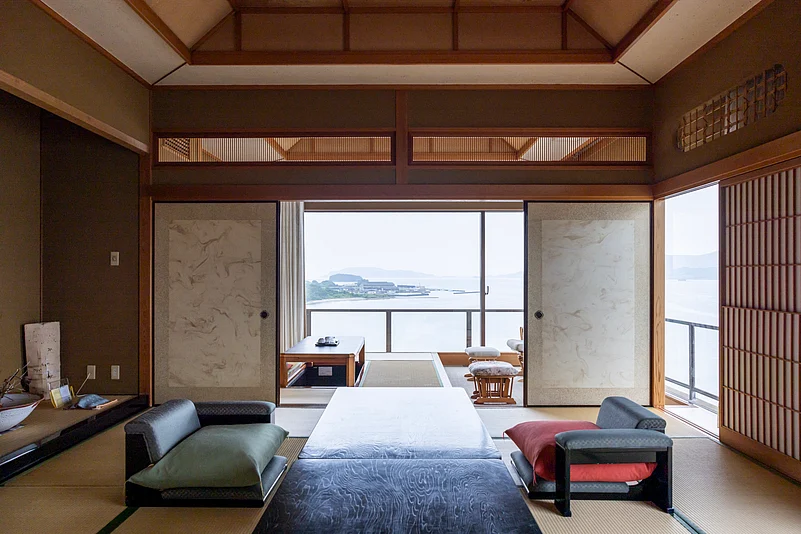

The Nagato experience starts right from the accommodation. In Nagato, you don’t stay in a hotel. You stay in a ryokan, the traditional Japanese inn that turns sleeping into a cultural experience, think tatami floors, sliding shoji doors and futon beds.
And then there is omotenashi, Japan’s brand of hospitality that goes beyond service and wanders into the realm of philosophy. Everything is thoughtful without being fussy, ceremonial without being cold.
Most ryokans in Nagato have their own onsen, the natural hot spring baths fed by underground volcanic waters. It’s community bathing and you are nude so it is awkward for the first thirty seconds. But it is such a part of Japanese culture that it is worth shedding your inhibitions for. Nagato has five natural hot springs, each with its own mineral composition and health benefits.
Visiting Motonosumi Shrine

If you’ve ever been jostled through the vermilion torii tunnels of Fushimi Inari in Kyoto, prepare for a very different experience at Motonosumi Shrine. Here, you climb a cliff through 123 brilliant red torii gates, all the while taking in great views of the sea. With no hordes of tourists to push you around, the walk is almost meditative.
The shrine was built starting in 1987 to honour a white fox spirit believed responsible for granting blessings as practical as financial success and as poetic as safety on the seas. People throw coins at the offering box perched atop the final gate to make a wish. It’s a job that requires precision, a flick of the wrist, and a touch of faith! Needless, to say, I didn’t succeed.
The Alps—Of The Sea

Nagato’s coastline is beautiful and rugged. Omijima Island, part of the Kita-Nagato Kaigan Quasi-National Park, sits just offshore with rock formations that the locals call the “Alps of the Sea.” Imagine stone pillars, cliffs twisted by time, and sea caves carved into sculptural arches.
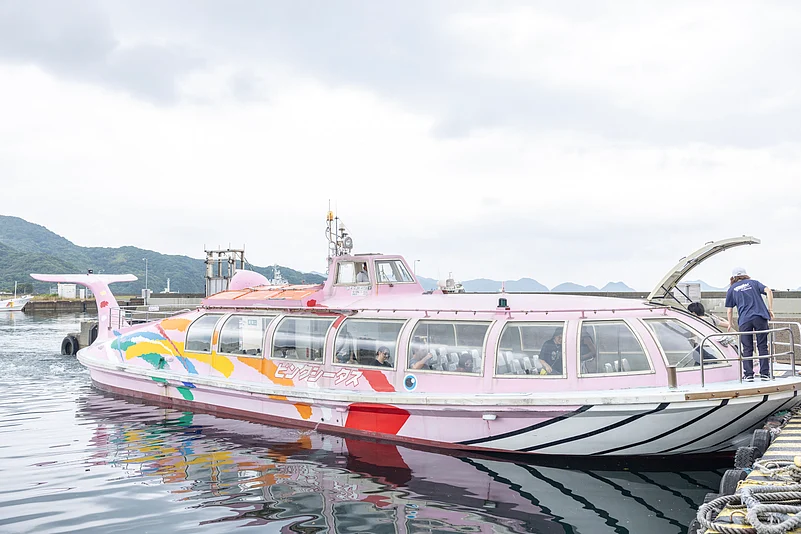
The best way to take it all in is on the Omijima sightseeing cruise, where whale-shaped boats float along the coastline for about an hour to an hour and a half. The ticket costs roughly 2,000 yen for adults. To maintain the marine theme, the boat even “spouts” a playful spray of water from its faux blowhole at the end of the ride!
Land Of Fugu
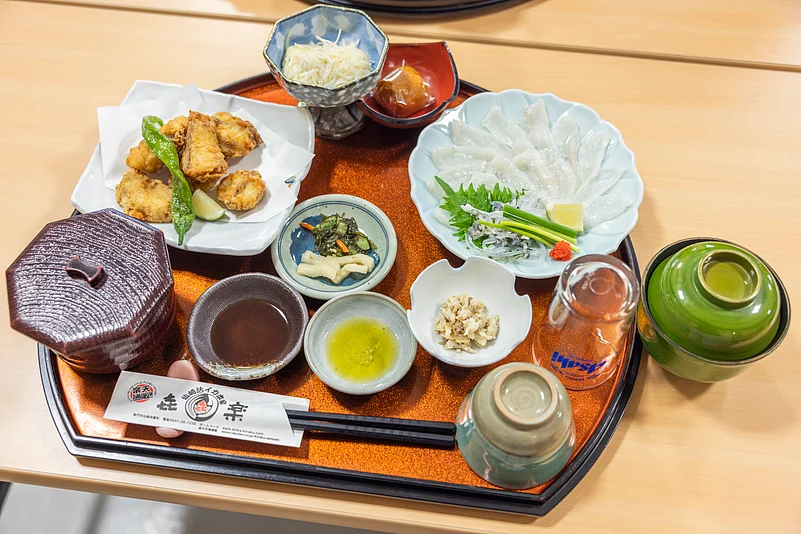
To be in Nagato is to be in fugu country—Japan’s notoriously poisonous pufferfish, beloved for its delicate flavour and feared for its lethality. Only rigorously trained and certified chefs can prepare it, which adds a thrill to the dining experience. A bit like Russian roulette, you never know if the next bite will be your last.
Fugu farms around Nagato raise the fish before selling them to restaurants across Japan. The most remarkable fact I learned: baby fugu have their teeth clipped with scissors so they don’t chomp each other in shared tanks. While the mental image was unsettling, I was most amused that this was actually someone’s job title. In this case a smiling old man with all his teeth intact, who happily pointed out tiny fugu teeth littered all around the tank. By preventing baby fugu from killing each other you get perfectly grown fish that eventually lands on your plate. It’s a strange universe, at least for the fugu!
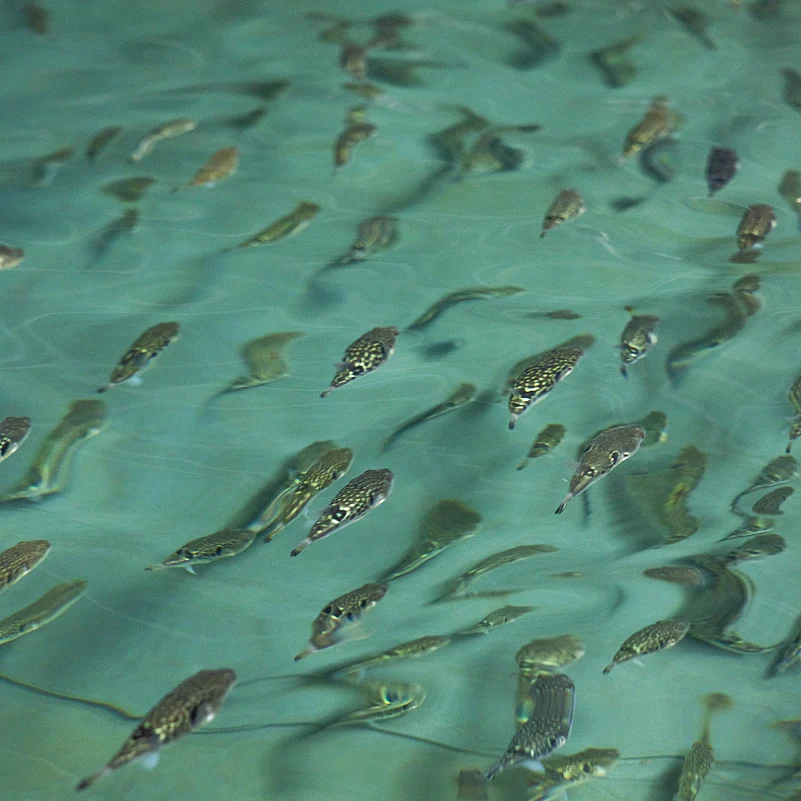
I had my fugu feast at Kiraku, a casual seafood restaurant with its own farm. For 3,500 yen, I got to try fugu done several ways including karaage (fried, crisp, addictive) and sashimi sliced so thin it was practically translucent. I trusted the meal more once I learned that the executive chef had previously worked at The Ritz-Carlton in Tokyo before returning to run the family business. Nothing like a luxury-hotel pedigree to reassure you when eating something that can, theoretically, kill you.
Land Of Sake
No trip to rural Japan is complete without a visit to a sake brewery, and Nagato has one of its oldest: Nagayama Honke, founded in 1888 and still family-run. The current, fifth-generation owner, Takahiro Nagayama, pointed out the rice fields they own right across from the brewery, nourished by the Koto River. The water originates in the Chugoku Mountains and passes through the limestone plateau of Akiyoshidai, picking up minerals that make it “moderately hard”—a quality Nagayama explains is perfect for fermentation. I nod, pretending to understand the nuances, while sipping a sample that tastes clean, crisp, faintly floral.
The Question Of Time
Nagato won’t stay this way forever. Already Japan’s total number of tourists in the first nine months of the year exceeded 31 million, expectantly, more than 13,000 would have made their way to Nagato too. The word is out.
My advice? Go now. Before the torii gates get crowded. Before the fugu chefs get too busy. Before Ofuka-san meets so many visitors from “Indo” that he no longer bows in delighted surprise.
How To Reach
Nagato is a 40-minute shinkansen (bullet train) ride from Fukuoka’s Hakata Station.