

When the seagulls follow the trawler, it is because they think sardines will be thrown into the sea.
— Eric Cantona, French former footballer, 1995
It is a big fixture. The Electricity Board Football Club is playing the Military Cantt Football Club at the Gandhi Maidan stadium in Gaya. The former comprises players employed under the sports quota at the Electricity Board, while the latter comprises young military men training at the Officers' Training Academy.
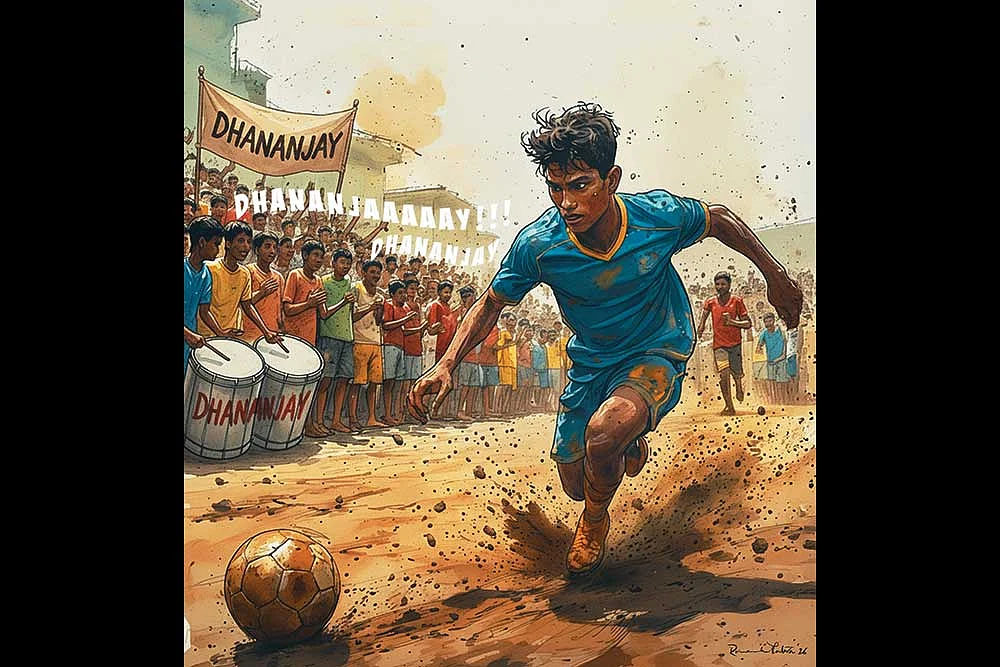
The terraces of the stadium reverberate with the single, unbroken chant: “DhanDhanDhanDhan…”
On the pitch, the left winger, Dhananjay of Electricity Board Football Club, is charging down the flank. Rain has slicked the ground and mud slings from his boots as he paces. Defenders slide in at his feet and he survives the skirmishes. He gallops on; the drumming is for him—louder and more insistent—as he closes in on his target.
Any moment now, he might cut inside and place a sweet curler ball past the goalie, low in the bottom of the mesh with a satisfying “Whoosh!” If the stadium had a roof, it would’ve blown off at that point. DHAN-DHAN-DHAN-DHAN, the crowd roars for Dhananjay—catatonic, bodies colliding. The sound engulfs everything.
Perhaps, for the charging winger, it is all close to the blindness that comes when you’re onstage, lights blazing, looking out. In that instant, a goal is in the offing; the attack unfolds. In those days, it was almost customary to drum up the din in Dhananjay’s name. The man’s name as a lethal winger was a kind of currency.
I was around six or seven years old when my Uncle Shahid, a veteran football enthusiast and now a resident of Mumbai, first recounted this local tale to me. It is perhaps his story—or his candid pleasure in narrating it—that I now date as the dawn of sport taking a hold on me. Evidently, much of the enjoyment of the spectacle lies not in the clash and its verdict but in the stirring emotions ranging from murderous rage to gentle whimsy. Sport, to be sure, affects life directly.
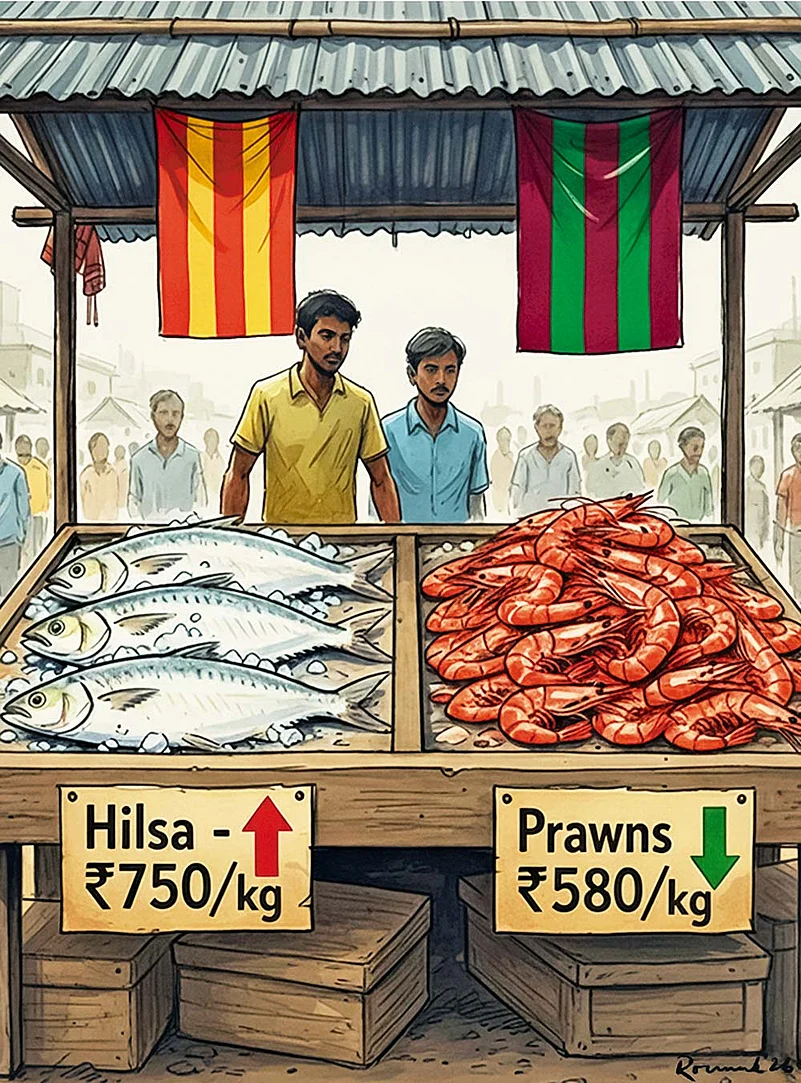
At some places, the relationship sport maintains with life reaches remarkable extremes. A chef I know in Delhi—who wished to remain anonymous in his reminiscences—shared with me a crumb that brings his profession and sport together in Kolkata. “The results of the Kolkata Derby directly control the fish market pricing,” he said. “The day Mohun Bagan wins, chingri (prawns) prices on the following day go up; when East Bengal wins, it’s the hilsa (illish) prices that shoot up,” he added.
To understand this curious entwinement between sport and the market, one must return to the history of the Kolkata Derby and its belligerents, Mohun Bagan and East Bengal. While the former has long been synonymous with the Ghotis, prawn-inclined urban settlers, the latter is made of the Bangals, migrants who arrived in West Bengal from the river-rich districts of eastern Bengal, present-day Bangladesh. Naturally, the Mohun Bagan supporters share a penchant for prawns–urban and market-friendly, while East Bengal’s relish in the pleasures of hilsa. On Derby day, a victory warrants an indulgence just as a defeat withholds it. Prices rise and plummet, not due to the availability of fish but because auspicious indulgence overrules reason, and the market keeps an eye out for these permutations.

Shaunak Ghosh, a sports journalist from Kolkata, once described to me his experience of the same Kolkata Derby as a first-timer. After the final whistle, as he made his way back home, Ghosh told me he noticed “a man sitting outside the Salt Lake Stadium selling pieces of bricks by the bundle for Rs 5 each,” he said. “I later learnt it was for the use of spectators to throw at the opposition fans after the match was over,” he said, still faintly astonished.
Aside from football, Ghosh, perhaps on account of his profession, also kept up with cricket. Though it is a game that has long run ahead of me, I have managed fairly to keep up with its quirks and trivia.
It was an Indian Premier League (IPL) fixture between Royal Challengers Bangalore and Kolkata Knight Riders, Ghosh told me. The Knight Riders had the home advantage at Salt Lake Stadium. Ghosh and company were seated at long-on with Cheteshwar Pujara fielding within earshot. Gautam Gambhir was on strike and had already hit two shots towards him, and he had made two good saves.
“The crowd, including me,” Ghosh said unambiguously, “immediately riled up behind him, pressurising him to miss the ball, so it would go for a four.” It was at that point that a seasoned heckler sitting behind Ghosh chose to thrust his skill. If Pujara missed the next one, he shouted, he would reward him with a packet of biscuits—the very packet the fielder was eating at that point, sending the entire terrace into a frenzy of laughter; even Pujara turned around and smiled. “Funnily enough,” Ghosh added, “he did make a pretty silly misfield two balls later. It went for four.”
By reputation, I believe Ghosh also knew a certain individual who “went to see Lionel Messi in Kolkata on the morning of his wedding day.” While it may come across as illogical, downright incomprehensible to some, Ghosh tends to think of it as “the unrelenting passion for sport that keeps one going.”
Funny as they are, some of these sports quips and anecdotes tend to outlast the matches themselves. One such anecdote was shared with me by a friend, Shamik Banerjee, a Delhi-based journalist and a devoted sports enthusiast if I ever saw one. It dates back to 2002, when the FIFA World Cup was held in Asia for the first time. In those days, television sets were still rare in his Bengal town, but his uncle—who lived across the street—had bought a colour TV expressly for the tournament. Each evening, neighbours gathered at his house to watch the matches.
“My best memory from that World Cup was, obviously, the final—Brazil vs Germany at Yokohama,” Banerjee told me. Following in his father's footsteps, he supported Brazil and, like most of the world that summer, pledged allegiance to Ronaldo Nazario (and his iconic haircut). On the day of the final, the house was full. “My father got two roses from a plant in our backyard and placed them on the TV top,” recounted Banerjee. “It was a good luck charm.”
The first half passed without incident. Ten minutes of the second half went the same way. Anxiety began to settle in. That was when his father, struck by a sudden conviction, widened the gap between the two flowers on the TV top. The logic, as he explained it, was simple: widen the gap, open the goalposts, invite a breakthrough. The result? Minutes later, Ronaldo scored. Then he scored again. Brazil were champions.
“A lot of time has passed since,” Banerjee said. “My dad doesn’t watch football anymore. But that day made me a football fan—for the first time, and for the rest of my life.”
With these thoughts in mind, one begins to read the quote by Cantona less as provocation and more as a metaphor. As the trawler of sport trundles along, breathing and blaring, we—loyal seagulls—hover over it, awaiting something worth pecking at: heartfelt exchanges, passing absurdities, or the old, well-timed lampoon.
Looking for more such exciting and meaningful stories? Grab our latest issue on Amazon.